




- Additional levy on excess tobacco waived
- Three-year jail term for deposit fraud accused
- 18 returnable plots allotted to Amaravati farmers
- Rash handling by cops reason for Kakumanu’s death: YSRCP
- 37 lakh tonnes target set for kharif procurement
- Surplus discharge from Prakasam barrage rises to 47,125 cusecs
- Govt okays Rs 1,500 cr capital subsidy, 400 acres
- Dedication key for better future of students
India must pursue goal of large, diversified defence-industrial base
In Short
Explore insights from Defence Secretary Rajesh Kumar Singh at DEFCON 2026 on augmenting India's defense-industrial base, reducing import vulnerabilities, and expanding missile production.

Share :
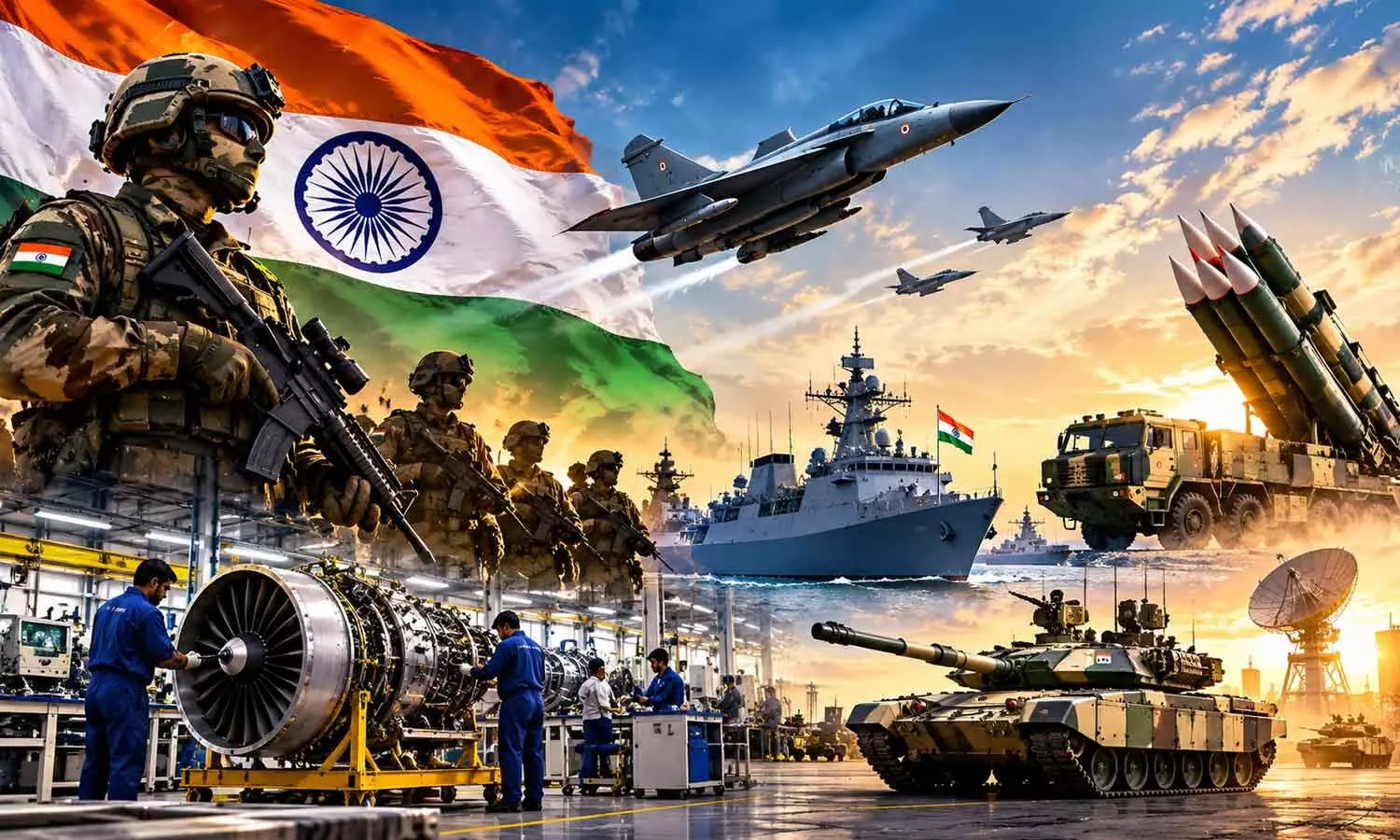
India must pursue goal of large, diversified defence-industrial base
India’s defence manufacturing base has made impressive progress in the last few years, but it still has a lot of ground to cover. Defence Secretary Rajesh Kumar Singh highlighted this while comparing our missile production capacity with that of Ukraine’s.
Speaking at News18’s DEFCON 2026, Singh said, “One company in Ukraine is able to manufacture 100 missiles and a thousand drones a month. We can’t continue in a situation where we are making 200-300 missiles a year. “That’s not good enough, which is why widening of industry is another lesson that we have drawn and we have already acted upon,” he said, adding that the nation traditionally relied on only missile manufacturer Bharat Dynamics.
This situation is unacceptable. For one thing, this underlines woefully untapped potential; India, with its vast scientific and technological prowess, economic might, and diversified industrial base, can do much better than that. There is no reason why we cannot augment missile and drone production exponentially in a short span of time.
The issue assumes considerable salience against the backdrop of our hostile neighbourhood. Pakistan is loath to discard its pathologically anti-India stance; it regards India not just as an unfriendly nation which broke it in two parts in 1971 but as an ideological foe; this was evident from Pakistan Field Marshal Asim Munir’s evocation of the two-nation theory a few months ago.
Then there is China, which, despite its BRICS rhetoric and affectations of some sort of Asian or Global South bonhomie, stays committed to its policy of encircling India, flooding our market with its goods, and not providing us with the goods essential for our manufacturing.
Further, the importance of missiles and drones can scarcely be exaggerated in today’s world; the ongoing war between Russia and Ukraine has highlighted it; during Operation Sindoor last year too, this became evident.
Singh termed dependence on imports as a potential vulnerability, which “could be a problem if an ally is not predictable.” That’s why an ecosystem has to be developed, and a cycle of mutual dependence has to be developed, he added.
Cognisant of the importance of defence production, the government earmarked Rs 1.85 lakh crore for capital acquisition for this fiscal, which is approximately 24 per cent higher than the capital acquisition budget for 2025-26.
Besides, the Narendra Modi government has also enthusiastically promoted private sector participation in defence production, a decision that has paid rich dividends; our success in Operation Sindoor is a testimony to that.
The need of the hour is to double down on these policies. India must not merely expand defence production in quantitative terms; it must create a broad, resilient, and technologically sophisticated defence-industrial ecosystem capable of meeting the requirements of a modern military. This means encouraging more private companies to enter the sector, enabling greater collaboration between established defence manufacturers, startups, MSMEs and research institutions, and ensuring that indigenous innovation moves efficiently from the laboratory to the production line.
At the same time, indigenisation should not become an excuse for technological complacency: India must continue acquiring, adapting, and developing advanced technologies while progressively reducing external dependence. The experience of recent conflicts has demonstrated that industrial capacity can be as consequential as battlefield prowess. The goal should be a defence-industrial base that is large, diversified, innovative, and scaling-compliant.


