






- Tamil Nadu Government Apologises to Supreme Court Over Thirupparankundram Temple Lamp Row
- Black Friday 2026: iPhone 17 Pro vs iPhone 18 Pro – Where to Get the Best Deals?
- SCR announces special trains from Hyderabad for Sankranti
- Saurav Das moves Delhi High Court after allegedly being stopped from travelling to UK
- Dilip Ghosh mocks Congress over UP seat sharing talks, says party survives on ruckus and statements
- Annanagar wallows in civic neglect as bad roads, dirty water plague dwellers
- No solo rides, embrace shared mobility: CP Dr M Ramesh
- IRISET sharpens railway workforce skills
Rahman govt shouldn’t be vindictive against Hasina
In Short
Former Bangladesh PM Sheikh Hasina's planned December 16 return on Victory Day stirs tensions with Tarique Rahman's government, Awami League dynamics, and South Asian geopolitics.

Share :
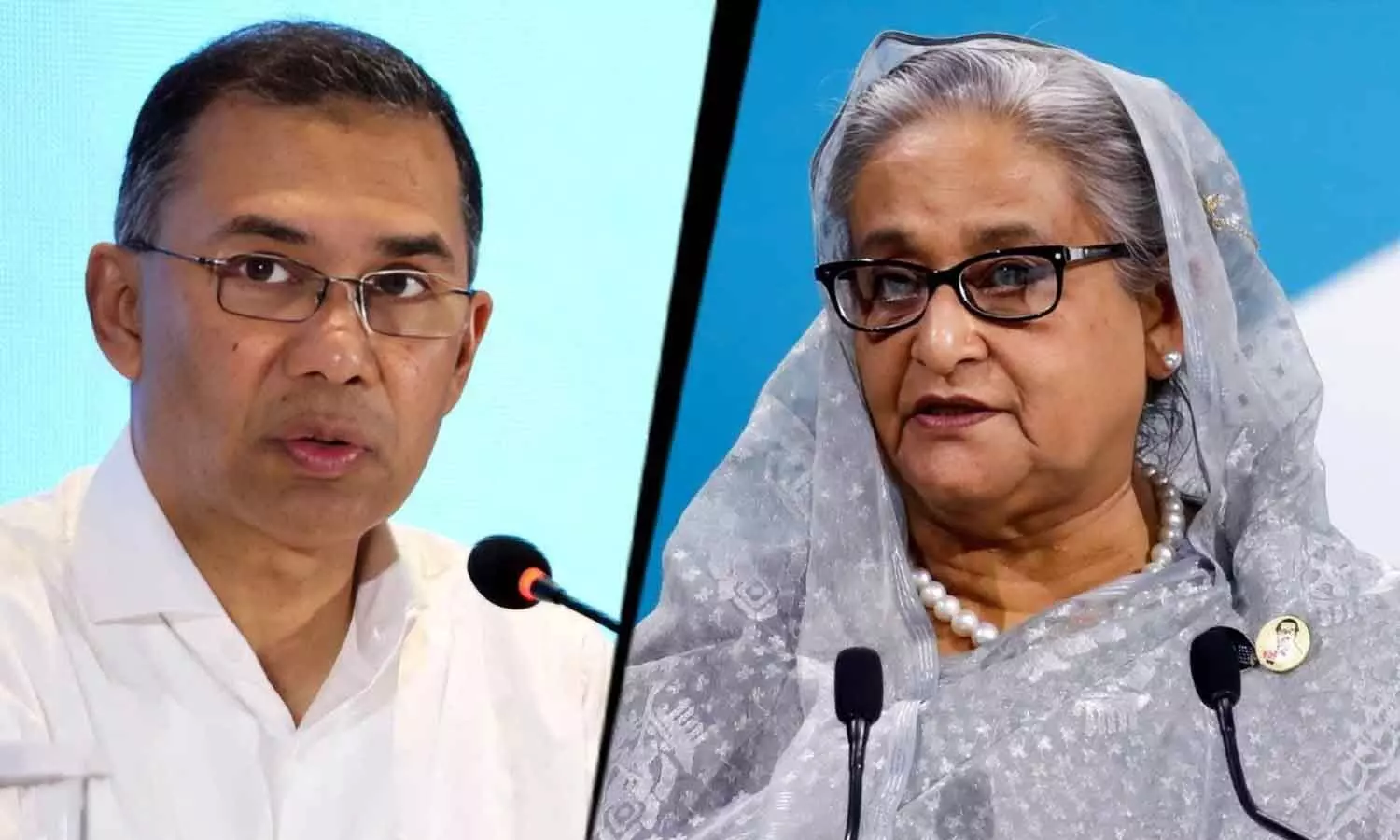
Rahman govt shouldn’t be vindictive against Hasina
Ousted Bangladesh prime minister Sheikh Hasina’s announcement of her return to her country may become a headache for Dhaka and begin a new chapter in the history of not just her country but also impact the Indian subcontinent. For the date of her planned return, December 16, involves not just our eastern neighbour but also the western one, Pakistan, from which it was carved out—with India playing a heroic role in the 1971 Liberation War. Celebrated as Victory Day in Bangladesh, it still riles jihadists and Islamists in the country, who had shamelessly colluded with the murderous Pakistan Army in the Liberation War.
Worse, many of them are still in cahoots with the ruling clique. For instance, in July, the Tarique Rahman government succumbed to pressure from radical Islamist groups and stopped the construction of an 81-foot Lord Ram statue in Palashbari in Bangladesh’s northern Gaibandha district. A few weeks later, on August 5, an official event organised by Bangladesh’s acting President, Hafiz Uddin Ahmad, to commemorate the July 2024 uprising was disrupted because of protests by Jamaat supporters.
Rahman’s Bangladesh Nationalist Party (BNP), which won hands down in the general elections in February, has had ties with the Jamaat-e-Islami for decades. The BNP, under Rahman’s mother Khaleda Zia, had also won in 2001 in coalition with the Islamist party, resulting in the cooling of relations with India. This was despite Delhi’s magnanimity; the Atal Bihari Vajpayee government ensured that the then national security adviser Brajesh Mishra was the first foreign dignitary to congratulate Khaleda Zia.
Dhaka, however, increasingly chafed Delhi by improving ties with Washington and Beijing and even Islamabad—betraying the trust and hopes of millions of Bangladeshis who had suffered under the unconscionable Pakistani occupation and genocide. Such is the spell the jihadists can cast. The spell is still getting various expressions. As Bangladesh Minister Humaiun Kobir’s stated: “She [Hasina] can only be brought back in handcuffs or under strict surveillance.” In a similar vein, Zahed Ur Rahman, Information and Broadcasting Advisor to the Prime Minister, said, “A serious criminal is in India along with her associates. She has been convicted”.
So, whether she will come or not, whether she will travel on Biman Bangladesh Airlines or their aircraft, or come on foot, and how she will be handed over have to be seen. These matters will be discussed with India. “As if Hasina were a terrorist and not an elected prime minister. There is a possibility that some people within the Rahman government want Hasina and her party, the Awami League, permanently out, so that they could rule indefinitely—with some support from the Islamists.
A few concessions to the mad mullahs are a small price to stay in power forever”. It appears good. At least in theory. In practice, however, that will be difficult, for in a country as politically volatile as Bangladesh, permanently excluding a former prime minister and her party from the political mainstream is easier said than done. Hasina still commands considerable loyalty among sections of the population, particularly those who remember the economic progress and relative stability that her tenure ensured. Moreover, the Awami League has a deep organisational network that cannot simply be wished away, which the Rahman govt must be wary of. The price of political survival could prove prohibitively high.
PM Modi’s decades-old personal bond with late Parkash Singh Badal draws BJP-Akali Dal closer
Trump, Nvidia and China: The Story Behind Jensen Huang's 11-Day Nvidia Dramatic Comeback as CEO
Polling set for 23 Andhra Pradesh ULBs
Telangana SEC releases draft graduate voter rolls
VHP Demands Stringent Action Against TVK Govt For Insulting Judiciary and Hindus
Tamil Nadu Government Apologises to SC: Shifts Blame To Temple Trust


