






- Ten years after demonetisation: Time for an honest assessment
- We went for a peaceful protest: Shiv Charan
- Congress approaches Women’s Commission against Owaisi
- Telangana: Rs 5L cover for 1 member aged between 18 and 59
- Shared civilisational heritage key to stronger SCO cooperation: Gajendra Singh Shekhawat
- PM Modi praises Nitish Kumar's leadership, says Bihar's development journey continues under CM Samrat Choudhary
- ‘It was a great pleasure’: PM Modi after meeting Nitish Kumar at Patna airport
- Google Creates a Fake Internet to Test Its AI
Dorian Gray’s sins got nothing on Samit Basu’s Bollywood
In Short
Internationally acclaimed author Samit Basu breaks down what makes Dorian Gray unremarkable in a world obsessed with youth and beauty; and what classifies as sins that destroy the soul

Share :
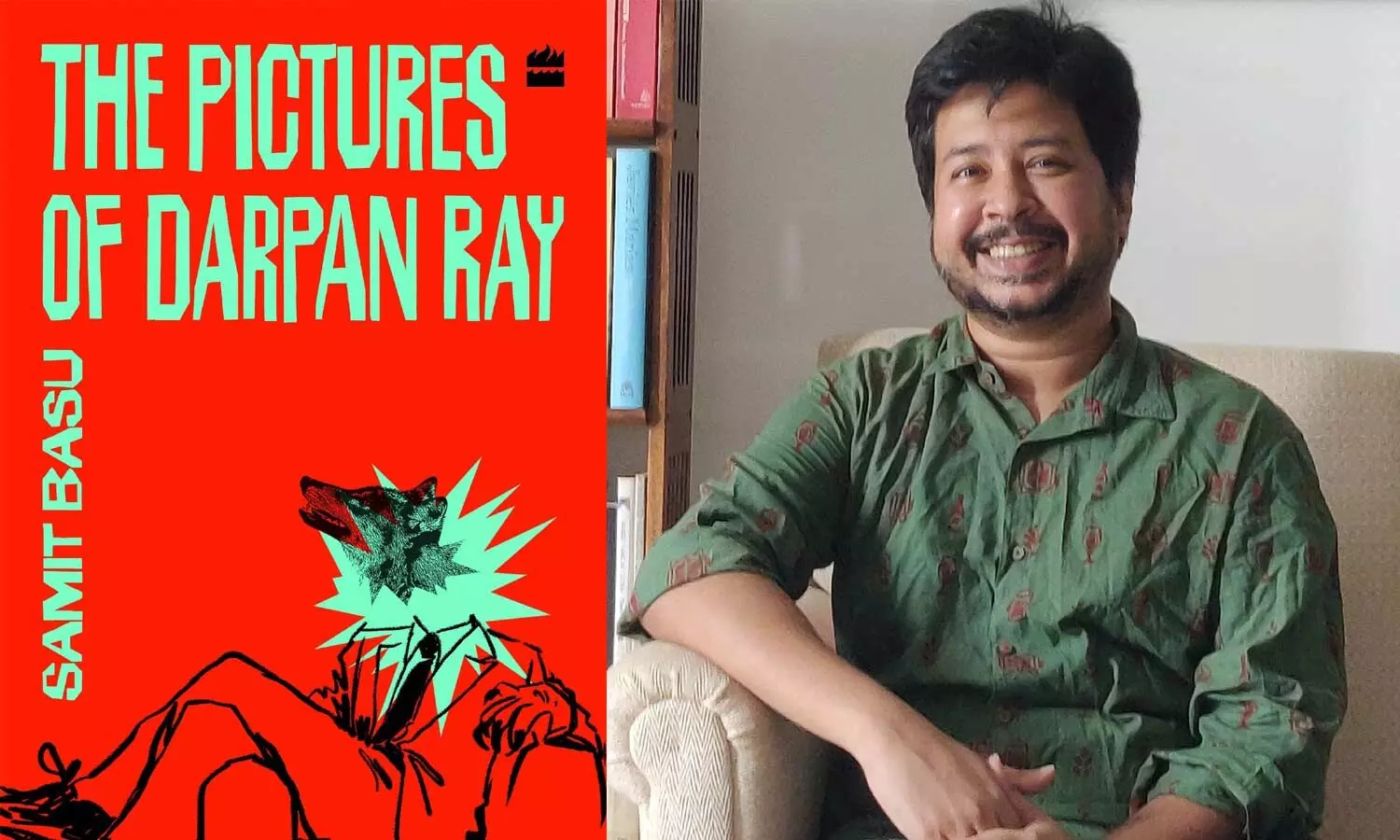
Dorian Gray’s sins got nothing on Samit Basu’s Bollywood
What happens when the beautiful, morally corrupt Dorian Gray goes to Bollywood? Author Samit Basu’s latest novel, ‘The Pictures of Darpan Ray’ (HarperCollins India), digs into this idea. A contemporary reimagining of Oscar Wilde’s ‘The Picture of Dorian Gray,’ the novel traces India’s cultural transformation through the lens of Bollywood.
Basu was in his early twenties when he first encountered the Hindi film industry, which he endearingly calls “a demonic vortex.” Involved with Bollywood through the 2000s, he was left with a story of individuals and an ecosystem caught in a downward spiral, increasingly obsessed with looking good and staying young.
To ground that world, Basu turned to his early career. Working as a young journalist in Delhi after his debut novel’s release, he found himself meeting famous people for the first time. “The sheer rise in the quotient of what assholes they were… not to me, but in general,” he recalls. That dynamic shaped Rishi, the novel’s narrator, a writer with access to Bollywood’s inner circle while remaining an outsider to it.
“In all of my decades of being frustrated by Bollywood people, they have such brilliant lines when they’re doing the bleakest things,” Basu says.
Bollywood, thus, became the vessel to reimagine Wilde’s Dorian Gray. At the centre of Rishi’s observations is Darpan Ray, whose ageless beauty barely makes a mark.
“Everybody is a Dorian Gray now,” Basu insists. “We’re all on our phones with filters on, looking young and beautiful. Now, everyone’s a celebrity and therefore, no one is. In Bollywood, an average 40-year-old looks like they’re 25. Someone who doesn’t age is literally unremarkable.”
When asked if narrating through Rishi’s lens left Bollywood bereft of glamour, Basu agrees. When told that parts of the prose read tedious and seemingly required editing, he responds, “I’m sorry I made you feel bored. This was not an editorial mistake. It was intentional that a reader experience Rishi’s slow, tedious decline.”
Humour, thus, remains central to Basu’s prose. “Here is a story where you’re not supposed to particularly like the characters or what happens. What I try to do is just be angry and cantankerous; say things in a way that hopefully people find funny,” he notes. “I will be so depressed the day someone reads anything of mine and doesn’t find it funny.”
The novel channels Wilde’s provocative, flippant wit through Rishi’s account of the breezy chatter around him about issues from #MeToo and Jeffrey Epstein to Palestine and Hindutva.“That’s why it’s set in Bollywood,” Basu explains. “When Bollywood says it’s apolitical, everyone assumes it’s out of cowardice. In truth, they genuinely don’t know.” The callous remarks in the book are drawn from conversations the author witnessed in those rooms. “I was remembering things people had said and put Rishi through it.”
In Basu’s view, modern moral decay stems from an active willingness to look the other way.
Where Dorian Gray’s portrait bore the physical rot of his sins, Darpan’s world normalises its corruption. As Basu puts it, “The lack of empathy at an individual and societal level is this era’s fundamental sin.”
An autobiography without introspection: A journey of lies
It has damaged trust and credibility of Hyderabad: KTR
AICC summons Raj Gopal Reddy
French co to invest Rs 4K cr in Telangana
Maha CM Fadnavis inaugurates high-tech facilities for Brihanmumbai Police Commissionerate
PM Modi says appeal to cut gold purchases helped bring down prices, credits citizens for heeding advice


