




- Two students killed in MVSR Engg College Dandiya event mishap
- DGP Anand flags off rally for drug-free India
- Congress seeks TJS support for Graduate MLC elections
- 10 arrested in Rs 1.30 cr kidnap-for-ransom case
- Suspended inspector had amassed 2.8 cr assets
- Nalgonda pitted against MBNR on water issue
- Saddula Bathukamma: A floral celebration of Telangana’s culture and traditions
- FSSAI mulls ban on added sugars in infant foods
Ideas Visualised in Art: How Brihattar Bharat shared knowledge across
In Short
Brihattar Bharat represents a wider network shaped by the movement of ideas, people and artistic traditions.

Share :
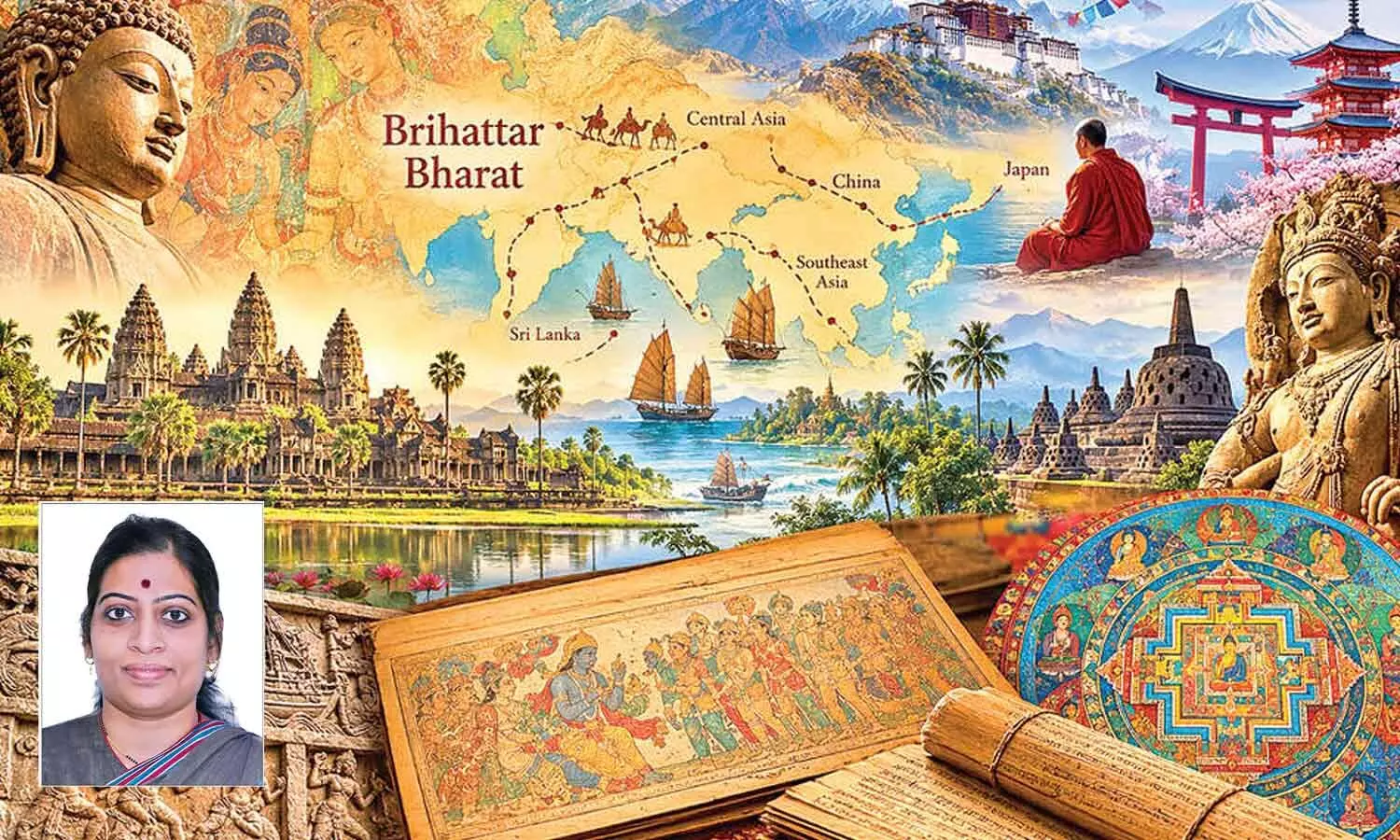
Ideas Visualised in Art: How Brihattar Bharat shared knowledge across
Art has a remarkable ability to bring people closer. A painting can tell a story across generations, a sculpture can express a profound idea without speaking a word, and a temple can preserve the imagination of an entire community. Long before the world became connected through the internet and modern communication, people shared knowledge through art, architecture, stories, symbols and spiritual traditions. The idea of Brihattar Bharat helps us appreciate this extraordinary history of cultural connections across Asia and beyond.
Brihattar Bharat represents a wider network shaped by the movement of ideas, people and artistic traditions. It reminds us that knowledge has always travelled across mountains and seas, carried by monks, traders, pilgrims, scholars, artisans and storytellers. As these ideas reached new societies, they found fresh expressions, blending with local traditions and giving rise to distinctive forms of creativity.
This is the beauty of cultural exchange: people share what they know, learn from one another and create something meaningful for future generations.
When art becomes a language of knowledge
Art has always helped people understand the world around them. The design of a temple may express a vision of the universe. A sacred image may communicate spiritual values. A mural may preserve a story, while a traditional performance may pass history and wisdom from grandparents to children.
These artistic expressions make knowledge accessible to people from different backgrounds. Even when languages differ, a visual symbol or a familiar story can invite curiosity and understanding. Art therefore serves not only as an expression of beauty but also as a bridge between knowledge and everyday life.
The theme Ideas Visualised in Art encourages us to look beyond what we see and discover the ideas that shaped it. Who created an artwork? What did it mean to its community? How did its form change when it travelled to another region? Such questions help us understand the people behind the monuments, paintings and symbols that continue to inspire us.
From Bharat to the wider Asian world
The history of Buddhism offers a compelling example of knowledge travelling across regions. Buddhist teachings, manuscripts, philosophical ideas and artistic practices moved through Central Asia and reached China, Korea, Japan and Vietnam. Monks, pilgrims and scholars played an important role in these journeys, while monasteries and cultural centres helped preserve and share knowledge.
As Buddhist traditions took root in different societies, artists gave them forms that reflected local sensibilities. Images of the Buddha, sacred paintings and monastic architecture expressed shared spiritual ideas while developing distinctive artistic characteristics. The resulting traditions remind us that cultural connections can flourish alongside regional identities.
The mandala offers another fascinating example. In several Buddhist and Hindu traditions, it serves as a symbolic representation of cosmic order and, in particular contexts, a focus for meditation and visualisation. Its carefully arranged forms invite reflection on the relationship between the individual, the universe and spiritual understanding. Studying mandalas across cultures allows us to explore both their shared features and the meanings that different communities have given them.
Monuments that tell stories of friendship and exchange
Across Southeast Asia, magnificent monuments preserve evidence of centuries of cultural interaction. Angkor Wat in Cambodia, Borobudur and Prambanan in Indonesia, and the historic monuments of Bagan in Myanmar reveal rich artistic traditions shaped by religious ideas, local craftsmanship and the vision of their patrons.
Inscriptions, sculptures, temple designs and narrative panels help us trace these connections. They also reveal the remarkable creativity of the societies that produced them. These monuments are not simply reminders of ideas received from elsewhere; they are achievements in their own right, shaped by local artists, communities and cultural experiences.
The Ramayana provides another beautiful illustration of this process. Its stories have inspired literary, theatrical and visual traditions in Cambodia, Thailand, Indonesia, Laos and other parts of Asia. Each society has interpreted the narrative in its own way, giving characters, episodes and performances distinctive local qualities.
A shared story can therefore become many different cultural experiences. Rather than diminishing the original connection, these interpretations demonstrate how communities make inherited knowledge their own and pass it forward in new forms.
The Ajanta murals in Bharat also invite us to reflect on the relationship between art and the movement of ideas. Their paintings preserve remarkable insights into artistic skill, religious imagination and the society of their time. Exploring their relationship with wider Asian artistic traditions can help researchers understand how images, techniques and ideas may have circulated through historical networks. Such connections become clearer when supported by careful study of dates, inscriptions, materials and historical evidence.
Shared heritage, distinctive identities
The story of Brihattar Bharat is most meaningful when we recognise cultural exchange as a two-way process. Every society that receives an idea contributes to its development. Artists adapt techniques, communities reinterpret symbols, and local traditions give familiar stories new significance.
This perspective allows us to celebrate connections without overlooking the individuality of the cultures involved. The artistic traditions of Japan, for example, developed through their own historical experiences while engaging with wider Asian Buddhist and cultural networks. Their distinctiveness illustrates how societies can welcome influences, nurture local creativity and preserve their identities at the same time.
Rabindranath Tagore’s engagement with Asian cultures also encourages us to appreciate the value of intellectual and artistic dialogue. Cultural relationships become richer when people approach one another with curiosity, respect and a willingness to learn.
Preserving the past, inspiring the future
Today, this shared artistic heritage offers opportunities for education, research and international collaboration. Digital archives, museum partnerships, conservation projects and exchanges among scholars can help document artworks and make knowledge more accessible to younger generations.
Schools can introduce children to these connections through stories, drawings, monuments and traditional crafts. Universities can encourage interdisciplinary research combining art history, archaeology, literature and cultural studies. Communities can continue to sustain their own traditions while sharing their significance with wider audiences.
Such efforts can transform heritage from something we merely admire into something we actively understand, preserve and pass on.
A living conversation among communities
The story of Brihattar Bharat reminds us that communities have always grown through encounters with one another. Mandalas, sacred images, murals, monuments and retold epics reveal how knowledge travels, changes and continues to inspire new generations.
Art makes these connections visible. It allows us to recognise common aspirations while appreciating the different ways societies express them. The true value of this heritage lies in the relationships it reveals: between people and ideas, tradition and creativity, memory and the future. By studying and celebrating these connections, we can nurture a deeper appreciation of Bharat’s cultural relationships with Asia and the wider world. We also affirm a timeless truth: when knowledge is shared with respect and creativity, it becomes a source of enrichment for all.
(The writer is a Creative Economy Expert)
Charles Matata wins Delhi Half Marathon men's race with course record, Alemu takes women's crown
FBI Director Kash Patel demands three apologies from US network over retracted Russia report
President wants 60 days to analyse impact of Russia sanctions law: Rubio
Iran's FM says Tehran ready for dialogue based on mutual respect, credible guarantees
Kolkata stampede: Death toll rises to 19, CM Adhikari announces Rs 2.5 lakh compensation, job for victim’s families
Scheduled power cuts for Telangana industry soon?
Naidu sets higher vote-share target
Negligence During Municipal Polls: SEC warns officials of suspension, transfers
Tensions rise amid TDP-YSRCP showdown in AP local polls
CM Revanth Reddy greets Telangana women on ‘Saddula Bathukamma’


