




- Jassper Shipping lines up $50-million investment
- Indigenous Kamikaze platform gets a boost
- Personality rights - where does the buck stop and with whom?
- MDR charges could shatter India’s payment revolution
- Foundation stone laid for new facilities at Nimmakuru APRS
- Handri-Neeva water released to 77 tanks in Dhone and Pathikonda
- 139 ‘Outstanding’ teachers honoured in on Teachers’ Day
- Foreign involvement in the CJP-led student protests is seriously worrisome
Money, artha, and purushartha: A framework
In Short
In a world where money shapes choices, opportunities and even social values, the question is no longer simply how much wealth we create, but what purpose it serves. This feature examines the place of money in contemporary life through the Indian philosophical framework of Purushartha—Dharma, Artha, Kama and Moksha. It explores whether material prosperity can coexist with ethical responsibility, social wellbeing and inner fulfilment, and asks whether money can be redirected from being an end in itself to becoming an instrument for the larger common good

Share :
Money, artha, and purushartha: A framework
Nothing surpasses money in the contemporary human way of life. Virtually no human activity exists without a money trail; it is an implicit factor in whatever we do, should do, or shouldn’t do. Although a world without money has long been imagined as a utopian ideal, and money—or rather, what it has come to mean and entail—is at the heart of much that has gone wrong in human society, the harsh reality is that it remains not only indispensable, but even critical to making the world a better place. That is the fundamental paradox.
Money was always a significant force in human life since at least pre-historic times; an ancient Indian text, the Arthashastra, says: “Dhanam mūlamidamjagat”—meaning “Money is the pivot of the material world.” Yet, in an apparent contradiction, another scripture Yoga Vasistha states: “Manasamāyattamidajagat” (“This world is dependent upon the mind”), The way to reconcile is to interpret the former as referring to the external world and the latter to the inner universe. Money dominates our minds and mind, in turn, controls our consciousness. The result is that both our civilization and our consciousness have become money-centric, creating the potential risk that such coupling could become an existential threat to the human race.
While the future is not for us to see, money-power is at once titanic and tectonic. Its influence extends far beyond its own purchasing power; its muscle in the marketplace is greater than that of any other merchandise. Where and when money matters most, there are few, if any, mahatmas; its seductive snare can be sweeter than sex. It is weaponized as a tool of raw and ruthless power, both individually and internationally. Nations covet it as much as military might—as a sine qua non of geopolitical hegemony. Psychologically, it induces us to view ourselves and others through the lens of value, price, income, and net worth. Fusing with technology, money acts as a hyper-efficient multiplier of human flaws and fragilities. It has become the default language through which we interpret reality and righteousness.
Another way of characterizing the might of modern money is to recall how D. H. Lawrence described it as early as the 1920s: “our collective money-madness” and as a “fearful, cruel power.” Way back in 1860, John Ruskin remarked, “The evil of money has come to possess our souls.” Similar refrain was struck by ancient Greek philosophers from Socrates to Seneca. Socrates said that ‘he is richest who is content with the least…’and Seneca phrased the idea differently and said ‘the greatest wealth is a poverty of desires. What sounds surreal is that the way society today values money was foretold thousands of years ago in Indian scriptures describing Kali Yuga. The Shrimad Bhagavatam, for example, notes: “A person will be judged unholy if he does not have money,” and further adds that “wealth will be regarded as the sign of good birth, proper behaviour, and fine qualities’
What the ancient seers and philosophers could not foresee was not only the rise of plutocracy but that such power would come to rest in the hands of those who, in J. W. Mason’s words, “control enormous resources of violence”, constituting the biggest barrier to social justice. More worrisome still is what such control has produced: a condition of what Johan Galtung called “structural violence”—a society in which vast numbers are deprived of food, healthcare, education, and economic opportunity because public resources are inadequate, diverted to wrong ends such as military expenditure, or captured by elite consumption. In contrast to physical violence structural violence shapes up as lawful and thus more destructive.
So, if our living context is supposed to be the most immoral of all time, if we have become individually “money-mad,” and if the Promethean power of modern money is monopolized, grossly misdirected, and misused, what do we do?
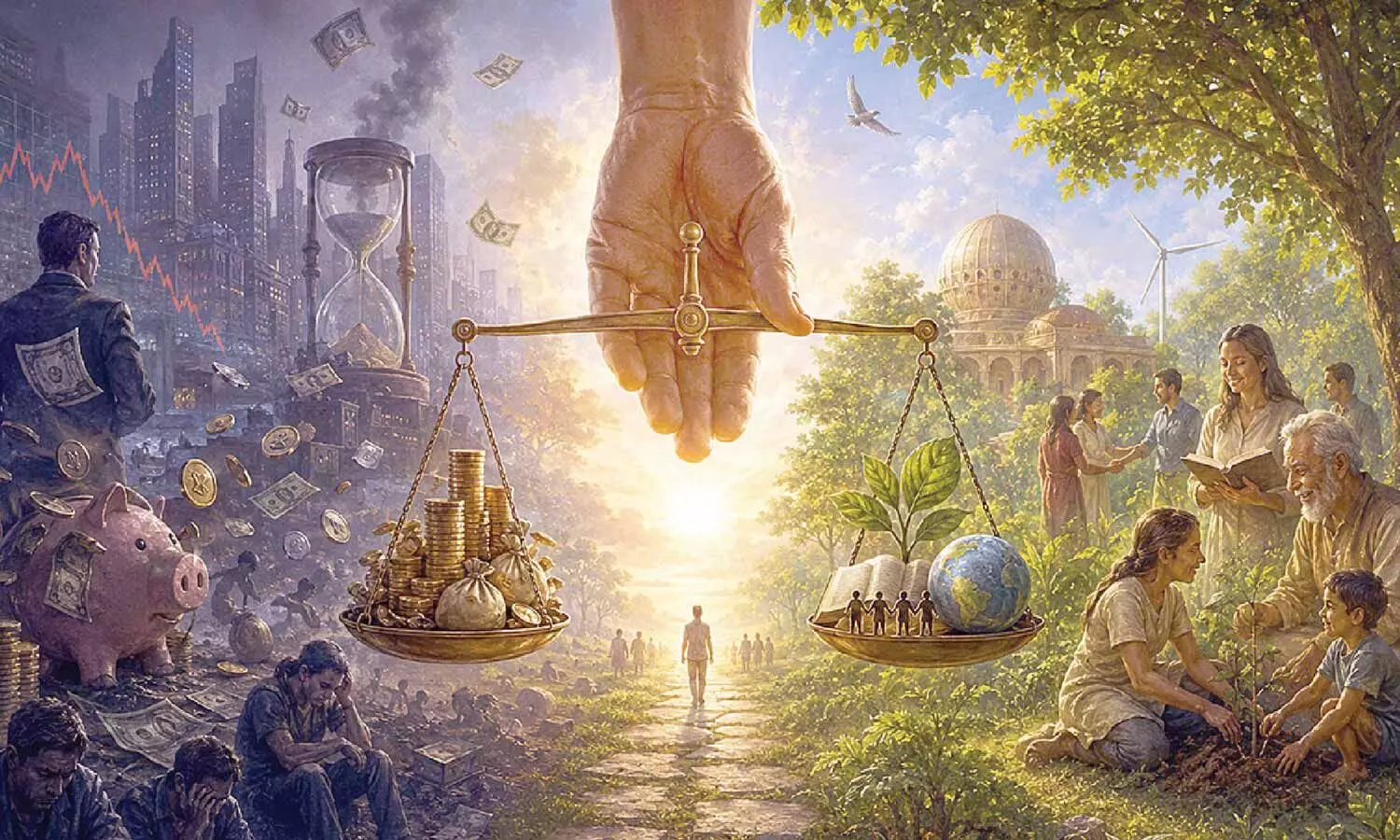
Although much of the negative impact of money is external; the real arena is the human mind. Amritabindu Upanishad says: “Mana evamanushyanamkaranam bandha-mokshayoh”— “The mind alone is the cause of an individual’s bondage and liberation.” This adage fits money as well contemporarily. Like the mind, money can be both the problem and the solution. The key is to change the direction of its utility—from serving primarily private wants to serving the common good. What makes this possible today is a new development: money, simply as money, has acquired an unprecedented capacity to transform abstract human empathy into life-saving infrastructure on a global scale, capable of lifting millions of lives from despair into dignity.
While money was long a game-changer in the material world, it is now a key player in the “war within” between the Arishadvargas—such as avarice, arrogance, and malice—and what Abraham Lincoln called the “better angels of our nature”: loving-kindness, caring, and sharing. Money has become an ally of our worst impulses. Turning it around could make money-mindedness part of the solution. That requires a financial reformation—a fundamental change in our relationship with material wealth. Money must circulate and be shared. The Rigveda says that the wealth of the liberal giver never dwindles and that wealth “revolves like the wheels of a chariot.” Zakat, Islam’s mandatory giving, embodies the same principle. In our money-dependent world, intelligently giving money may be the most scalable form of giving.
How, then, do we create a system sensitive to these imperatives? We need both an uplifting philosophy and a practical framework. The ancient Indian philosophy of Purushartha offers one. Its thrust is that human fulfilment rests on four distinct but holistic pursuits—Dharma (right conduct), Artha (material well-being), Kama (pleasure), and Moksha (liberation). Money is merely an instrument of Artha, not its end. Modern civilization has inverted this relationship, allowing money to eclipse Dharma and Moksha. In the Mahabharata, when Yudhishthira asks Bhishma on what the good life depends, Bhishma answers: “When men strive to obtain Artha through Dharma, then Dharma, Artha, and Kama exist together in unity.” That may be the principle we need: money must serve life, not become the measure and meaning of it.
Conclusion
The bottom line is this: the ultimate global hegemon is neither the United States nor China; it is money. And its virtual synonymity with debt adds more fuel to fire. Money has reduced humanity to “monetary peonage”—a kind of economic servitude, if not ‘Stockholm syndrome’. If reinforced by expected advances in Artificial Intelligence, it could further alter the age-old character of money and make it an amoral, autonomous, omnipresent force.
Money should be reconfigured by shifting where it flows, how it is taxed, and who controls it. That could transform money into an agency that automatically rewards good actions. We should follow wo-pronged approach: fully harness the omnipresence and plasticity of modern money to do things we couldn’t before for common god; and optimize non-monetary means of doing what money is doing.
The Purushartha paradigm offers a way forward by restoring money to its rightful place: as a useful but subordinate instrument within a larger dharmic and spiritual framework. It is not a magic pill; it offers the right philosophy and approach to build upon.
All that said, we need suitable soil to germinate this seed. What better place could there other India? It was renowned once as the cradle of spirituality and the land of dharma. Modern Indiastill possesses a civilizational and spiritual spark that many societies lack. The Purushartha principle was a guiding, governing ideal for so long that it has seeped into the soil and soul of India. That flickering flame must be rekindled. Indeed, a serious attempt is being made its basic fundamentals are being put to practical in places like Auroville is an experimental township in Tamil Nadu. The challenge is civilizational, and the opportunity is generational.


