




- Amala Akkineni launches Krishna Kiriti’s ‘Shiva Rupaya Vishnave’
- Demographic change and the creative economy
- Samay Raina Live tour sets record with one lakh tickets sold in under an hour
- Spending time with children is my favourite way to unwind: Rohit Sharma
- When it comes to heart health, feeling good is not enough
- Second Act Awards 2026: Celebrating courage, reinvention & new beginnings
- SEBI reviewing derivatives expiry settlement framework: Chairman
- Bandhan Flexi Cap Fund turns 21
A scientist in mind, spiritual in heart
In Short
From aerospace and defence tech to the Bhagavad Gita, Bharathi Subramanian finds space for both science and spirituality

Share :
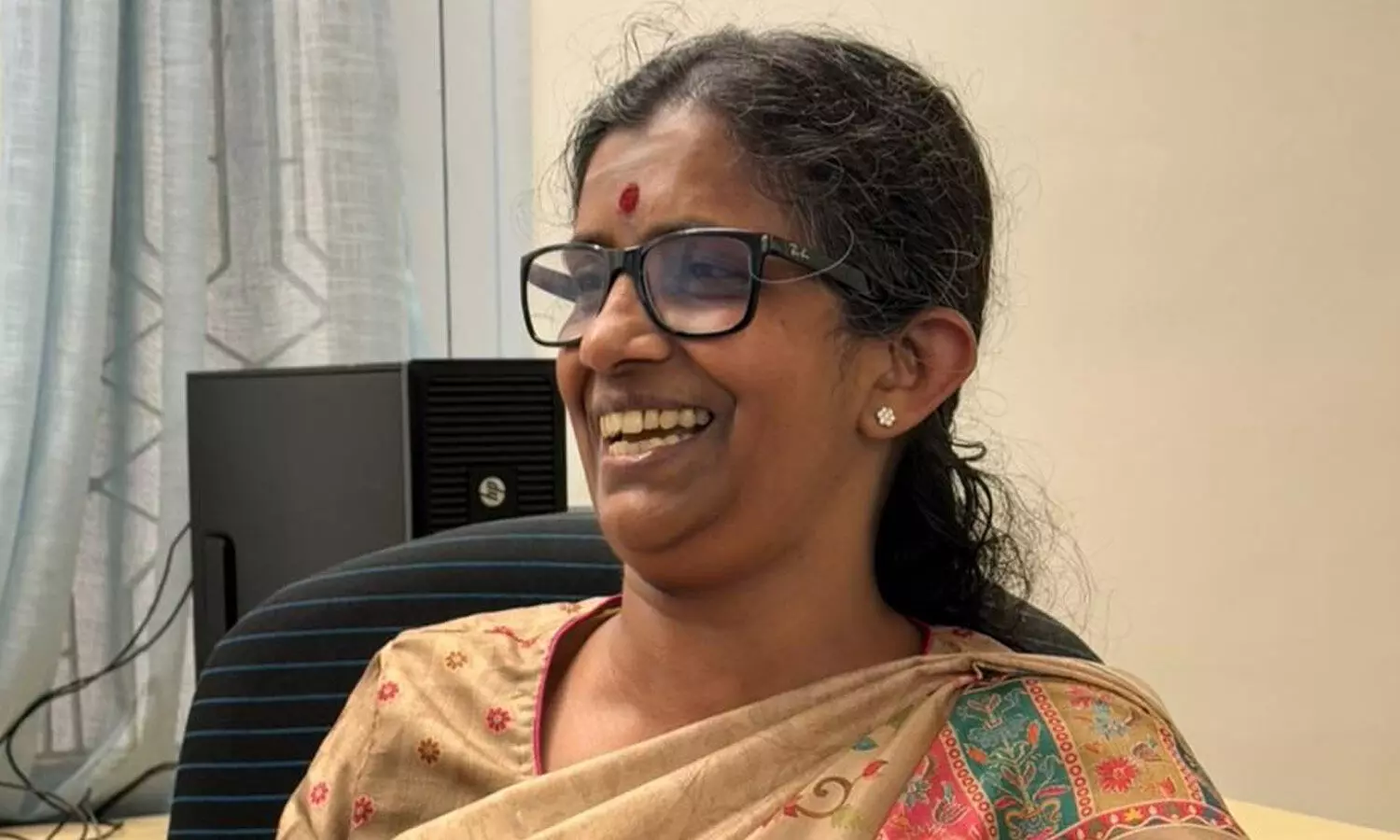
Bharathi Subramanian
With Vibhuti on her forehead, a saree and spectacles, Bharathi Subramanian could easily be mistaken for an ordinary homemaker. But beneath that familiar, next-door appearance is a scientist, technologist and entrepreneur who can move effortlessly from IoT and embedded systems to aerospace, avionics and drones. Deeply spiritual and rooted in tradition, she has spent much of her life at the cutting edge of technology, building a career that brings together two worlds that may seem far apart but are deeply connected.
“I love technology, mother India, mother earth and feel we all are lucky to have been here on this earth as humans,” she says.
For Bharathi, science has been her profession, spirituality her inner foundation and entrepreneurship the space in which she could bring her ideas to life. “Spirituality is my core base strength for all that I made of life,” she says.
Her journey into the technology space began with a BSc in Physics, followed by an MSc in Computer Science through a DRDO-sponsored programme in Mysore. She joined the Defence Research and Development Organisation in 1991, fulfilling what she describes as a childhood dream of working with computers and defence for India.
“I was lucky to get into the subject, domain of my choice. I wanted to do something with computers, defence and for India. I landed at DRDO job, my dream came true.”
The first 15 years of her professional life were spent at DRDO and the Aeronautical Development Agency, where she worked in a demanding, highly technical environment. Those years, she says, shaped not just her scientific thinking but also her approach to leadership, teamwork and problem solving.
Among the people who influenced her most were Prof. Nag of IIT Delhi, former DRDO chief Dr. Arunachalam, Dr. APJ Abdul Kalam and, in particular, Dr. Kota Harinarayana, the architect of the Light Combat Aircraft programme.
“Problem solving and taking challenges head on, outsourcing model, project management, reviews etc. All of this was due to a great leader Dr. Kota Harinarayana.”
After DRDO, Bharathi moved through roles at HCL and Thales and later worked with an MSME in medical electronics. “In all these years at DRDO and thereafter, I was always feeling I am restricted to do things as it should be and I could do something more.”
That desire eventually took her into entrepreneurship, leading to the founding of Tamopahaa Technologies. “Entrepreneurship was really like being thrown into a rough sea when one does not know to swim,” she says. “I really was naïve and romanticised the whole process.”
People she expected to support her sometimes went cold, while others were happy to offer advice without necessarily standing by her. “I tried my best to keep myself sane and be focused on moving forward.”
At the heart of that approach is a simple philosophy she calls “Do As You Should”. It is a principle that goes back to her childhood and to a family that placed greater value on doing the right thing than on taking the easy route.
She recalls being offered an engineering seat for a capitation fee of Rs 3,000. Her family chose not to pay it, and she eventually gave up the seat. “I always felt that I am happiest when I get results doing it the right way.”
The principle was not merely taught to her. She saw it being lived by her grandparents and parents, who continued to remain cheerful and self-respecting despite having very little money. “They never compromised even though there was very little money to even manage normal show. They were cheerful, happy and I wanted to be like that.”
At Bengaluru-based Tamopahaa, her work spans embedded systems, IoT, system engineering, avionics, defence and drone technologies, but she does not see these merely as commercial opportunities.
Her ambitions extend into agriculture, education, the environment and the lives of young people who she believes can use technology to address problems that have remained unresolved for generations. “We want to make agriculture fashionable to youth, find solutions to problems that could have far-fetched positive changes.”
She sees technology as a means rather than an end. “It’s not just about building embedded systems but a bigger change that we are attempting to set in motion in various areas which could give me satisfaction of having done a small splash towards goodness.”
Her concern for the environment is integral to this larger vision.
“We need to truly follow ‘Vasudhaiva Kutumbakam’ and it is actually simple. We need to do our best to not pollute mother earth and allow coming generations to enjoy earth as we are doing.”
Prayer, chanting and spiritual study form part of her everyday life. She chants Lalita Sahasranamam and Vishnu Sahasranamam and reads the Bhagavad Gita. Swami Chinmayananda and Maha Periyava have been among the spiritual influences on her, alongside the teachings and lives of figures such as Adi Shankara and Swami Vivekananda.
She does not see any contradiction between the scientist and the deeply spiritual woman.
In fact, she believes spirituality takes the search for understanding to a level beyond what science can ordinarily explain. “Spirituality is many levels ahead of science,” she says, explaining that science may deal with observable phenomena while spirituality explores the same existence at different levels and layers.
“Science is like looking at world below from a hillock. Spirituality is about going higher and being able to look at details far below with a hifi zoom-in feature, crystal-clear detailing. The picture is there, we need to clear our specs,” she says.
Bharathi wants young engineers to have room to think independently, rather than simply follow instructions. She believes that the relationship between generations must change. “The elders and youngsters need to meet halfway to make life meaningful for both. The next generation are smarter but have more distractions. They are impatient and are wanting quick solutions. We need to have conversations between generations without being judgmental, from both sides.”
Her philosophy of leadership is summed up in a line she attributes to National Security Adviser Ajit Doval: “Dare to take a decision after due considerations and then make it work.”
The woman behind the scientist, however, measures success differently. “Success is when we are able to make a difference even small.” For her, the real measure is what happens to the people around her. “The lives of people working with you and their family changes for good. And that is a chain reaction. Revenue, customers and business growth is only a means to the real success.” Her ambition is to create a community of people who share the same underlying philosophy. “A decade from now, I will be seeing many more of the ‘Do As You Should’ clan growing.” And the larger goal remains unchanged: “Making a difference in India, in the world and to mother earth.”
By-polls are not referendums: What 12 years of electoral data in TG and AP reveal
Will turn Amaravati into global deep tech hub: CM Naidu
AP takes BC quota battle to SC
Five killed in Sri City pharma factory blast
Lokesh pitches AP as investment hub
Regulatory frameworks need to evolve with rapidly changing environment: NITI Aayog’s Rajiv Gauba


