




- Prepare rabi season strategy based on water availability, not habit: Minister
- India’s industrial growth surges to 8 pc in August, manufacturing sector shines
- Gold trader, wife robbed after bike-borne miscreants open fire in Bengal’s Hooghly
- Shark Tank’s Anupam Mittal Says Elon Musk’s Grok Is Faster, Cheaper Than Claude
- PM-AJAY: Over Rs 1,730 crore released to states to skill 2.5 lakh individual and group beneficiaries
- No shortage of coal at power plants: Kishan Reddy
- India explores UAE as key LNG, LPG source: Piyush Goyal
- Radico Khaitan marks global travel retail milestone with UK Airport expansion
CSIR–NGRI Celebrates CSIR’s 85th Foundation Day with Open Day 2026
In Short
The event provided visitors with an opportunity to learn about geoscientific research through interactive exhibits, working models, live demonstrations and conversations with scientists.

Share :
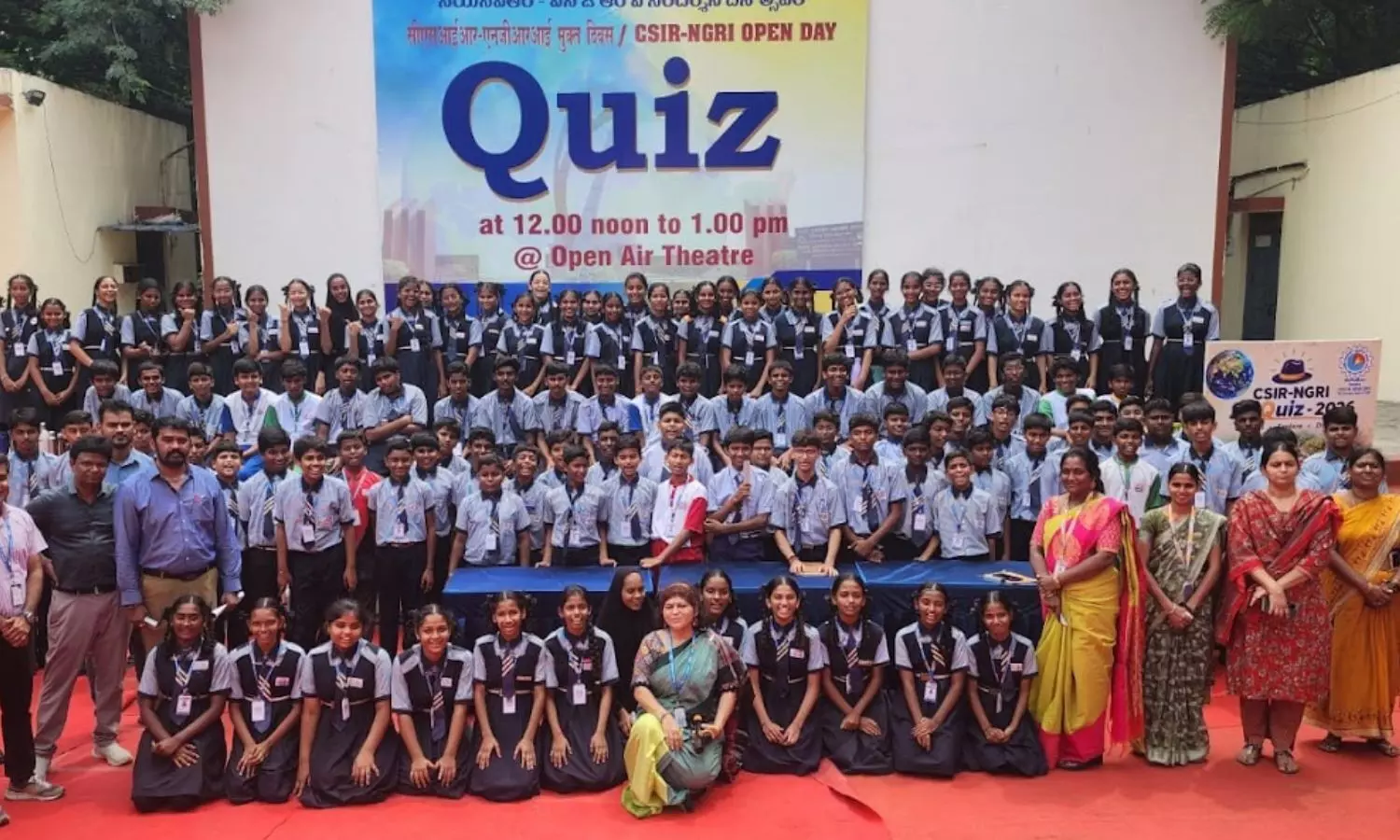
celebrations marking the 85th Foundation Day
Hyderabad: Around 5,000 students, educators and members of the public explored the world of Earth sciences at an Open Day organised by the CSIR–National Geophysical Research Institute (CSIR–NGRI) recently, as part of the celebrations marking the 85th Foundation Day of the Council of Scientific and Industrial Research (CSIR).
The event provided visitors with an opportunity to learn about geoscientific research through interactive exhibits, working models, live demonstrations and conversations with scientists. Students from schools and colleges formed a significant part of the visitors, with activities designed to encourage curiosity and interest in Earth sciences.
Nearly 20 thematic exhibits presented research across areas including seismic studies, tectonic geodesy, thermal geophysics, rock mechanics, palaeomagnetism, geomagnetism, planetary sciences, earthquake and tsunami hazards, groundwater exploration, geochemistry, magnetotellurics, geochronology and isotope studies.
Scientists demonstrated how earthquakes are recorded and analysed, how groundwater resources are mapped and monitored, and how geophysical techniques can be used to study minerals and other natural resources. A 3D visualisation of magnetotelluric techniques showed how variations in the Earth’s natural electromagnetic fields can help identify electrically conductive structures beneath the surface.
Several exhibits connected Earth science with everyday life. One display highlighted the rocks and minerals used in the manufacture of mobile phone components, while another explained the formation and evolution of the Earth over geological time.
A working model on recent catastrophic floods in Nepal illustrated how glacial collapse and the movement of ice and rock masses can contribute to flood events in mountainous regions. Another exhibit featured a prototype Android application demonstrating earthquake recording and audible alerts, highlighting possible applications of mobile technology in earthquake monitoring and public awareness.
Visitors also viewed Miracle in Antarctica, a video presentation focusing on scientific expeditions to the polar region and the environmental and logistical challenges faced by researchers.
Throughout the event, scientists interacted with students and visitors, answering questions and explaining how geoscientific research contributes to areas such as natural hazard assessment, groundwater management and sustainable resource exploration.
An interactive science quiz was also organised for students, encouraging them to engage with concepts related to Earth sciences and scientific research.
Dr Prakash Kumar, Director, CSIR–NGRI, visited the exhibition stalls and interacted with students, visitors and researchers during the programme. The event was coordinated by Dr B. P. K. Patro, Scientist G and Chairman of the Foundation Day Committee, with participation from scientists, researchers, students and staff of CSIR–NGRI.
CSIR–NGRI Celebrates CSIR’s 85th Foundation Day with Open Day 2026
Boeing 737 MAX software issue poses no safety risk to operations: Akasa Air
Asian Games: ‘Grateful for the errors made by judges, I got some rest,’ says Esha after silver
Large clinical trial finds 24 weeks of Ashwagandha well tolerated without liver or kidney injury
Peace, strong law & order hallmarks of new UP, those obstructing them should be taught lesson: CM Yogi Adityanath
Sohrabuddin encounter case: SC issues notice on brother’s plea against acquittal of 22 accused
Bhagat Singh Birth Anniversary 2026: PM Modi Remembers Revolutionary’s Courage And Sacrifice
CSIR–NGRI Celebrates CSIR’s 85th Foundation Day with Open Day 2026
'Were EVMs, EC correct when Cong won in 2004, 2009': UP Dy CM Keshav Prasad Maurya
J&K Assembly passes statehood restoration resolution amid protest, walkout by BJP MLAs


