




- Foundation stone laid for new facilities at Nimmakuru APRS
- Handri-Neeva water released to 77 tanks in Dhone and Pathikonda
- 139 ‘Outstanding’ teachers honoured in on Teachers’ Day
- Foreign involvement in the CJP-led student protests is seriously worrisome
- Kshaya Masa and its profound relevance
- Shifting spaces of inequalities in the education lifecycle
- Why Indian parents are moving from “cute” to “conscious” when buying babywear
- Swetha Prasanna: Carrying the Kuchipudi legacy forward
Kshaya Masa and its profound relevance
In Short
While most of us are familiar with the ‘Adhika Masa (extra month)’ added to synchronize our lunar calendars, there exists an even rarer, highly intricate calendar adjustment known as the ‘Kshaya Masa’ (Dropped or skipped month). Based on contemporary research and classical astronomical texts, leading astrologers confirm that an exceptionally rare ‘Pushya Kshaya Masa’ is manifesting in the upcoming lunar Keelaka (2028-2029) year.

Share :
Kshaya Masa and its profound relevance
The traditional Indian system of timekeeping (Kala Gana) is far more than a secular table of dates and months. It is a precise, scientific bridge that connects the cosmic paths of the Sun and Moon, the seasonal rhythms of nature, and the daily dharmic life of human beings. The mathematics of the Indian almanac (Panchanga) plays a pivotal role in translating complex astronomical occurrences into structural guidelines for our daily and seasonal prayers.
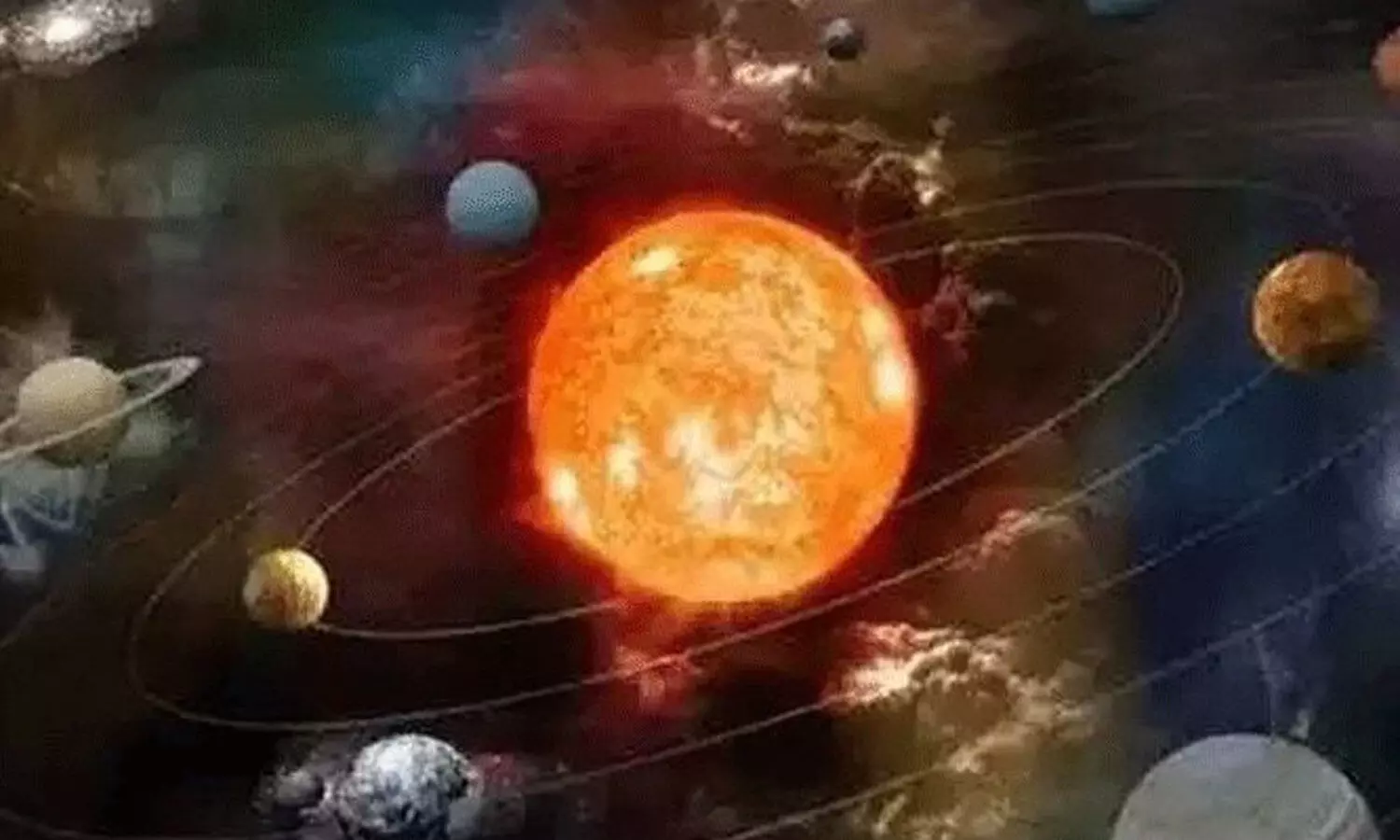
While most of us are familiar with the ‘Adhika Masa (extra month)’ added to synchronize our lunar calendars, there exists an even rarer, highly intricate calendar adjustment known as the ‘Kshaya Masa’ (Dropped or skipped month). Based on contemporary research and classical astronomical texts, leading astrologers confirm that an exceptionally rare ‘Pushya Kshaya Masa’ is manifesting in the upcoming lunar Keelaka (2028-2029) year.
Tracing the Vedic Seeds, physical causes, and everyday religious rules surrounding this dropped month is quite interesting. The primary baseline for this comprehensive study is drawn from the research papers presented and discussed threadbare by premier calendar architects at the ‘Telangana Vidwat Sabha Conclave’ held recently in Hyderabad, under the leadership of Telangana Vidvat Sabha Secretary Divya Jnana Siddhaanti and Treasurer Darshanam Marumamula Venkataramana Sarma.
To understand a dropped month, one must understand how our calendar breathes. The panchanga relies on a combined Luni-Solar model. According to the foundational ‘Surya Siddhanta,’ a standard solar year spans 365.258756 days, while a standard twelve-month lunar year totals only 354.367055 days. This creates an annual deficit of roughly 10.891701 days between the sun and the moon. When this difference accumulates to equal about a full month (roughly every three years), a lunar month without a solar transit (Sankranti) is created and labelled an ‘Adhika Masa’ to reset the seasonal clock.
Conversely, when the sun moves so swiftly that it crosses two distinct zodiac boundaries within the span of a single lunar month (from one new moon to the next), it creates a Kshaya Masa or ‘Dvi-Sankranti Masa’ (Dual-Transit Month). Therefore, it is vital to know that a dropped month does not mean thirty days are physically wiped out from existence. It simply means that a particular lunar month name (in this case, Pushya) is denied its own exclusive, independent new-moon-to-new-moon slot, causing it to merge into the surrounding months.
The concept of a dropped month is not a modern astrological invention. The ancient scriptures say that honouring a thirteenth conditional month and its rightful place in sacred rituals is a routine matter. According to commentarial traditions, a special year that hosts a dropped month produces three unique monthly characteristics to balance the cosmos. They are classified as: Samsarpa, Amhaspati, and Adhika Masa.
The transit-less month that arrives before the Kshaya Masa, because it glides along the normal calendar track without causing disruption, is called Samsarpa (the glider). The dual-transit Kshaya Masa itself, given the sacred Vedic title of ‘Amhaspati.’ The standard extra month that follows after the dropped month has occurred is Adhika Masa.
Modern astronomy and Kepler’s laws of planetary motion also reveal a beautiful harmony with our ancient systems.
Siddhantis explained that a Kshaya Masa can only happen when three precise physical conditions match perfectly.
1. A short solar month: The sun traveling at peak speed near earth’s perihelion;
2. A long lunar month: The moon traveling near its farthest point from Earth (Apogee), which slows its speed and extends the days between two new moons;
3. Boundary proximity: The first new moon landing just fractions of a degree before a solar transit, and the next new moon landing just after the subsequent transit.
The consensus research of Siddhantis provides concrete mathematical proof for the 2028–2029 occurrence.
On December 16, 2028, the first new moon conjoins. This is a razor-thin fraction of a degree away from the 240° zodiac boundary. Moments after this new moon concludes, the Sun enters 240°, triggering Dhanus Sankranti. Before the next new moon can form, the sun rapidly crosses the 270° line, completing Makara Sankranti. The subsequent new moon alignment only catches up on January 14, 2029, when the Sun has already advanced.
Even though the Sun’s real travel between these new moons is just 30°+ it successfully bypasses two transits (Dhanus and Makara) within one lunar month. This creates a merged Marga Shira-Pushya environment, effectively dropping Pushya Masa from its solo title. Immediately following this phase, the calendar triggers a balancing correction by inserting an Adhika Chaitra Masa from March 15, 2029, to April 14, 2029. The Siddhanta Shiromani tracks the historical return of dropped months using a classical word-number system called Bhuta Sankhya.
Siddhantis note that terms like ‘Kuvedendu’ signify a 141-year gap, while ‘Goku’ represents a short 19-year gap. Due to the constant gravitational tugs on planetary paths, there is no permanent, rigid cycle; each instance must be mapped fresh by the calendar makers.
It is perfectly normal for minor anxieties or misunderstandings to pop up across communities when a dropped month is announced. However, according to formal scriptural science, this is not an inauspicious omen or a curse; it is a magnificent mathematical self-correction of nature. As the texts remind us, if an individual’s personal natal chart is resilient, planetary alignments remain harmonious. To keep things completely clear for day-to-day life, simple guidelines may be followed. This is in reference to the core dropped month and extra-month phases (spanning roughly between December 2028 and April 2029).
The occurrence of a Kshaya Masa is an example of the timeless brilliance of our ancient astronomers and sages, who thousands of years ago successfully calculated the subtle speed variations of the sun and moon.
PM Modi interacts with National Teachers' Award winners; discusses innovative teaching, student confidence
Attend Assembly or quit
CM Revanth Reddy attacks Centre on mass deletion of votes
Bonanza for AP govt staff: CM Naidu clears 12th PRC, 2 pending DAs for employees
Naidu for overhauling edn to make students future-ready
AP to reconstitute 28 Zilla Praja Parishads


