






- Brainstorming session on policies for MP-2047 next month: CM Yadav
- Maha govt forms special panel to revive cooperative sugar mills
- PM Modi and Balendra Shah lay roadmap for future-oriented India-Nepal partnership
- PM Modi, Nepalese counterpart Shah flag off Saryu-Kamala Express train, inaugurate several projects
- Pavel Durov Jokes About Missing Telegram Groups in GTA 6
- Rahul Gandhi to visit Jaipur on Dec 9, Kharge to inaugurate training camp for new national secretaries
- PM Narendra Modi, Nepal PM Balen Shah Hold Bilateral Talks To Strengthen India-Nepal Ties
- PM Modi lauds India for crossing 1 crore HPV vaccine doses, calls it milestone in preventive healthcare
‘Leaders’ and their ilk cannot invent ‘de-citizenization’
In Short
Another vital pillar mentioned in the Preamble is Equality of two kinds: Equality of status and of opportunity. This is a right that is violated at every turn. Every government is duty-bound to punish crimes of inequality. Yet, who will punish them? The government itself is supposed to enforce the law—but does it? Consequently, the entire society becomes the victim. Finally, the Preamble assures an individual his dignity.
Share :
‘Leaders’ and their ilk cannot invent ‘de-citizenization’
It was on November 26, 1949, that the Constituent Assembly formally adopted the Constitution of India. It is celebrated as Samvidhan Divas or Constitution Day.
The Constitution is the lifeblood of democracy. But we have become accustomed to reciting the Constitution like a mantra and bowing before it as a sacred book. It is not meant to be revered from afar, wrapped in saffron silk, and placed high upon a shelf. It should be the protective shield for every ordinary citizen’s self-respect and rights.
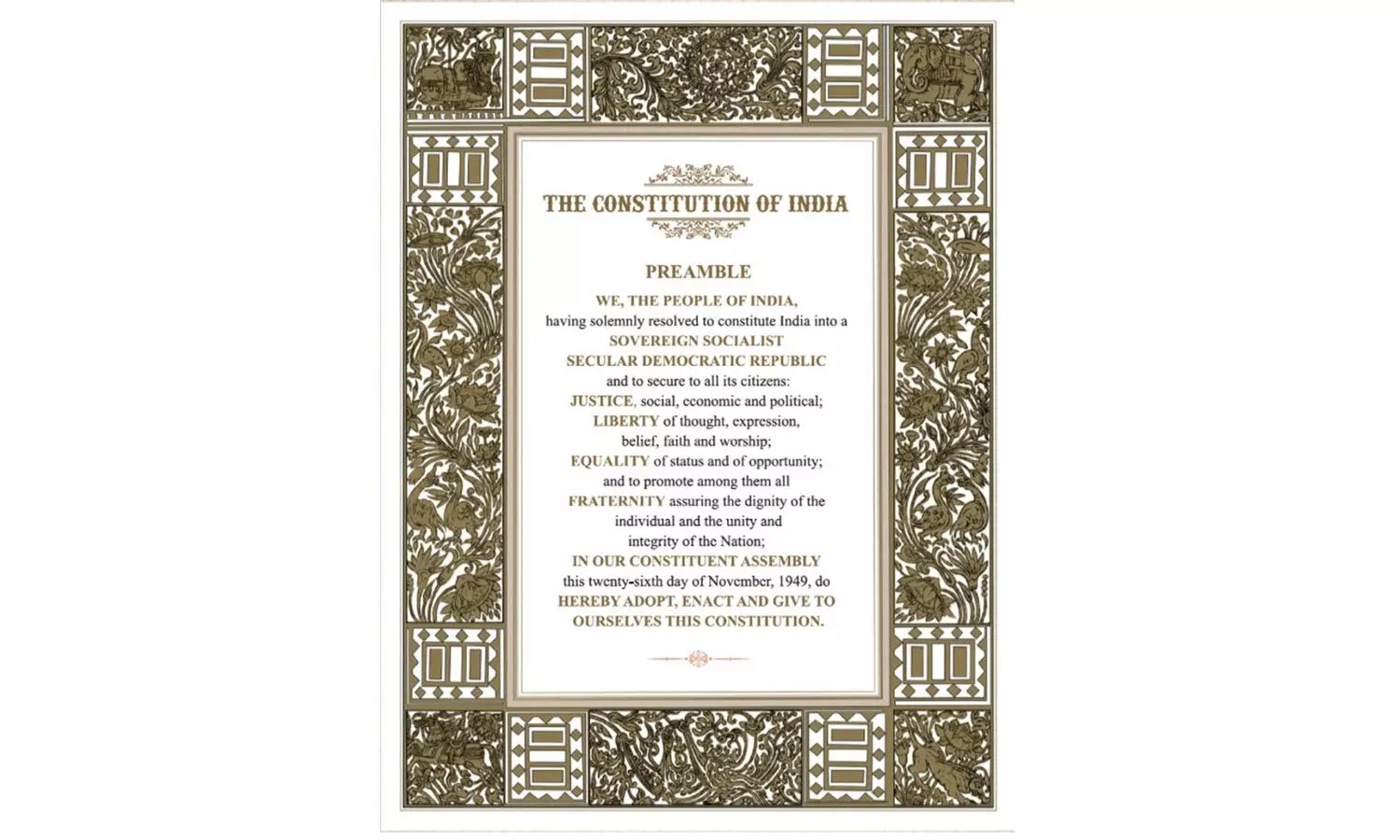
What is the basic structure? If it is just four walls and pillars that form the foundation of a building, the ‘Basic Structure’ of the Constitution is the foundation of our democracy. That Basic Structure does not exist in some distant realm; it lives and breathes within every single letter of the Preamble.
The Constituent Assembly has placed before us an extraordinary, unparalleled code of conduct, a “Bharatiya Geetha”. It is not penal code. Dr B R Ambedkar placed before us an extraordinary, unparalleled code of conduct. This “Bharatiya Geetha” is akin to the Bhagavad Gita.
The Preamble, a poem
It begins with “We, the People of India.” This phrase was not written to stoke hatred or claim the nation exclusively for any single religious group. Nor does “We, the People...” mean that only those who voted for the ruling party in the latest election are human, while those who did not are somehow less than human.
When the Constitution came into force in 1950, those words encompassed not only its architects but also its critics who debated it and ultimately signed it together, affirming, “Yes, this is ours.” It applied to every human being, citizen, and even the various foreigners present in the country at that time. One cannot claim it applies only to a particular sect or community. Furthermore, “We, the People” includes everyone born after 1950, every infant opening their eyes to the world at this very second, and every child yet to be born on this soil. “People” does not apply solely to those holding citizenship papers; under Article 21, it applies to all human beings, whereas rights under Article 19(1)(a) were drafted specifically for citizens.
Distorting the fundamental meaning of citizenship is a grave flaw, an injustice, and an atrocity. As some friends rightly explain, citizenship (Paurasatvam) is not merely a legal status—it is an ethos (Tatvam).
The Promise of ‘All’
When the Preamble declares its resolve “To secure to all its citizens...”, the word ‘All’ must be underlined three times. The Constitution’s core objective is to deliver justice to everyone without excluding a single soul.
Do our leaders truly comprehend the resolve “to constitute India into a Sovereign Socialist Secular Democratic Republic and to secure to all its citizens...”? Do they understand what a solemn resolve means? In “all its citizens,” the word ‘ALL’ is paramount. Even for those who do not know Telugu, simply understanding the English word ‘ALL’ is enough. It means granting social, economic, and political justice to everyone. Every person with humanity is a human being. ‘ALL’ does not belong to sycophantic gangs that divide people by gender, religion, or wealth to trade and exploit them for power; to those who possess humanity, ‘ALL’ means all of us together.
When translating the English Preamble into Telugu, simply saying Nyayanni (Justice in the singular) is insufficient; it must be understood as Nyayalni (Justices in the plural)—encompassing multiple dimensions of justice. That subtle plural inflection captures the Preamble’s profound, comprehensive vision: Social justice, economic justice, and political justice for all. Alongside these stand four essential liberties: Liberty of thought, expression, belief, faith, and worship. Have we ever paused to notice this? Without grasping this, how can anyone claim to understand the Constitution? Another vital pillar mentioned in the Preamble is Equality of two kinds: Equality of status and of opportunity. This is a right that is violated at every turn. Every government is duty-bound to punish crimes of inequality. Yet, who will punish them? The government itself is supposed to enforce the law—but does it? Consequently, the entire society becomes the victim.
Finally, the Preamble assures an individual his dignity. Did the earlier governments do it, or is the current government doing it? Is dividing people the standard practice of all? It is a matter of profound shame.
The Lifeblood of the Preamble- ‘Fraternity’ and ‘all’
A deep examination of the Preamble reveals three guiding principles:
Fraternity as the true foundation: The spirit of brotherhood and friendship—recognizing that we are all members of one human family—is the true strength of our Constitution. People’s Poet Kaloji Narayana Rao remarked: “I have not yet moved from ‘I’ to ‘We’... True democracy exists only when we say ‘We’!” Those words are the truest definition of the collective spirit that is envisioned by the Preamble.
Social justice over legal technicalities: Nowhere in the Preamble is the phrase “Legal justice” written; it simply says “justice.” If judges and lawyers confine themselves to dry legal jargon and procedural technicalities, the common citizen will never receive true justice. Constitutional guarantees like Article 16 must not remain mere promises on paper; the Constitution’s purpose is fulfilled only when they bring light into the lives of the marginalized communities.
A self-given covenant: Where was this Constitution forged? The Constituent Assembly on November 26, 1949, “adopted, enacted, and gave to ourselves this Constitution.” We wrote it for ourselves—it was neither an AI-generated poem nor borrowed intelligence from Google. Adopted means we accepted it willingly; enacted means we gave it the force of law after thorough debate and consensus. In those early days, the Left criticized the Constitution as useless, while right-wing circles wrote editorials claiming it was unsuited to our traditions and epics. Today, those who once rejected it have had a welcome change of heart.
This entire Preamble is a single sentence—yet within that one sentence lies an epic poem.
People vs. Citizens: ‘We the People’
Our Constitution opens not with “We the Citizens,” but with “We the People of India.” While freedoms like speech and expression under Article 19(1)(a) apply to citizens, the Right to Life guaranteed under Article 21 belongs to every human being who breathes on this soil, regardless of citizenship.
The Illusion Behind the Word ‘Shall’
Article 16(1): “There shall be equality of opportunity for all citizens in matters relating to employment or appointment to any office under the State.” Observe how 16(A) is different from Article 16(2). It says “No citizen shall, on grounds only of religion, race, caste, sex, descent, place of birth, residence or any of them, be ineligible for, or discriminated against in respect of, any employment or office under the State.” Here, the word “shall” denotes a mandatory, non-negotiable obligation. However, immediately after these two clauses, the mandatory “shall” disappears and is replaced by the permissive phrase: “Nothing in this article shall prevent...”—meaning “the State may do so if it wishes.”
This is a subtle legal assurance, but a mystery. It offers no binding guarantee; it essentially means “if possible, we will; if not, we won’t.” They risk remaining mere paper assurances.
The government possesses no authority to invent new definitions of “de-citizenship” at its whim. Far from having the power to strip away citizenship, the State bears the constitutional duty and dharma to protect it.
(The writer is former Registrar, NALSAR University of Law, Hyderabad)
‘Carrying the Constitution is not enough’: BJP accuses Congress of ‘double standards’
KCR mortgaged Telangana’s water rights to Andhra: CM Revanth Reddy
‘Farmers, ASHA workers left to suffer’: K’taka BJP mocks Shivakumar’s Japan visit
TN govt plans mental health services expansion in 12 districts: Health Minister
After PM Modi’s praise, Gujarat Guv thanks him for recognition of social outreach
Hardeep Puri interacts with GAIL employees and families during Ujjain visit


