




- PM Modi pays tribute to Lal Bahadur Shastri on birth anniversary, recalls ‘Jai Jawan, Jai Kisan’ legacy
- Aqua Industries Must Follow Pollution Control Board Regulations- AP Deputy CM Pawan Kalyan
- UN chief condemns attack on FlyDubai flight
- Why inner wellness is becoming the new beauty essential
- FIEO to organise one-day programme on Customs Schemes for Exporters in Hyderabad
- NALSAR marks UPSC Centenary through Collaborative Book on 100 Landmark
- Farmer welfare is the goal of the Modi government: 2027-28
- Congress a habitual offender in ushering in a divisive agenda to divide people- UM Kishan Reddy
What good is experience in the age of AI?
In Short
The real question is not whether experience can defeat AI or whether AI has made experience irrelevant. The real question is what happens when experience and Artificial Intelligence come together

Share :
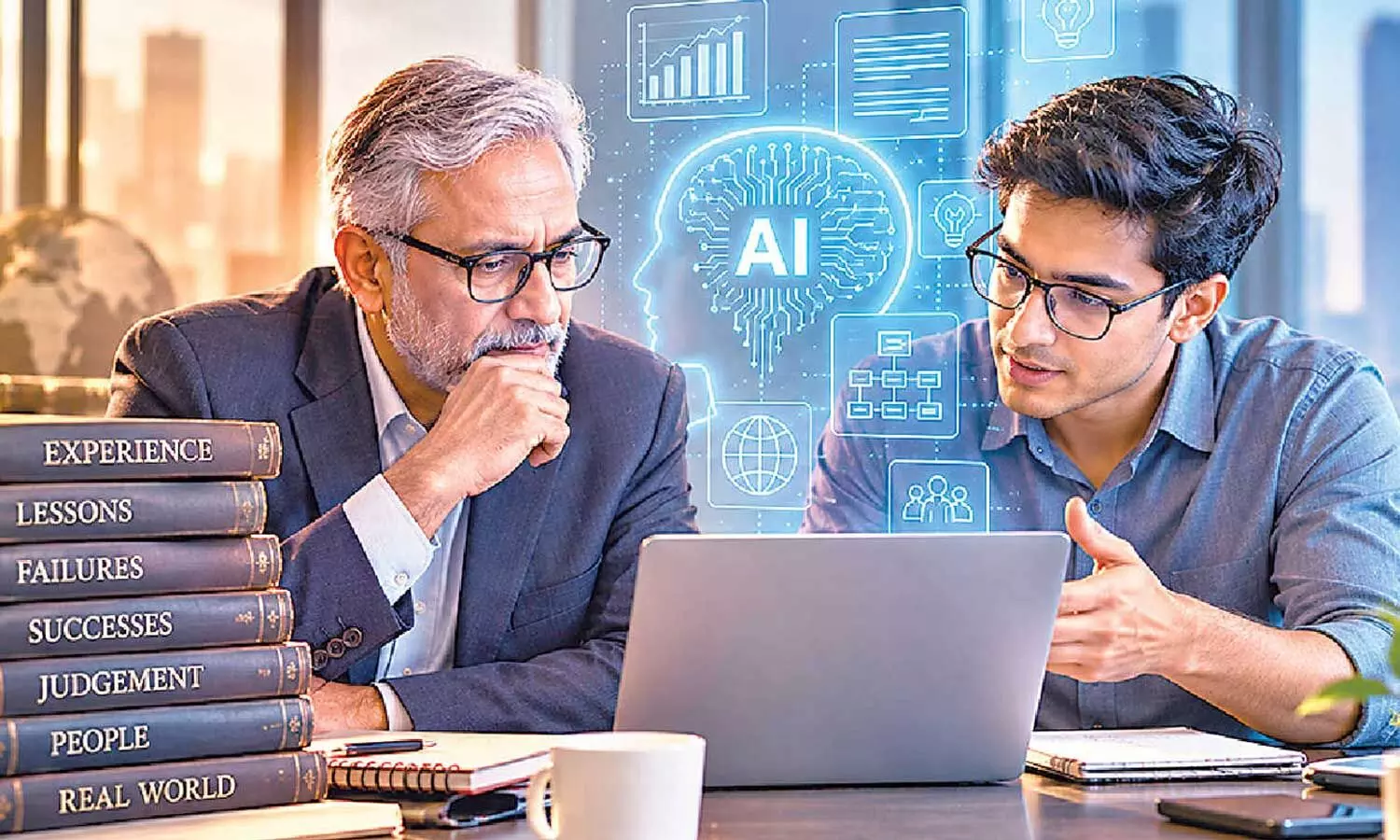
What good is experience in the age of AI?
Therewas a time when experience was the most valuable currency in professional life. The longer you worked, the more you learned. Years brought exposure, exposure brought lessons, and lessons gradually developed into judgement. A senior executive was valued not merely because he knew more, but because he had experienced more.
He had experienced decisions that worked and decisions that failed, people who delivered and people who disappointed, markets that changed unexpectedly and strategies that looked brilliant on paper but collapsed in execution. Experience is accumulated wisdom earned through time. Artificial Intelligence has disrupted that equation.
A young professional entering the workforce today can access in seconds what earlier generations spent years learning to find. Information, analysis, research, frameworks, presentations, code, ideas and alternative solutions are now available almost instantly. A curious 24-year-old who understands his subject, knows how to ask the right prompts and can use AI intelligently can sometimes produce work that would have taken a much more experienced executive several days.
This has understandably created a new confidence among young professionals. But confidence can quickly become arrogance when access to information is mistaken for possession of wisdom. At the same time, there is another form of arrogance at the other end of the spectrum. Many experienced executives believe that their decades of knowledge automatically give them an advantage over younger professionals. Some still regard AI as a useful gadget rather than a fundamental transformation in the way knowledge work will be done. Both are mistaken.
The real question is not whether experience can defeat AI or whether AI has made experience irrelevant. The real question is what happens when experience and Artificial Intelligence come together.
The great collision: Experience meets Artificial Intelligence
I have always believed that experience is precious. It cannot be downloaded. It cannot be acquired from a presentation. It cannot be manufactured by reading hundred books or asking an AI system a thousand questions.
Experience is the accumulated record of our actions and their consequences. It is the memory of decisions made with incomplete information. It is knowing what happened when a seemingly minor warning was ignored. It is remembering how a customer reacted, how an employee responded, how a market behaved and how a strategy that appeared flawless in a boardroom failed in the real world. That distinction matters.
Artificial Intelligence can tell us what has happened across thousands of situations. Experience tells us what happened when we made a particular decision in a particular context, with particular people, under particular circumstances. This is the difference between information and judgement.
Yet we must be careful not to romanticise experience. Thirty years in a profession does not automatically produce thirty years of wisdom. A person can repeat the same mistakes for three decades and call it experience. Someone can become so comfortable with what worked in the past that they become incapable of recognising what has changed. That is where AI becomes disruptive.
For the first time, accumulated experience is being confronted by a technology capable of challenging assumptions, generating alternatives and processing information at a speed no individual human can match. The senior executive who once possessed an information advantage can no longer assume that advantage simply because of his position or tenure.
The young professional can now arrive at the table with extraordinary informational power. But informational power is not the same as wisdom. A machine can give you ten possible strategies. It cannot automatically tell you which one your organisation is culturally capable of implementing. It can analyse a negotiation, but it cannot necessarily recognise the subtle hesitation of a person sitting across the table. It can identify patterns in data, but it cannot fully understand the human consequences of a decision. That is why experience has not become irrelevant. Its nature has changed.
The young are not wrong, the experienced are not right
Young professionals today have something previous generations did not have at the beginning of their careers: an extraordinary intellectual tool available almost instantly.
A young person who is curious, conceptually strong and willing to experiment can learn at astonishing speed. If that person knows how to frame a problem properly and articulate precise prompts, AI can dramatically expand his or her capabilities. And I would not dismiss that as a technological trick. It is a genuine competitive advantage.
A young manager may ask AI to examine a business problem from multiple perspectives, challenge an assumption, identify blind spots, compare competing strategies and simulate possible outcomes before walking into a meeting. That person may arrive better prepared than someone with twenty years of experience who has not bothered to understand the technology.
The young professional is therefore right about one thing: experience alone no longer guarantees an advantage. But this is precisely where some young professionals become foolish.
AI can help you find an answer. It cannot automatically give you the wisdom to know whether the answer is appropriate. A beautifully structured strategy can still be wrong. An impressive presentation can still fail to persuade. A technically perfect recommendation can still destroy trust. The workplace is not an examination where the person who produces the fastest answer wins.
It is a human environment involving customers, employees, egos, incentives, politics, relationships, uncertainty and consequences. A young professional who believes that access to AI makes senior experience obsolete has confused access to knowledge with ownership of judgement. But the experienced executive has an equally important lesson to learn. Years of experience do not provide immunity from obsolescence.
I have seen professionals become prisoners of their own success. They say, “I have seen this before.” They rely on what worked ten years ago. They dismiss new methods because their old methods served them well. They assume that younger people have enthusiasm but lack depth. That attitude is dangerous.
The executive who has spent 25 years building expertise and then refuses to upgrade himself because he believes his experience is sufficient is effectively converting his greatest asset into his greatest weakness. Experience without learning becomes rigidity. And in the age of AI, rigidity will be punished.
The augmented professional: Human intelligence plus Artificial Intelligence
The future therefore does not belong to the young at the expense of the experienced. Nor does it belong to the experienced at the expense of the young. It belongs to those who can combine human capability with machine capability.
Consider an experienced executive who has spent two decades understanding an industry. He knows the customers, the competitors, the internal dynamics, the regulatory environment and the mistakes his organisation has made. Now imagine that executive becomes genuinely proficient with AI.
He can interrogate his own assumptions. He can analyse information faster. He can explore scenarios that previously took weeks to prepare. He can ask the machine to challenge his thinking rather than merely confirm it. He can use AI to identify possibilities he may not have considered. His experience has not been diminished. It has been amplified.
Now consider the young professional at the other end. Give that person curiosity, conceptual knowledge, intellectual humility and access to AI. Add the willingness to learn from people who have already made mistakes. That combination can be formidable.
The young professional brings speed and fresh thinking. The experienced executive brings context and judgement. AI can increase the analytical capacity of both. This is why I believe we need to stop talking about AI simply as a replacement technology. It is increasingly becoming an augmentation technology. The smartest professionals will not necessarily use AI to do their thinking for them. They will use it to make their thinking better.
They will ask it to challenge their assumptions. They will ask what they are missing. They will ask for the strongest argument against their own position. They will use it to expose weaknesses in a proposal before somebody else does. That is a very different relationship with technology.
The professional of the future will need experience, curiosity, conceptual knowledge, AI fluency, critical thinking, judgement and emotional intelligence. Remove any one of these and the professional becomes less complete.
AI may know millions of examples. Experience teaches us that no two human situations are exactly the same. AI may generate the perfect response. Emotional intelligence tells us whether this is the right response for the person standing in front of us. AI may identify the rational choice. Leadership requires us to take people along with that choice. This is where human capability retains its deepest value.
The future will punish both complacency and arrogance
The greatest mistake we can make in this new age is to assume that AI has created a simple contest between generations. It has not. It has created a new test for both. The young must learn that technology does not eliminate the need for experience. They must have the humility to learn from people who have made mistakes they have not yet made. They should not confuse speed with depth or access to information with judgement.
The experienced must learn something equally important. Their past achievements do not guarantee their future relevance. Experience must remain open to reinvention. The executive who refuses to learn AI is not protecting his experience. He is gradually isolating it from the world in which that experience must operate.
This is perhaps the most important leadership lesson of the AI age: experience must evolve. Experience should not be treated as a certificate of competence. It should be treated as raw material for better judgement. And AI should not be treated as a certificate of intelligence. It should be treated as an instrument whose value depends on the intelligence, curiosity and judgement of the person using it.
The old workplace hierarchy was built around who knew the most. The emerging workplace will increasingly reward who can learn the fastest, think the clearest and combine different forms of intelligence most effectively. That changes the definition of professional excellence.
A 25-year-old with curiosity, conceptual clarity and AI fluency can outshine a 55-year-old executive who has stopped learning. There is nothing unfair about that. At the same time, a 55-year-old who combines decades of experience with an open mind and genuine AI capability can be extraordinarily difficult to compete with. There is nothing surprising about that either. The real advantage is no longer age. It is not even experience.
It is the ability to convert experience into judgement, knowledge into insight and technology into capability. The great opportunity before us is therefore not to choose between human experience and artificial intelligence. It is to bring the two together. Because AI has not made experience worthless, it has made stagnant experience worthless.
And perhaps the most valuable professional of the future will not be the person who knows the most, has the longest résumé or uses AI the fastest. It will be the person humble enough to keep learning from all three: experience, human intelligence and Artificial Intelligence.
(Author is a senior BJP leader, Chairman of Nation Building Foundation & a Harvard Business School certified Org. Strategist)
DSC 2.0 notification within month
AP High Court nixes 34% BC quota in local polls
Naidu vows to pursue 34% BC quota in SC
Dinesh Kumar appointed 12th Pay Revision Commission chief
‘May Bapu’s timeless message keep guiding us towards better society’: PM Modi on Gandhi Jayanti
Khairatabad bypoll: Vijaya Reddy seeks HC stay on notification


