




- Impact of tariffs on BRICS: India can take lead in measuring the economic burden
- Women leaders take centre stage at HBA India Leadership Summit 2026
- Neha Dhupia: Becoming a mother has made me very shaky
- Exploring a world where time has no boundaries
- Brain stroke patient should be shifted to hospital in golden hour
- Not all pains are failure of organs
- Surekha summoned to Delhi
- Assembly passes CURE Bill amid objections
Why didn’t you just go to Pakistan?
In Short
The world has changed dramatically at the turn of the millennium. Technology, migration, economics, geopolitics, and even the way we understand identity have changed. Should an 80-year-old wound continue to determine how a 30-year-old sees his neighbour? Or should history be something we understand enough to ensure that we do not repeat it?

Share :
Why didn’t you just go to Pakistan?
Imagine a state, one of the richest in the world, trying to retain its autonomy. There are political tensions, restrictions on the movement of goods, shortage of petrol and other essentials, attempts to procure arms through clandestine routes, and eventually a military operation. It sounds almost contemporary, perhaps like the ongoing US-Iran dispute?
Well, it isn’t. This was Hyderabad between 1947 and 1948. Ironically, there are some remarkable parallels in the India of then and now.
Today, Donald Trump thunders: ‘Iran must surrender’, while Jawaharlal Nehru had said: ‘Hyderabad must surrender’. Should one conclude that they all want Muslim states to surrender?
While on the subject, September 17 has emerged as a momentous day in the annals of history.
This year, it is tied to the SIR exercise in Telangana, bringing questions of citizenship, documentation, and who gets to be counted as an “Indian.”
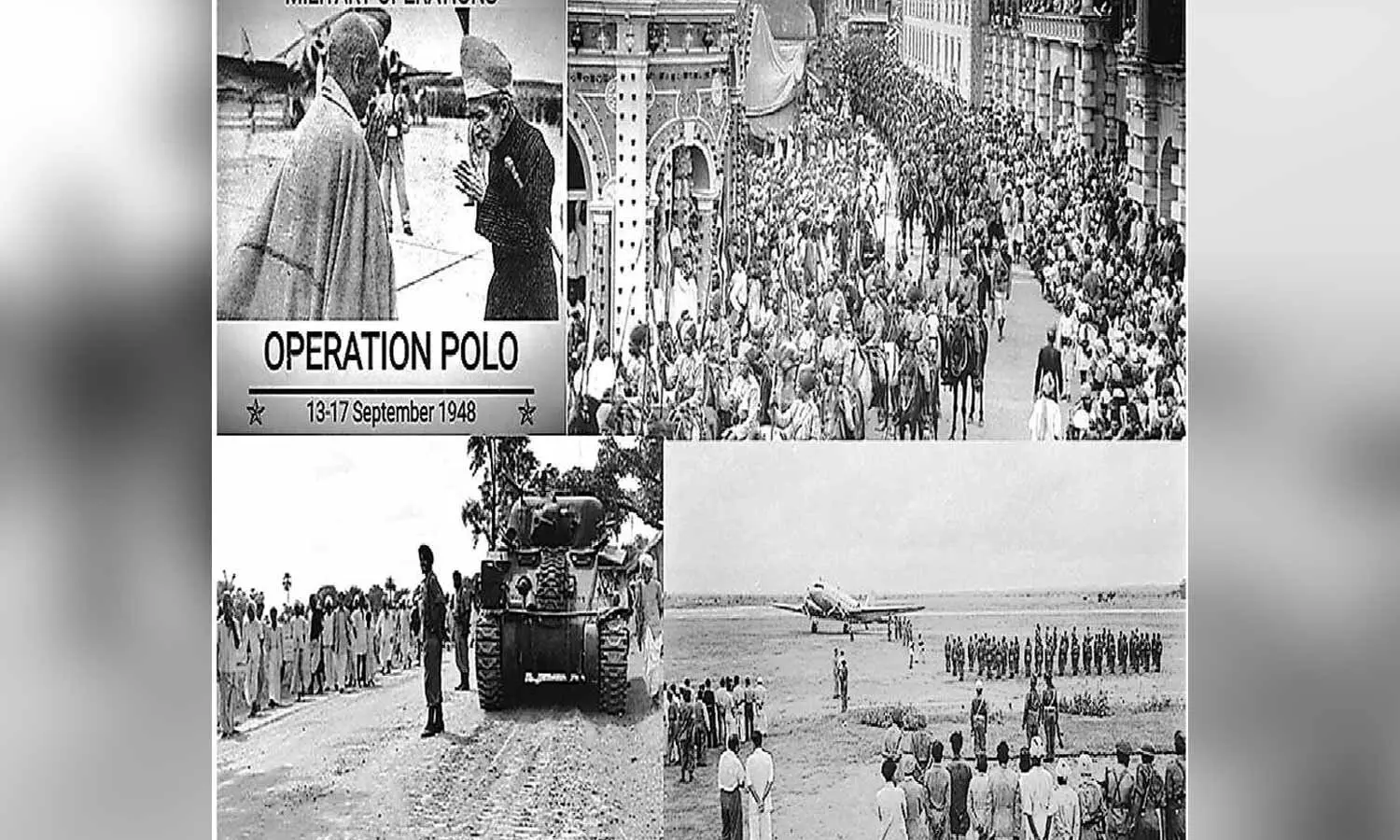
And, of course, it also marks ‘Hyderabad Liberation Day’, the day the Princely State was integrated into the Indian Union.
A recent fiction work by author Zeenat Khan titled, ‘The Sirens of September,’ which has been heavily researched for six years, throws light not only on ‘Operation Polo’ or ‘Police Action,’ it builds a world of the Hyderabad Princely State. Another non-fiction work by Daneesh Majid, ‘The Hyderabadis: From 1947 to the Present Day’ dissects what happened to the people on the ground and how they rebuilt their life after losing it all.
That, perhaps, is the problem with history when it is reduced to dates and political outcomes. We remember September 17. We forget about what life was before and after it.
During the time of the seventh Nizam, Mir Osman Ali Khan, Hyderabad figured among the most prosperous princely states in India, thanks to his being the richest man in the world.
So why, then, was Hyderabad so militarily vulnerable? Because wealth is not the same as military power. Being landlocked, Hyderabad had no access to arms and strategic supplies. The problem was compounded as the Indian government had imposed restrictions on the movement of goods, except for food, salt, and certain medical supplies. There was a blockade on arms and strategically important commodities. Contemporary accounts describe shortages of petrol and other essentials.
Hyderabad attempted to procure arms through clandestine routes. There were efforts involving Pakistan and the Australian pilot Sydney Cotton. But by September 1948, Hyderabad simply did not possess anything remotely comparable to India’s military capability. The Nizam’s massive wealth could not manufacture an air force overnight.
The other side of Nizam’s legacy:
For all the political arguments surrounding Osman Ali Khan, there is a reason why his name still carries a peculiar weight and commands an awe, even in today’s Hyderabad. His political project to preserve Hyderabad’s sovereignty failed but his institutional legacy did not. Education is perhaps the clearest example.
Osmania University, Nizam College, and several other institutions became part of the educational architecture of Hyderabad. The pride associated with studying at Osmania, or earning a degree from Nizam College, still exists in families far removed from the city’s old aristocracy. That is a remarkable legacy. A ruler can lose a state and still leave behind institutions that generations continue to identify with.
Perhaps that is why the memory of the Nizam is so complicated. It is possible to question his politics, his stubborn insistence on sovereignty, and the shortcomings of his administration, while acknowledging the institutions and cultural infrastructure that continue to shape Hyderabad.
And then the bloodshed:
The surrender on September 17 did not mean that violence simply stopped. Violence surrounding the accession, including attacks on civilians, reprisals, killings and looting, continued beyond the five-day military operation. The Telangana Communist Rebellion added another layer to an already fractured landscape.
This is the slice of history that is rarely conveyed when we recall the run up to ‘Liberation Day.’ Liberated from what? For whom? And what did liberation look like to the person standing on the street rather than reading about it decades later?
A character in Khan’s novel asks a Muslim: Why didn’t you just go to Pakistan? It is such a simple question. And yet, in the context of Hyderabad in 1948, it sounds absurd. Go where? Hyderabad was home.
The people being asked why they did not go to Pakistan were not immigrants sitting on the other side of the border. They were people whosefamilies, homes, and memories existed in Hyderabad long before the map around them changed.
And perhaps that is why the question continues to haunt many. 80 years down the line, that question still exists in our political vocabulary.
Who belongs here? Who is Indian per se? Who has the documents to prove it? Who gets counted as a citizen?
Contemporary debates around citizenship, electoral rolls, and documentation are not identical to the political crisis of 1948. They can never be equated. But the anxiety surrounding the question of belonging is not difficult to recognise.
Do millennials and Gen Z need to know all of this?
Do we need to know every death, every humiliation, every political betrayal, and every act of violence from the freedom struggle and the years that followed? Yes and no. We need to know enough to understand what happened. But we also need to ask what we are going to do with that knowledge.
The people who shaped much of our political landscape lived through Partition and its immediate aftermath. Their fears, loyalties, and politics were formed by that world. But the youngest millennials and oldest Gen Z are living in an entirely different one that bear no resemblance to the then Hyderabad, India and Pakistan for that matter.
The world has changed dramatically at the turn of the millennium. Technology, migration, economics, geopolitics, and even the way we understand identity have changed. Should an 80-year-old wound continue to determine how a 30-year-old sees his neighbour? Or should history be something we understand enough to ensure that we do not repeat it?
Perhaps in that context, historical fiction and non-fiction has a place. Because sometimes a fictional character can make you ask the question that a textbook never did. ‘Did this really happen?’
When you go looking, you discover what is documented, what is contested, what was embellished, and what was forgotten. Perhaps that is the most useful way for a younger generation to approach history.
Not as an inheritance of grievances or an instruction manual for whom to hate. But, as a mirror.
Because if September 17 makes us look back at Hyderabad, and Hyderabad makes us look at the present, then perhaps the real question is not whether we should remember what happened 78 years ago.
It is whether we can build a future that does not need another September 17 to teach us the same lesson. And perhaps, before asking an Indian Muslim, ‘Why didn’t you just go to Pakistan?’ we should ask a much simpler question: What was the need then? Why must they now?
They were already home. And so are they now.
Centre offers to back Quantum Bio Valley
Vijaya Dairy to hike milk prices by up to Rs 2/Litre from tomorrow
AP to digitise citizens’ health records from Jan 1
CM Revanth Reddy firms up steps for Ganesh festivities
Make health a priority, says Director of Public Health
Holy Darbha mat procession taken out in Tirumala


