




- Free and fair elections form our constitution’s basic tenet
- EC rejects 2.55 lakh Form 6 voter applications out of 10.93L received
- Govt orders scientific surveys to resolve pending revenue, forest land disputes
- Town Planning tops public grievances at CMC Prajavani
- Hyderabad: Move to cap rice prices fails to cut ice with traders in city
- Civil Supplies department cracks down on illegal rice trade; registers 11 FIRs
- Mahesh Goud rubbishes Shah’s RR Tax allegations
- Civil Supplies dept conducts surprise raids on illegal rice traders in Hyderabad, RR
CSIR-NGRI and ASTC hold annual convention on earth sciences and strategic resources
In Short
The convention brought together scientists, academicians and experts to discuss developments in Earth sciences, resource security, indigenous technologies and interdisciplinary research.

Share :
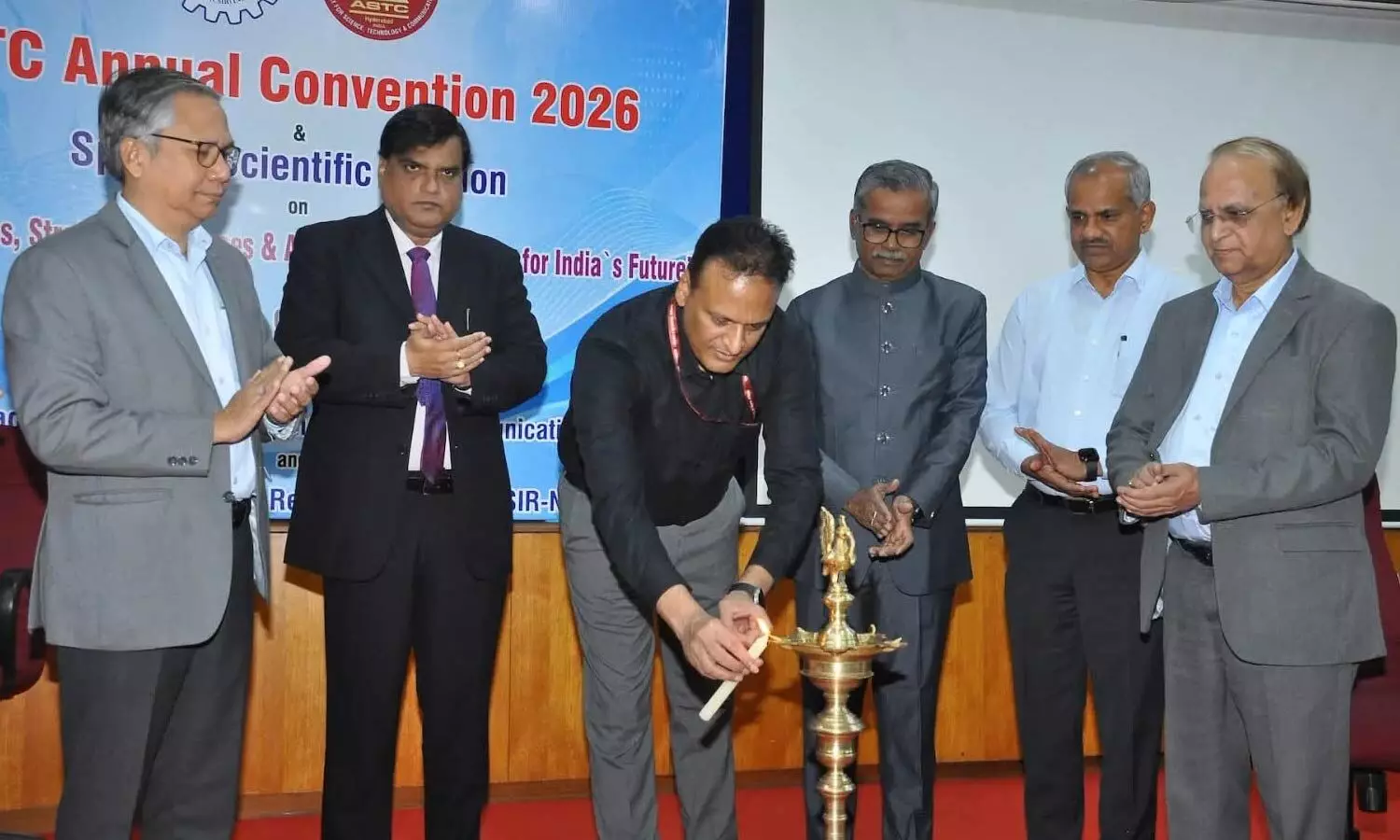
CSIR-NGRI and ASTC hold annual convention on earth sciences and strategic resources
The Academy for Science, Technology and Communication (ASTC), in collaboration with CSIR–National Geophysical Research Institute (CSIR-NGRI), Hyderabad, organised the ASTC Annual Convention 2026 and a special scientific session on “Earth Sciences, Strategic Resources and Advanced Technologies for India’s Future” at the CSIR-NGRI campus.
The convention brought together scientists, academicians and experts to discuss developments in Earth sciences, resource security, indigenous technologies and interdisciplinary research.
Welcoming the participants, Dr Prakash Kumar, Director of CSIR-NGRI, highlighted the role of scientific collaboration and advanced Earth science technologies in addressing national priorities and resource security.
Dr T. Srinivasa Kumar, Secretary, Ministry of Earth Sciences (MoES), Government of India, and chief guest, spoke about India’s progress in ocean forecasting and related technologies.
He referred to the Bharat Forecast System and its applications for fishing communities, noting that improved forecasts had enabled fishermen to achieve two to four times higher catches. He also highlighted the Samudra App and the need to translate scientific developments into public services.
Dr M. Ravichandran, Visiting Faculty at IIT Madras and former Secretary of MoES, emphasised interdisciplinary research and collaboration for the effective use and management of natural resources. He also discussed the importance of data availability in supporting scientific research and technological development. He presided over the release of the ASTC Communications Series.
The convention featured lectures by Dr U. Kamachi Mudali, Vice-Chancellor of Homi Bhabha National Institute, on India’s Heavy Water Programme and technological self-reliance, and Dr S. V. S. Narayana Murthy, Chairman and Managing Director of MIDHANI, on critical mineral resources and indigenous technologies. Dr Ch. Mohan Rao, Chairman of the ASTC Scientific Advisory Council, delivered the presidential address.
ASTC Honorary Fellowships were conferred on contributors to science, technology and communication.
The programme also included the release of a brochure on geothermal energy and public-awareness booklets on eye health and chronic kidney disease. The discussions covered the role of research institutions, data, technology and institutional partnerships in addressing resource-related and environmental priorities.
Hyderabad: Water wastage could burn a hole in citizens’ pockets
INDIA bloc against SIR to protect infiltrators: Amit Shah
Orange alert in 3 districts
Telangana Government releases Rs 125 cr for HMRL
TN govt disburses Rs 167.12 cr Deepavali bonus to over 1.06 lakh transport employees
AP Energy Department Goes on High Alert to Ensure Safety


