






- MMC chief puts Ghatkesar civic works on fast track
- Congress hits back at KTR over Sonia’s role in TG formation
- Sridhar Babu rolls out red carpet for Mumbai investors
- Telangana will oppose AP’s 1.8 TMC Nagarjuna Sagar water plan: Uttam
- BRS vows fight until all eligible get pensions
- GHMC sets target of 3,400 new Self-Help Groups
- GHMC to crack down on roadside dumping
- Kids below 12 can't use lifts alone in Maha
IIIT-Bangalore team develops AI tool to identify cases for early settlement
In Short
The team comprises Harshit Khattar, Aarush Gupta, Utkarsh Gupta and Adarsh Singh.

Share :
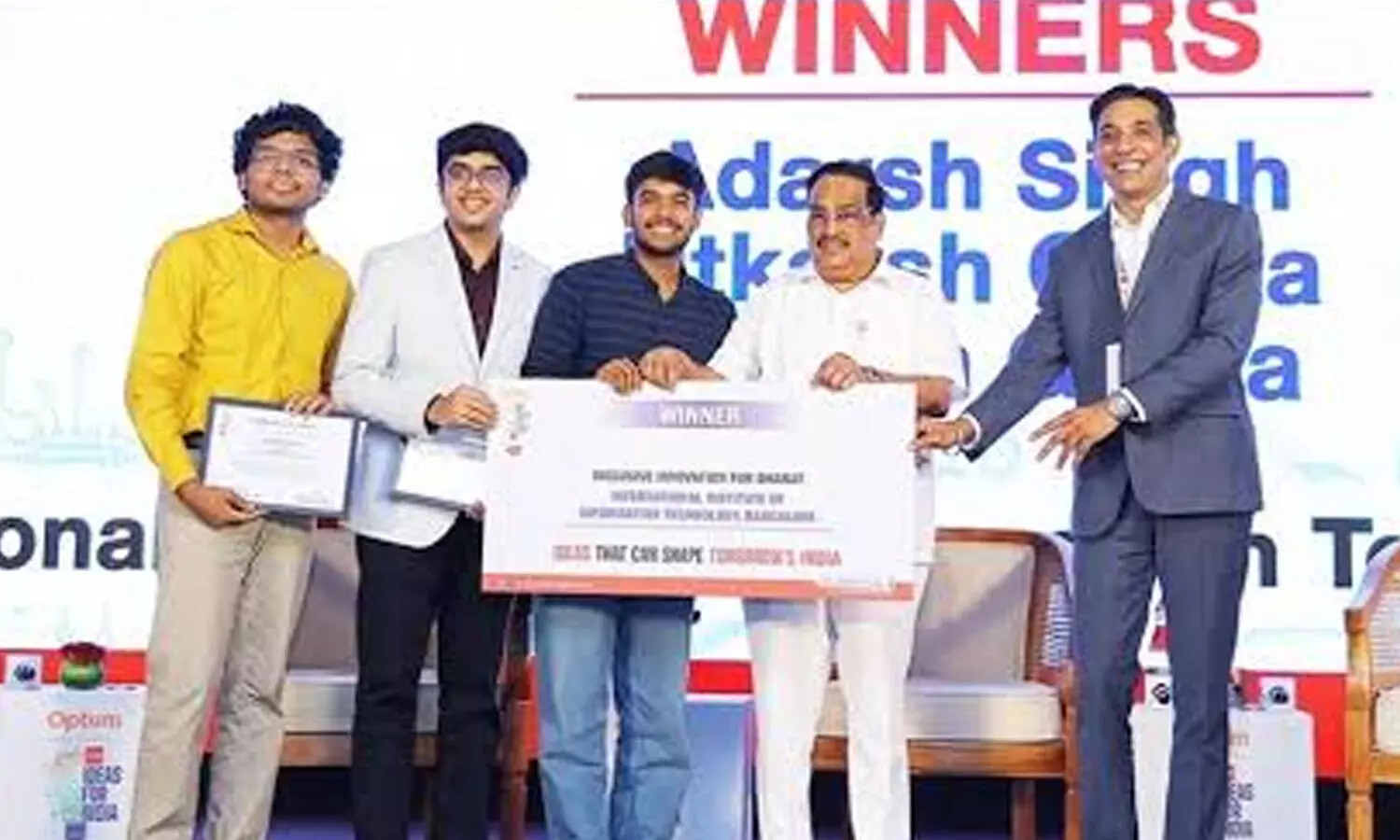
IIIT-Bangalore team develops AI tool to identify cases for early settlement
A team of four students from the International Institute of Information Technology Bangalore (IIIT-Bangalore) has won the Inclusive Innovation for Bharat track at the Ideas for India Innovation Challenge 2026 for developing Nyaya Setu, an artificial intelligence (AI)-based assistant designed to help identify pending court cases that may be suitable for early resolution through mediation or Lok Adalat.
The team comprises Harshit Khattar, Aarush Gupta, Utkarsh Gupta and Adarsh Singh. They received the award in New Delhi from Union Minister of Jal Shakti C. R. Patil.
The project addresses the large backlog of cases in India’s district courts, estimated at 4.99 crore. The students identified that some disputes could potentially be resolved through alternative dispute resolution (ADR) mechanisms rather than lengthy court proceedings. However, determining which cases are suitable requires examining their individual facts and legal circumstances.
Nyaya Setu uses AI-assisted case analysis to screen pending cases and identify those that may be appropriate for mediation or Lok Adalat. It also provides explanations for its recommendations. The platform combines an AI model with a rule engine that checks relevant legal provisions. The AI system does not override statutory requirements, and the committee retains the final decision-making authority.
Prof. Debabrata Das, Director of IIIT-Bangalore, said the project demonstrated how students could apply technical knowledge to challenges of public importance. He noted that Nyaya Setu explores the use of AI in judicial procedures while keeping legal requirements and human decision-making central.
Team member Aarush Gupta said the idea emerged from observing how disputes that could potentially be settled through mediation often remain in courts for years. He said the team wanted to develop a tool that could identify suitable cases and provide reasons for its recommendations.
Harshit Khattar said the platform aims to make alternative dispute resolution more accessible by providing transparent assessments rather than relying on an opaque automated system.
Utkarsh Gupta highlighted the technical learning involved in developing the platform, including working with large datasets and designing a system that combines AI-based screening with legal checks. Adarsh Singh said the project also gave the team experience in explainable AI and tools such as TreeSHAP, which help interpret model decisions.
The recognition highlights the application of student-led technology projects to challenges in public institutions. The team said its work focuses on exploring how AI-assisted analysis, legal safeguards and human oversight can support alternative dispute resolution and potentially contribute to more efficient judicial processes.


