




- BJP moves President Murmu for removal of Kerala PSC leadership
- Reid Hoffman reacts to US midterm results, takes aim at Elon Musk
- Rahul Gandhi’s Alcohol Remark, AAP’s ‘Pappu’ Jibe Turn Congress-AAP Rivalry Personal Ahead Of Punjab Polls
- 'Paper Leak Mafia' being run in Punjab under Kejriwal, CM Mann's directions, alleges BJP
- CM Adhikari approves compensation for farmers with homes damaged in recent floods
- From 'gun' bullets to bullet trains; Assam's unstoppable journey of progress, says CM Sarma
- Union Minister Pemmasani Chandrasekhar casts his Vote at Burripalem
- Bengal BJP plans to retain over 50 pc of old faces in Kolkata, Howrah civic polls
Lightning strikes on mangrove forests are helping create nursery habitats: WII
In Short
Lightning strikes in mangrove forests often result in the formation of small- to medium-sized canopy gaps, characterised by the death of trees in a circular pattern.

Share :
Wildlife Institute of India (WII)
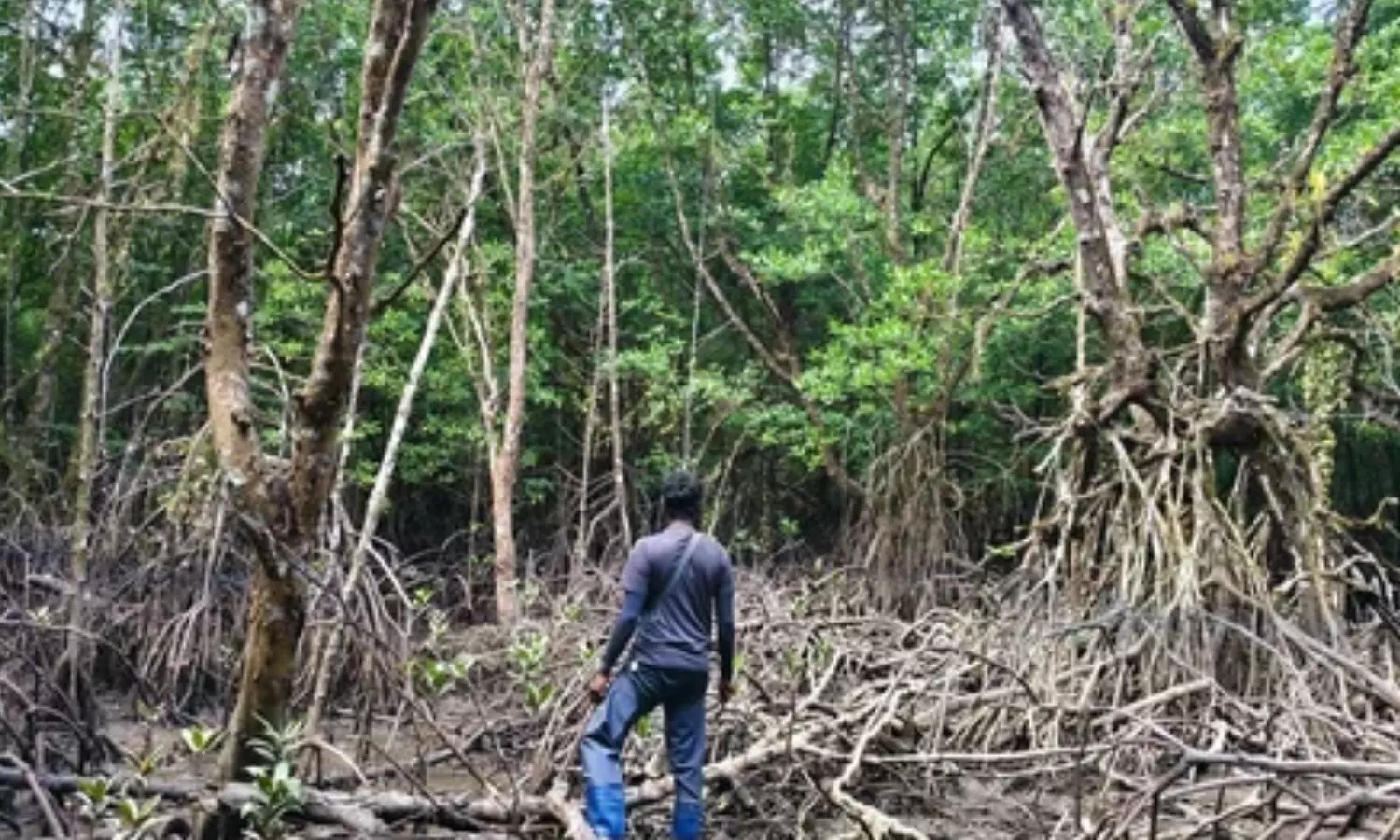
Kolkata: While lightning strikes can be deadly, they are crucial for maintaining large-scale demographic patterns in plant communities, the Wildlife Institute of India (WII) has ascertained through a study of the dense mangrove forests in the Andamans.
Lightning strikes in mangrove forests often result in the formation of small- to medium-sized canopy gaps, characterised by the death of trees in a circular pattern.
The study focused on understanding canopy gap attributes and vegetation compositional differences across the mangrove canopy gap succession in the Andaman Islands.
The hypothesis was that canopy gaps within the monodominant mangrove forests facilitate a greater number of species to establish in the early gap recovery stage.
The species richness declines over time as plants with special adaptations to thrive in the seaward mangrove zones outcompete others.
The study revealed that disturbances play a crucial role in determining species richness and composition in many ecosystems.
This small-scale disturbance is crucial for maintaining large-scale demographic patterns in the plant communities.
"We investigated canopy gap attributes and vegetation recruitment by assessing 20 canopy gaps in each of two age categories: New Canopy Gaps (1–6 years old) and Recovering Canopy Gaps (7–15 years old) across six sites in the Andaman Islands. Each canopy gap was paired with a control plot in the intact forest. Canopy gap area ranged between 270 m² and 2463 m². Water temperature increased with canopy openness, whereas water pH and salinity were not significantly influenced by the canopy gaps," the institute has said.
The study revealed that plant species richness was highest in newly formed canopy gaps and declined with an increase in gap age.
Both seedling and sapling densities were two-fold higher in the new canopy gaps than in the intact forest.
Rhizophora apiculata Blume, a tall stilt mangrove, was the dominant species in all sampling categories.
The study provided baseline information on the vegetation structural changes and species diversity among the regenerating canopy gaps and intact forests.
"Further, long-term canopy gap monitoring at varying size classes and fixed year intervals would provide crucial insight into mangrove canopy gap succession that helps in understanding mangrove recovery, following a disturbance event," the WII has said.
Previous studies have already revealed how the clustered death of trees in a contiguous closed-canopy forest creates an opening that exposes the forest floor to increased sunlight, altering local microclimatic conditions, such as light availability, temperature, soil moisture, and nutrient dynamics compared to the adjacent intact forests.
"Our study shows that the canopy gaps likely caused by lightning disturbance in mangrove forests are acting as a nursery habitat for plant regeneration and enhancing structural heterogeneity in the vegetation. It allows a greater number of plant species to establish in the early gap regeneration stage, but the species richness declines in the later gap successional stage, indicating competitive exclusion by dominant species, which are better suited to the specific microhabitats," the WII researchers have said.
The establishment of a canopy by the growing vegetation is likely to limit the light availability and hinder seedling establishment.
Such an understanding of vegetation recovery following disturbance is critical for ecological restoration planning in mangrove ecosystems, the study has said.
"Our results suggest that only a few species found in early successional stages persist into the mature stage. This highlights the need to select appropriate species for mangrove restoration that suit the specific microenvironment. Overall, canopy gaps within contiguous mangrove stands serve as a regeneration niche for vegetation and promote structural heterogeneity in the mangrove forest. Further, we suggest that the long-term monitoring of vegetation recovery in the canopy gaps would be required to understand the mangrove succession at a finer scale," the researchers said.
Lightning strikes on mangrove forests are helping create nursery habitats: WII
Odisha CM assures Ganjam residents of all possible support; meets Central team
Extension for ‘Agniveers’ draws mixed response: Welcome step for some, deception for others
South Africa's IEC urges calm as vote counting continues
AP MPTC ZPTC election Live Updates: Polling Under Way for parishad elections
Odisha CM assures Ganjam residents of all possible support; meets Central team
FS Misri calls on Nepal PM Balendra Shah ahead of his India visit
Congress appoints former MLA Baijnath Kushwaha as MP OBC Dept chief
Karnataka govt releases first drought relief instalment to farmers in time for Diwali; promises Rs 2,500 more soon
Hardeep Singh Puri elected unopposed to RS from MP v


