




- Rahul Gandhi expresses concern on reported deaths of tribal children in MP's Balaghat
- Tejasvi Surya seeks white paper on ₹5,500 crore spent on Bengaluru roads
- Gujarat CM stresses technology, tradition to prepare education system for future
- MSVP of Malda Medical College removed after 89 infant deaths in August
- Elon Musk Reignites Old Feud With Chess.com Over His Chess Skills
- Shivaji is a symbol of public governance with dharma, justice and self-respect
- Ram Gopal Varma And Sai Dharam Tej Send Their Best Wishes To Maremma Team
- Xbox to limit free cloud gaming hours starting in November
Andaman's Dive Season Reopens in October: What First-Time Divers in Havelock Should Know
In Short
Andaman’s dive season reopens in October. Discover what first-time divers should know before diving in Havelock, including the best time, safety tips, dive sites, and preparation.

Share :
Andaman's Dive Season Reopens in October: What First-Time Divers in Havelock Should Know
The southwest monsoon is pulling back from the Bay of Bengal, which for the Andaman Islands means the end of the slowest four months of the year. From October, dive centres across Swaraj Dweep, the island most travellers still call Havelock, reopen for a season that runs until May. Anyone planning a first dive this winter should be booking now.
Why October is the month that matters
Diving in the Andamans follows the weather rather than the calendar. Between June and September the southwest monsoon brings strong winds and rough seas, boat trips are cancelled at short notice, and visibility drops. From October the sea settles down.
Through the season, underwater visibility usually sits between 15 and 30 metres, and the water stays between 26 and 29 degrees Celsius, warm enough that most divers need nothing heavier than a thin suit. The peak runs from December to March, when conditions are steadiest and the islands are at their busiest. October and November fall in between, with clear water and far fewer people in it.
Administration figures put domestic arrivals in the islands above seven lakh in 2024, and a large share of them pass through Havelock, where diving is the main draw.
Most first-timers cannot swim, and that is not a problem
The question dive centres are asked more than any other is whether swimming is necessary. For anyone booking scuba diving in Havelock for the first time, the answer is no.
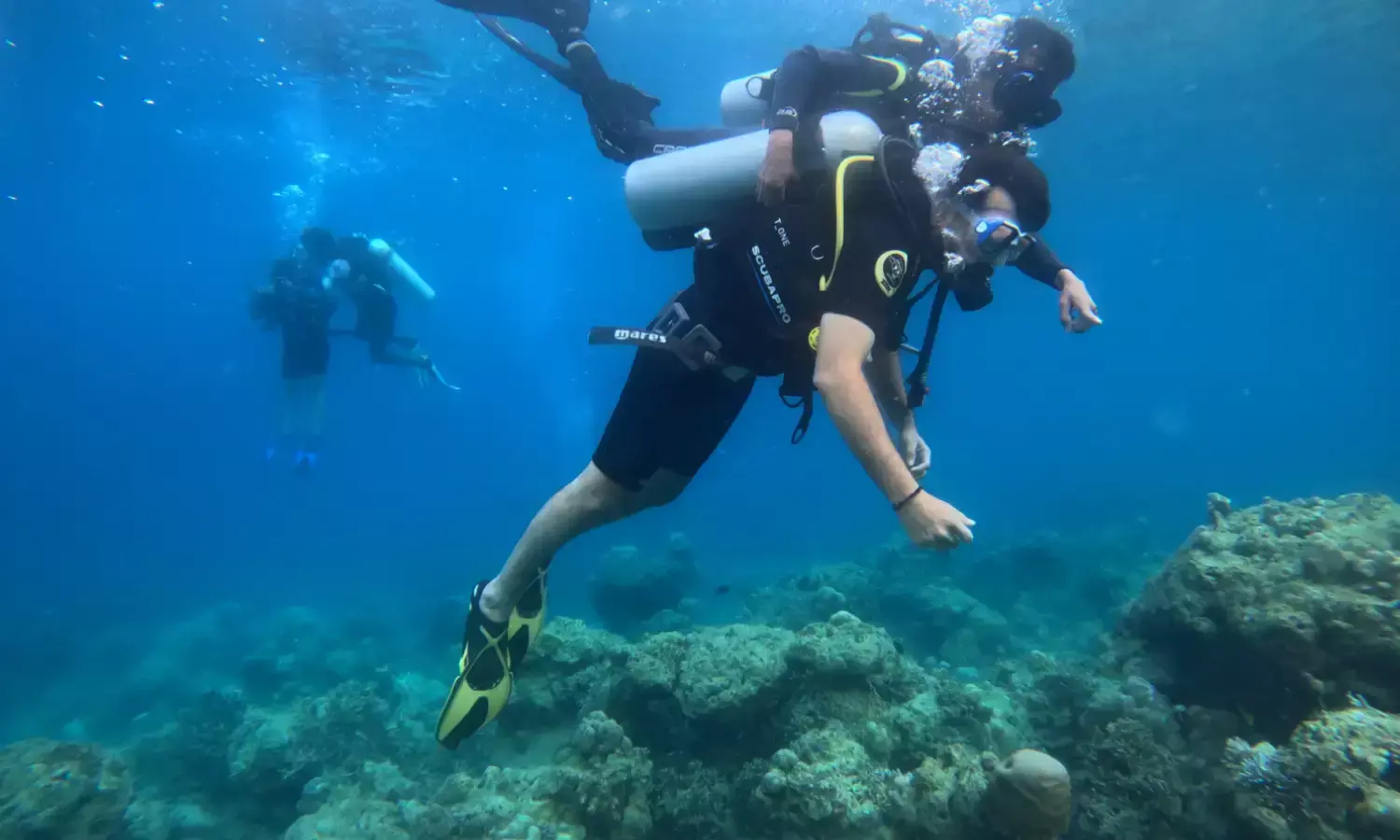
On an introductory dive the instructor stays alongside the guest throughout and handles the equipment and the buoyancy. The guest only has to breathe through the regulator. The depth is limited and the dive is short, and nobody goes near the reef before a briefing and a practice session in shallow water.
"Most people who come to us have never breathed underwater before, and a large number of them cannot swim," said Suchit, who runs Frogman Adventures at Govind Nagar on the island. "What decides whether the dive goes well is not swimming ability. It is the ratio. If one instructor is looking after one guest, that guest settles down in the first two minutes."
Shore dive or boat dive, and which beach
Beginners in Havelock have two broad options.
The shore dive is done from Govind Nagar beach, where a reef known locally as Nemo Reef lies close in. Divers walk in from the sand and the dive stays at around six metres. It suits nervous first-timers and anyone who would rather not sit in a boat. Younger children who meet the age limit usually start here as well.
Boat dives run to sites a short distance offshore, among them Red Pillar, Tribe Gate, Juvi's, Lighthouse, Slope, Turtle Beach and Aquarium. For beginners these are capped at about 12 metres. The coral is generally in better condition and the fish life is denser, which is why most operators will suggest a boat site to a guest who seems comfortable.
Elephant Beach, which a lot of visitors ask for by name, is mainly a snorkelling and watersports destination, so travellers who specifically want a scuba dive should confirm what is being sold to them before paying.
What it costs
Rates are broadly similar across licensed centres, and the difference usually comes down to how far the boat has to travel.
A shore dive at Nemo Reef starts at around Rs 2,500 per person. Boat dives run from about Rs 3,500 for the nearer sites to Rs 6,500 for the farthest ones, and these rates are quoted before GST. Already certified divers pay on a different scale, usually around Rs 3,000 for a standard site and Rs 5,000 for the deeper premium sites, where dives go to between 25 and 40 metres.
Travellers who want a certification rather than a single dive are in a different bracket. An entry level Raid Open Water course on the island runs over roughly four days and is priced at about Rs 28,000 before GST. Site-wise rates and scuba package details are published at official Scuba Diving in Havelock Price list
Age, health and the checks that actually matter
Most centres on the island take guests between 12 and 49 years for an introductory dive. Anyone between 49 and 60 is usually asked for a medical certificate. Heart and lung conditions, epilepsy, asthma and any ongoing ear or sinus trouble will normally rule a person out, and this is not a form to be filled in casually.
There is one more rule that catches travellers on a tight itinerary. A diver should not board a flight for at least 18 to 24 hours after diving, which means the last day on the islands is the wrong day to book a dive.
"People fix the flight first and think about the diving later, and then they ask us to make an exception," Suchit said. "We do not. The gap before flying is a safety limit, not a scheduling preference."
Booking as the season opens
A few things are worth settling before booking. Ask exactly which dive site is included, because the rate changes with how far the boat has to go. Take the earliest slot on offer, because the sea is usually calmest in the first half of the morning and the light underwater is better.
Book with the dive centre directly. Going through a hotel desk or a package agent adds a commission, and the operator who will actually take you out is often not named until you arrive. For December and January, book well ahead. The better centres fill up early.
October and November are the easiest weeks to go. The sea has settled by then but the season rush has not started, which means emptier boats and slots that are still available at short notice.
PM Modi interacts with National Teachers' Award winners; discusses innovative teaching, student confidence
V-P Radhakrishnan to visit Assam tomorrow, attend series of programs
Nara Lokesh attends Teachers Day event, says will conduct three more DSCs by 2029
CJI Surya Kant calls for healthy disagreement, deliberation at BRICS Chief Justices’ Forum
Maharashtra forms high-level panel to overhaul govt recruitment exam system
KTR Slams Congress Over Unfulfilled Promises to Telangana Youth


