






In a Bid to drive growth, job creation...AP focuses on 3 economic regions
In Short
- CM reviews 3 corridors, Rs 9 lakh-cr investment pipeline
- Visakhapatnam to emerge as ‘Bay-Tech City’
- Amaravati targets global quantum mfg hub
- Tirupati eyes semiconductor design leadership

Share :
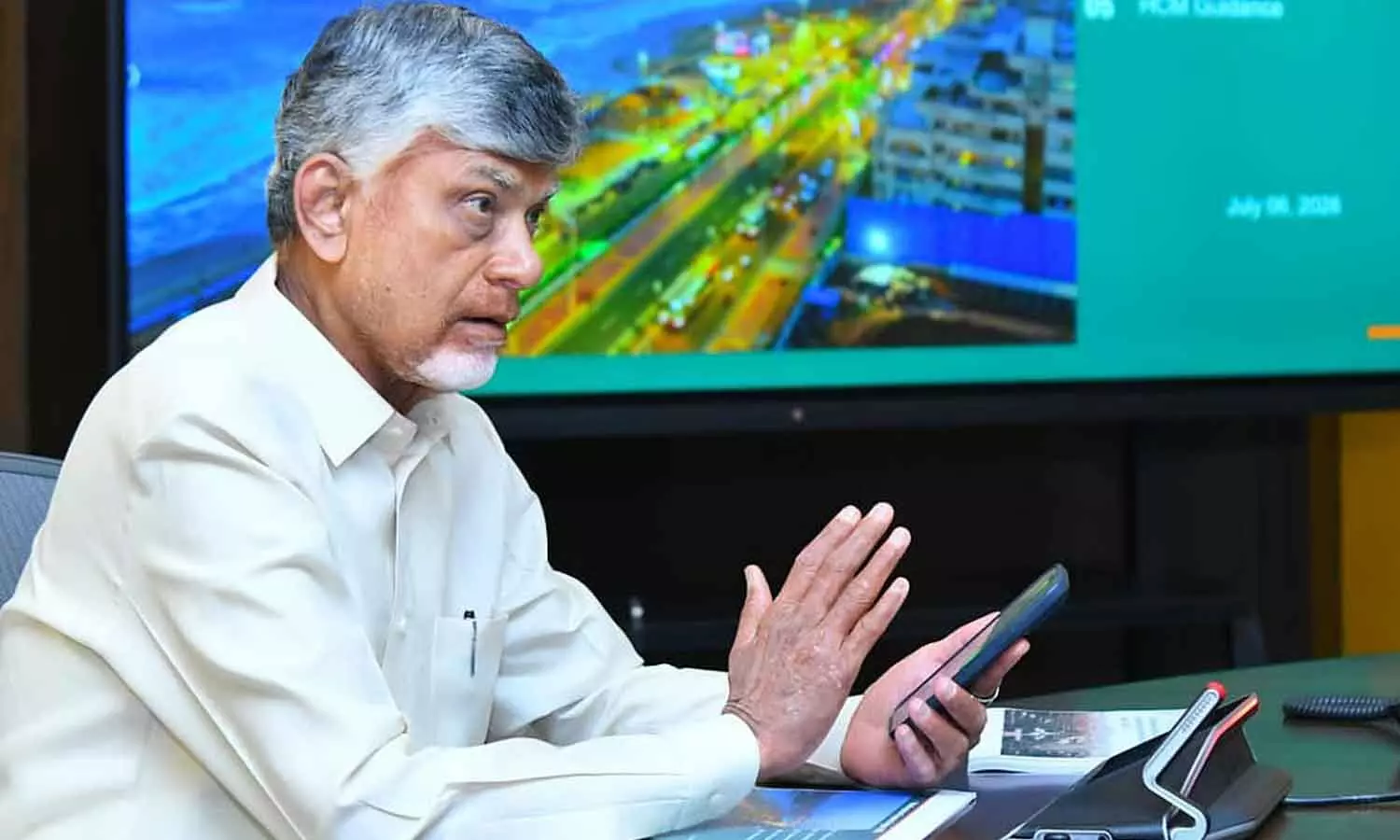
Chief Minister N Chandrababu Naidu
Amaravati: Andhra Pradesh is positioning three distinct economic regions as interconnected engines of industrial growth, with Chief Minister N Chandrababu Naidu seeking to convert an investment pipeline of nearly Rs 9 lakh crore into employment, higher household incomes and globally competitive industrial ecosystems.
At a review meeting on Thursday, Naidu examined the development blueprints for Visakhapatnam, Amaravati and Tirupati, directing departments to move beyond investment announcements and accelerate project execution.
His central objective was to ensure that industrial expansion translates into livelihoods, higher per capita income and improved living standards. He ordered dedicated dashboards to track investments, projects and implementation gaps, alongside periodic reviews and coordination among departments.
The most prominent proposal for the Visakhapatnam Economic Region (VER) is a new urban-industrial extension named 'Visakha Bay-Tech City', conceived on the lines of Hyderabad's Cyberabad. Of 167 projects identified across sectors, 64 are already under implementation. Naidu directed officials to build land banks around Vizianagaram and Anakapalli and explore similar arrangements in other industrially constrained districts through APIIC.
He also called for stronger port, airport and logistics connectivity, townships around industrial zones and completion of a convention centre within a year, with preparations to host the next CII Partnership Summit in Visakhapatnam.
The Tirupati region is being positioned as a technology, manufacturing and spiritual tourism hub. Naidu wants Tirupati developed as a global semiconductor design centre, supported by R&D facilities in electronics, space technology, robotics and drones. The Kopparthi, Tirupati and Lepakshi industrial clusters are to be strengthened, with 16 towns targeted for transformation into industrial cities.
Green energy accounts for the largest investment component, at Rs 5.70 lakh crore within the overall investment pipeline. The Chief Minister also identified rare earth minerals as a strategic opportunity, proposing a magnetic cluster, alongside a three-year action plan for a global horticulture hub.
The Amaravati Economic Region has 48 projects worth Rs 4.65 lakh crore under implementation. Naidu wants the capital region developed into a quantum corridor, encompassing a quantum valley and quantum manufacturing ecosystem. Better connectivity to Machilipatnam and Ramayapatnam ports, along with the Inner and Outer Ring Roads, is expected to support industrial expansion. Aquaculture, cocoa and palm oil remain important regional economic drivers.
Across all three regions, the Chief Minister stressed that large industries must be supported by networks of local MSMEs supplying components and services. He also proposed leading educational institutions as knowledge partners, including IIT for Tirupati and BITS Pilani for Amaravati, to strengthen industry–research collaboration.
Tourism forms another pillar, with plans for coastal resorts, eco-tourism at Araku and Lambasingi, master plans for Suryalanka and Gandikota, and a Buddhist circuit linking Nagarjunakonda and Amaravati. Naidu also directed execution of 60 projects worth Rs 9,180 crore under the Centre's City Economic Region scheme.
Akvan Impact: Rough Seas Force 80 Andhra Fishermen to Take Shelter in Odisha
Modi to India Inc: Chart 10-Year Roadmap to Make India a Viksit Bharat by 2047
Akvan hurtling to Odisha coast
Gadkari asks engineers to come up with proper DPRs
CM Revanth Reddy urges Gadkari to green light TG’s multiple road devpt projects
Rumblings in Congress over Raj Gopal Reddy’s outbursts


