






- Fire breaks out on Pacifica Hillcrest Apartments; no casualties reported
- AICC appoints Simon Alex Saran as Secy for Telangana
- Bengal govt initiates preparation for 2027-28 state budget, sets Nov 23 deadline for proposals
- PM Modi to inaugurate First SCO Civilisational Dialogue Forum in Delhi tomorrow
- 'Moily revealed that UPA-era allegations against PM Modi, HM Shah were politically motivated': BJP
- Boost wages to drive consumer demand, sustain growth momentum: Economic Affairs Secretary
- PM Modi Urges Ministers To Promote Savings, Says ‘Khao, Peeyo, Mauj Karo’ Not Part Of Indian Culture
- Rahul calls Indian democracy 'sick' in US; BJP says he is against India's democratic fabric
Gadkari asks engineers to come up with proper DPRs
In Short
“No new black spots should ever be created on our roads”

Share :
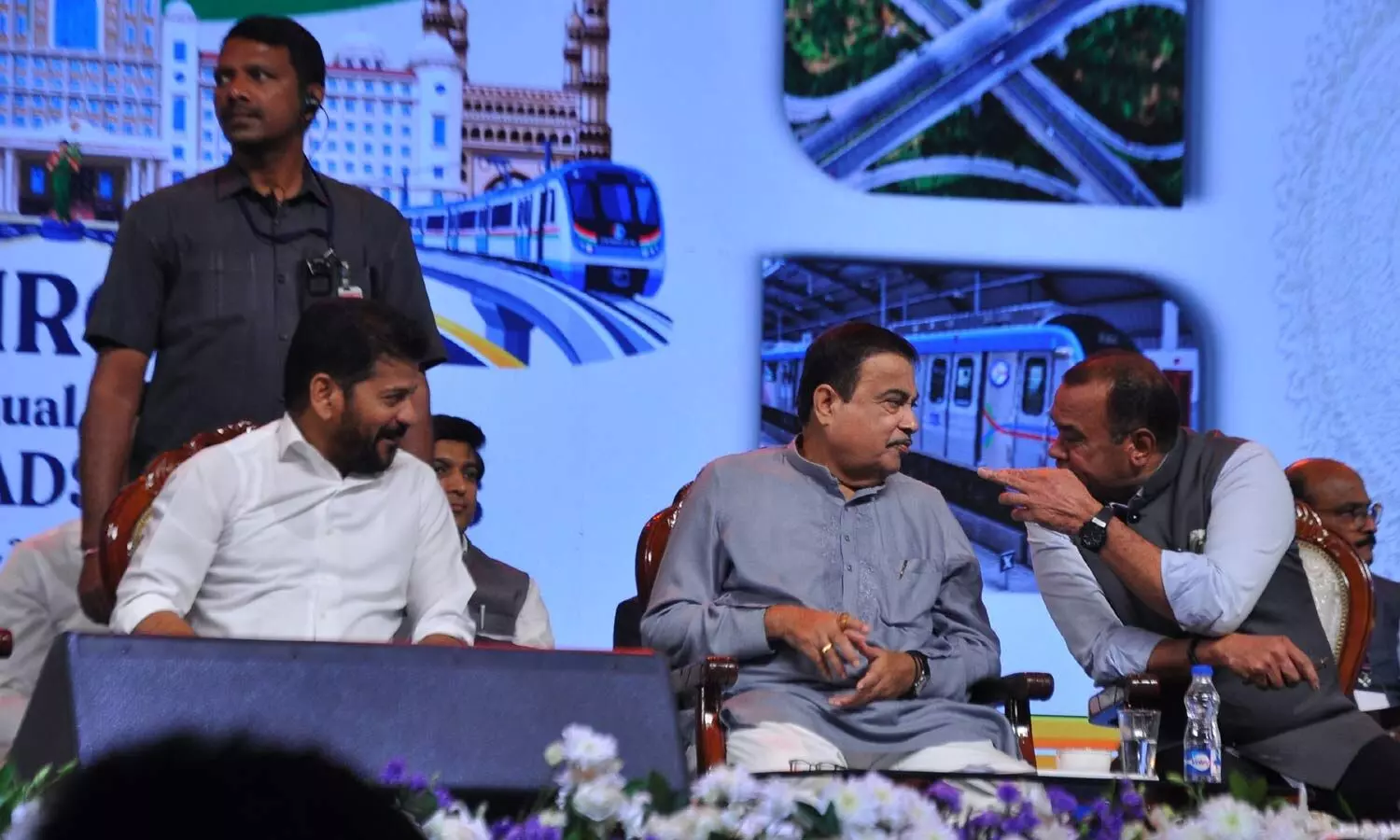
Union Surface Transport Minister Nitin Gadkari (centre) in conversation with Telangana Roads and Buildings Minister Komatireddy Venkat Reddy (right) and Chief Minister A Revanth Reddy (left) on the dais during the inaugural session of the 85th Indian Roads Congress at HITEX in Hyderabad on Thursday
Hyderabad: Union Surface Transport Minister Nitin Gadkari, expressing his concern over the rising number accidents on highways with “so many blackspots”, criticised the substandard Detailed Project Reports (DPRs) being submitted and wanted engineers to own the task of preventing black spots along the highways through better DPRs, junction designs, flyovers, underpasses, and safety audits.
The Union Minister, along with Chief Minister A Revanth Reddy and Transport Minister Komatireddy Venkat Reddy, inaugurated the 85th Indian Roads Congress 2026 at the HITEX convention venue in the city on Thursday.
Gadkari said that road safety was a critical and challenging issue. “We see five lakh accidents annually, resulting in 1,80,000 deaths and 66 per cent of those who perish are young people between the ages of 18 and 34. We have now begun work to improve 18 'black spots'. I feel deep sorrow and pain. At times, I am struck by a guilty conscience, feeling that, in a way, it is my fault. But I must ask- why do accidents occur on these roads? How are the DPRs prepared? Often, they are not well-crafted. I regret using this term, but the contract for the DPR is awarded to the 'lowest bidder' whoever quotes the lowest price gets the job,” said Gadkari.
The Union Minister said that his ministry had put an end to this 'lowest bidder' system, and added that in future he would hold those responsible accountable.
“How many lives are being lost? I speak with such intensity because, in many ways, we have created these black spots simply because we lack a sense of 'ownership'. Why don't we consider that, tomorrow, it could be our own child involved in an accident? Our goal must be to save lives through road safety; no new black spots should ever be created on our roads. I urge every engineer to take full ownership of their work. I implore you with folded hands—to take this seriously,” the Union Minister observed.
The minister urged engineers to keep upgrading. It is often said that knowledge relevant today may not remain so tomorrow. Knowledge is a continuous process, constantly evolving through ongoing research. He suggested the construction sector look for alternative materials. If a monopoly develops over certain materials, suppliers may form a cartel and keep driving up prices.
Gadkari said that his ministry had adopted a very strict stance regarding national highways. “Action has been taken against many contractors because, ultimately, these assets belong to the people of India. We are merely their trustees. If the work is not executed properly, it would essentially amount to a betrayal of the public trust. Therefore, I must emphasise that our roads, bridges, and tunnels form the backbone of our infrastructure,” said Gadkari.
Referring to a three-trillion-dollar economy, Gadkari said that Prime Minister Narendra Modi also envisions India becoming the world’s third-largest economy by 2027 and to achieve this, the most critical elements were the development of infrastructure, water, power, transport, and communication.
He assured all possible help to Telangana. He said that an 'Atmanirbhar Bharat' cannot be realised without the development of villages, carrying along the poor, laborers, and farmers.
He asked the engineers not to stop at merely drafting documents. He said that their policy focuses on solutions that were import-substituting, cost-effective, pollution-free, and indigenous.
“We currently import fossil fuels worth Rs 22 lakh crore. Imagine the transformation that could take place if this Rs 22 lakh crore were to reach our villages,” he said. He said that Indian road network was number one in the world.
Akvan Impact: Rough Seas Force 80 Andhra Fishermen to Take Shelter in Odisha
Modi to India Inc: Chart 10-Year Roadmap to Make India a Viksit Bharat by 2047
Gadkari asks engineers to come up with proper DPRs
CM Revanth Reddy urges Gadkari to green light TG’s multiple road devpt projects
Rumblings in Congress over Raj Gopal Reddy’s outbursts
CM Revanth Reddy blasts KCR, Harish for AP pacts


