




- ‘Kalki’ sequel regular shoot to begin in Oct, targets mid-2027 wrap
- ‘Kaaka’ dubbing commences; getting ready for Sankranti release
- Aakash Jagannadh launches ‘Chakkora - Lunar Love Bird’ trailer
- ‘Konda Kona’ of ‘Garividi Lakshmi’ grabs attention
- ‘Premane Oorilo’ locks Oct 2 release
- Beyond the USA pill: How Indian pharma quietly reinventing itself
- Technology, spirituality and the search for human balance
- The Eagle’s Sky
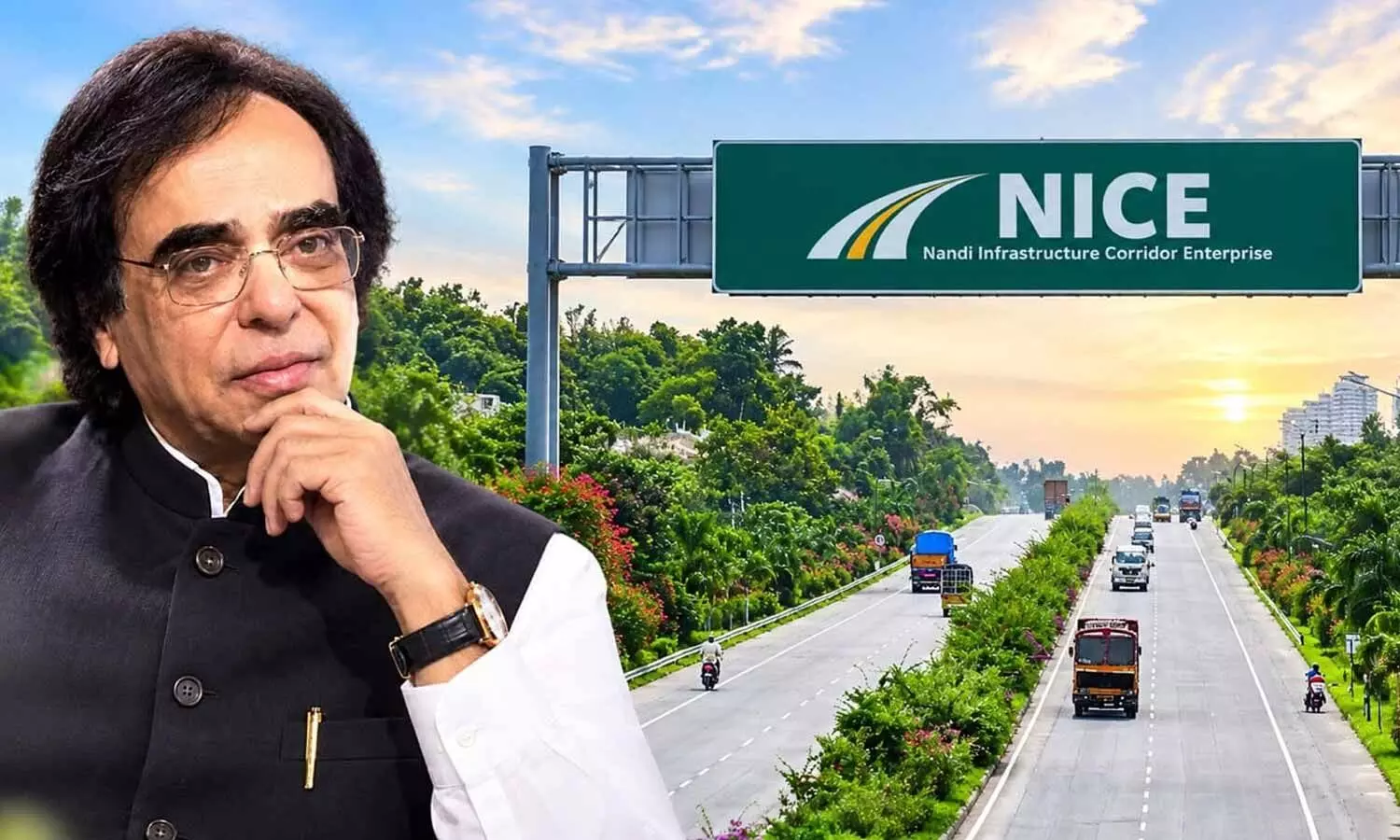
Thirty Years, Three Courts, and the Paper Trail Behind Bengaluru’s NICE Road Battle
In Short
The decades-long controversy over Bengaluru’s NICE Road has resurfaced amid fresh political attacks. An examination of government records, court rulings, toll agreements, land acquisition documents, and Supreme Court judgments reveals a complex legal and administrative history behind Karnataka’s most litigated infrastructure project.

Share :
Thirty Years, Three Courts, and the Paper Trail Behind Bengaluru’s NICE Road Battle
Bengaluru: Karnataka’s most heavily litigated infrastructure project has once again erupted into a high-decibel political controversy. Union Minister H.D. Kumaraswamy has publicly urged motorists to bypass toll plazas without paying, while former Prime Minister H.D. Deve Gowda has written to the Chief Minister demanding the immediate revocation of toll rights. A political campaign titled "Nothing NICE" has been launched online, and a recent Karnataka High Court ruling characterized the project as one of the state's biggest scams.
Yet, an examination of thirty years of primary records including government orders, cabinet committee proceedings, official gazette notifications, and state and supreme court judgments—presents a far more complex narrative than current political campaign rhetoric suggests.
The Original Blueprint
In the early 1990s, travel between Bengaluru and Mysuru was severely congested, with the existing highway taking up to four hours to navigate. Lacking public funds to construct a high-speed corridor, the Karnataka government invited private participation under a Build-Own-Operate-Transfer (BOOT) framework. The original blueprint conceived an ambitious integrated transit corridor: a 111-kilometer expressway connecting Bengaluru and Mysuru, a 41-kilometer peripheral ring road around Bengaluru’s southern edge, a link road, and five designated townships to make the capital-intensive project commercially viable.
The foundational Memorandum of Understanding was signed on February 20, 1995, in the presence of the Governor of Massachusetts and then-Chief Minister H.D. Deve Gowda. Following cabinet reviews, a formal Government Order was issued in November 1995, culminating in the master Framework Agreement signed on April 3, 1997. Today, only a fraction of that vision stands built: the 41-kilometer peripheral road, part of the link road, and a minor 5-kilometer stretch of the expressway. This operational stretch is what commuters today call "NICE Road."
The Fraud Allegations in Court
Allegations that the project served as a cover for real estate speculation rather than public infrastructure are not new. They have been litigated across three distinct court proceedings over two decades.
In 1998, the Karnataka High Court upheld the Framework Agreement and declined to order a CBI probe. In 2005, the High Court went further, ruling that state claims of fraud were false and contradicted the government's own prior records. The court ordered the state to implement the project expeditiously and directed the prosecution of two senior state bureaucrats for filing false affidavits.
In 2006, the Supreme Court affirmed the High Court’s findings in State of Karnataka v. All India Manufacturers Organisation. The apex court described the government’s fraud argument as "utterly dishonest," noted that political leadership transitions appeared to drive the sudden shift in state stance, and fined the state government ₹5 lakh for frivolous litigation.
Political Origins and Defamation Proceedings
Court records trace the origin of the political campaign against the road back to 2004, when Deve Gowda publicly characterized the project as a charade. Days later, his son H.D. Revanna, serving as Public Works Minister, issued an internal note freezing further land acquisition. The Supreme Court highlighted this sequence in its 2006 judgment, calling it strange that the administration raised fraud concerns seven years after signing the master contract following a political transition.
Following televised statements in 2011, Nandi Infrastructure Corridor Enterprises (NICE) filed a civil defamation lawsuit. In 2021, a Bengaluru civil court awarded NICE ₹2 crore in damages and issued a permanent injunction against repeating the statements. On appeal in February 2022, after Deve Gowda submitted a sworn undertaking promising not to make defamatory statements pending appeal, the High Court stayed the financial penalty. That appeal remains pending before the High Court.
The Toll Mechanics
The legal basis for toll collection is one of the central disputes in the current boycott call. However, public records confirm that toll rights were established under a Toll Concession Agreement signed on September 4, 2000, between NICE and the Governor of Karnataka.
The contract fixed 1998 base rates and permitted an annual compound rate increase of up to 10 percent. Every subsequent toll revision has been authorized and published through official Karnataka Gazette notifications issued by the Public Works Department in the Governor's name. Re-calculating the notified rates for 2008, 2010, and 2011 against the 1998 baseline confirms that all actual rates matched or fell slightly below the maximum 10 percent cap.
The toll notifications were also challenged in court. A 2009 public interest petition was dismissed after state counsel informed the High Court that NICE had built the road according to contract terms. The Supreme Court upheld this dismissal in 2011.
Land Allocation Numbers
Public statements frequently claim that NICE holds 13,000 acres of excess land. Government committee minutes show a different breakdown regarding land handovers.
At a review meeting chaired by then-Chief Minister B.S. Yeddyurappa in November 2009—called after the Supreme Court initiated contempt proceedings against the state for non-implementation—official records noted that out of roughly 20,000 acres envisaged for the overall project, only 7,124 acres had been handed over to NICE, while 13,609 acres remained undelivered.
While a 2010 state government affidavit recorded a 554-acre local excess on the peripheral road stretch specifically, the same filing recorded a 13-acre shortfall on the link road and 537 acres of promised government land that had never been delivered to the company.
Compensation and Incentive Plots
Under statutory acquisition rules, compensating landholders is the legal obligation of the state acquisition agency, the Karnataka Industrial Areas Development Board (KIADB), while NICE is required to fund the acquisition. KIADB records demonstrate that NICE deposited ₹359.99 crore across 16 separate installments between January 2003 and May 2025.
Beyond monetary compensation, a Deputy Commissioner-led committee agreed in 2003 to provide consenting landowners with a free developed residential site as an incentive. In March 2023, NICE submitted plans to construct roughly 480 incentive plots near a road interchange in Kengeri. The state planning authority rejected the application, citing a 2020 Supreme Court ruling that limits residential developments—including incentive plots—strictly to the five designated townships, rather than traffic interchanges. The state also noted in correspondence that the incentive scheme was an ex-gratia commitment rather than a statutory entitlement under the original 2001 package.
Why the Expressway Remains Unbuilt
Critics frequently point out that only 5 kilometers of the planned 111-kilometer expressway has been constructed after 25 years. State proceedings document that unfulfilled land delivery was the primary driver of this delay. Land acquisition was frozen by administrative notes in 2004, delayed further during alignment modifications in 2010, and stalled when price-fixing meetings for 1,916 acres near Bidadi were abandoned due to local protests in April 2010. Separately, the Bangalore Development Authority’s designated portion of the peripheral ring road saw no construction over two decades.
Context of the July High Court Order
The July High Court ruling arose from petitions filed by specific landowners whose land had been notified for acquisition between 1998 and 2009, but for whom no compensation awards had been finalized. The court's specific legal finding was that keeping acquisition notifications in limbo for over two decades without disbursing compensation violated constitutional protections, causing those specific acquisitions to lapse. State counsel acknowledged in court that physical possession of these specific plots had never been handed over to NICE.
While the bench made sweeping observations characterizing the project as a scam, those general remarks exist alongside earlier Supreme Court rulings in 2006, 2009, and 2011 that validated the core contracts and toll rights. Unless modified on appeal by the Supreme Court, the High Court's July ruling stands as the legal standard for the specific land parcels involved.
KTR Pays tribute to Konda Laxman Bapuji, hails his contribution to Telangana movement
Thirty Years, Three Courts, and the Paper Trail Behind Bengaluru’s NICE Road Battle
PM Modi highlights Modhera’s resilience, from Sun Temple destruction to India’s first solar village
2016 Surgical strike showcased India’s anti-terrorism policy to world: PM Modi in 138th episode of 'Mann Ki Baat'
Rains subside in Chinturu Agency, flood relief underway
Karur Stampede Anniversary: CM Vijay Remembers 41 Victims, Says Pain Has Not Faded
Godavari breaches 40-feet mark at Bhadrachalam
Students From LPU Vandalise Campus After Unverified Gang-Rape, Suicide Rumours; Police Deny Claims
AP, Telangana to receive rains amid low pressure area in Bay of Bengal
Tamil Nadu: Karur marks first anniversary of crowd crush that killed 41


