






Hyderabad public transport hobbled by last-mile connectivity hitch
In Short
Buses, Metro and MMTS connect major hubs, but uneven frequency and poor residential access leave significant gaps in the city’s transport network

Share :
Hyderabad public transport hobbled by last-mile connectivity hitch
Hyderabad: As Hyderabad continues to expand, connecting its growing residential neighbourhoods, workplaces and commercial hubs has become one of the biggest challenges for urban mobility.
The city's three major public transport systems --buses, Metro Rail and Multi-Modal Transport System (MMTS) --play a crucial role in keeping the city moving. Together, these networks provide thousands of commuters with affordable and accessible travel options while offering an alternative to private vehicles.
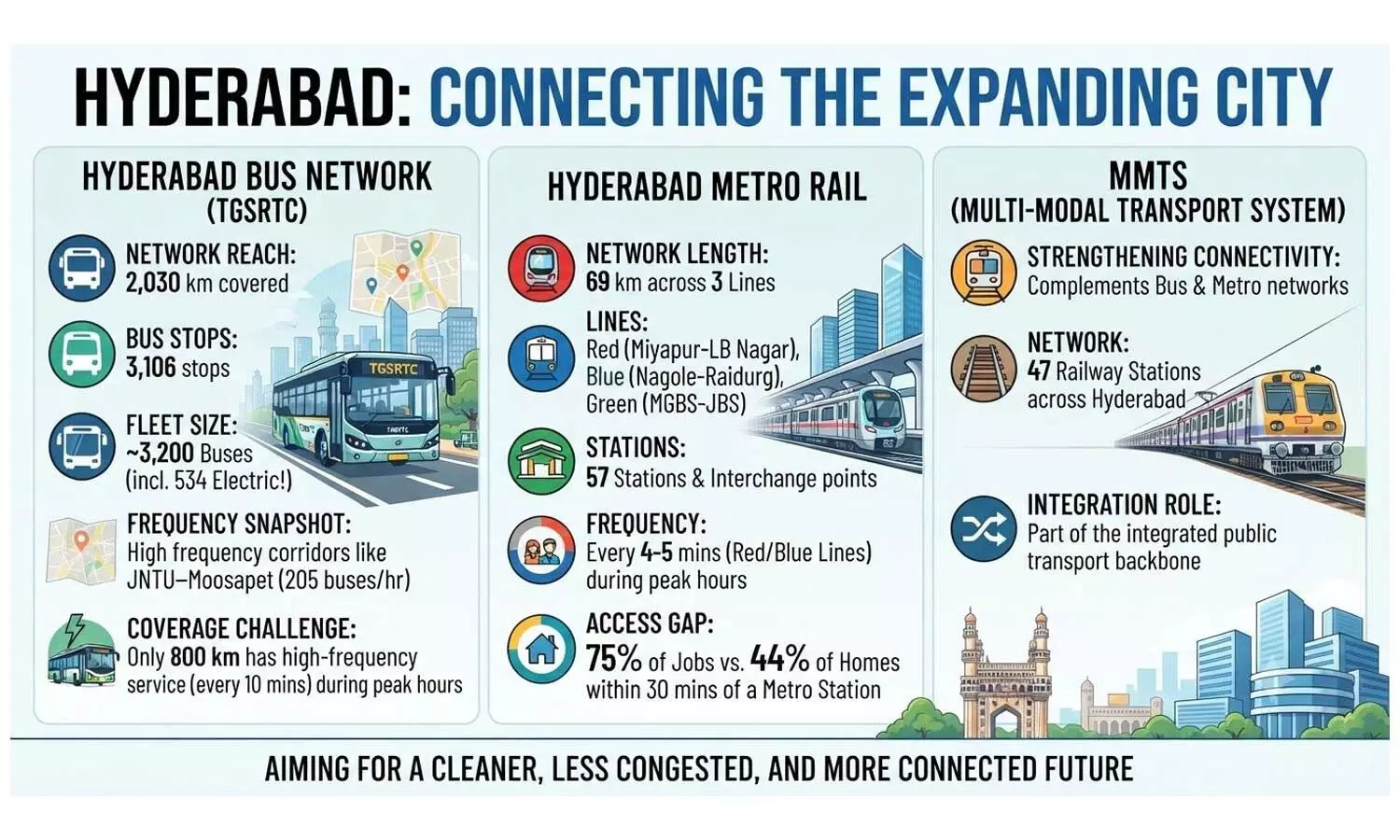
Hyderabad's Core Urban Region (CURE) has an extensive bus network spanning 2,030 km, with 3,106 bus stops and 1,152 routes listed in the Telangana State Road Transport Corporation (TGSRTC) timetable.
The network covers several parts of the city, connecting residential, commercial and important locations. However, the distribution of bus services and their frequency vary across different areas.
The city operates around 3,200 buses through 27 depots, including 534 electric buses, while the remaining fleet is mainly diesel-powered. The growing presence of electric buses reflects the importance of moving towards cleaner and more sustainable public transport.
Bus services operate along 30 major corridors, with an average of one bus passing every minute. The JNTU–Moosapet corridor records the highest frequency, with 205 buses an hour, followed by Chilakalguda–Tarnaka with 204 and Patancheru–Chandanagar with 196 buses an hour. In contrast, Thirumalgiri–Lakudawala records the lowest frequency at 57 buses an hour, highlighting the differences in service availability across the city.
Despite the extensive network, frequent services remain limited. Of the total 2,030 km bus network, only 800 km has at least one bus every 10 minutes during morning peak hours. Bus services are concentrated mainly in central Hyderabad, while several outer areas have fewer frequent services. This underlines the need to strengthen bus frequency and improve last-mile connectivity.
Hyderabad Metro Rail is another important pillar of the city's public transport system. Covering 69 km with 57 stations across three lines, the Metro connects several major parts of the city. The Red Line runs between Miyapur and LB Nagar, the Blue Line connects Nagole with Raidurg, and the Green Line operates between MG Bus Station and JBS Parade Ground.
Metro trains run every 4–5 minutes on the Red and Blue lines, while the Green Line operates at 12-minute intervals between 7 am and 10 am. The network also has interchange stations that allow passengers to change lines and reach different destinations. The MMTS network, with 47 railway stations, further strengthens public transport connectivity across Hyderabad.
However, access to Metro services remains uneven. Around 75% of jobs in Hyderabad are located within a 30-minute reach of a Metro station, while only 44% of homes have similar access. This means workplace connectivity is considerably better than residential connectivity, leaving more than half of the city's residential areas without convenient access to a Metro station.
Together, the bus, Metro and MMTS networks form the backbone of Hyderabad's public transportation system.
The challenge now is to improve service frequency, extend connectivity to residential neighbourhoods, increase electric buses and integrate different transport systems. Better last-mile connections and reliable services can encourage more people to choose public transport over private vehicles, helping Hyderabad move towards a cleaner, less congested and more connected future.
State Election Commissioner hails peaceful GP polling
NDA-backed candidates sweep GP 1.0 elections
Jain family donates 121-kg studded gold jewels to Lord Balaji
No differences between JD(S), BJP; NDA to field consensus candidates in Karnataka bypolls: Kumaraswamy
Record turnout endorsement of honest govt, says Punjab CM at Moga rally
Maharashtra proposes ‘Vertical Property Cards’ to establish uniform ownership records for flats


