




- Indian-Origin Nithya Raman Wins Los Angeles Mayoral Election, Defeats Incumbent Karen Bass
- Don't Destroy Traders' Livelihoods for Political Gains: Live and Let Live
- Canva lays off 1,271 employees, offers 6 months' salary and free MacBooks
- Two killed in explosion at gunpowder manufacturing unit in Rajasthan's Nagaur
- TGSRTC Plans Special Buses to Sabarimala during pilgrim season
- Congress MP Akoijam gets relief as Delhi court bars coercive action without 7-day notice
- Google Offers Voluntary Exit Packages to Employees in Five Countries
- AP ZPTC MPTC election: Voter Turnout of 4.8% recorded by 9am
24-hour deadline to produce accused before Magistrate runs from actual detention, not formal arrest: SC
In Short
The Supreme Court ruled that the 24-hour deadline to produce an arrested person before a Magistrate starts from actual detention, not the formal arrest time recorded by police.

Share :
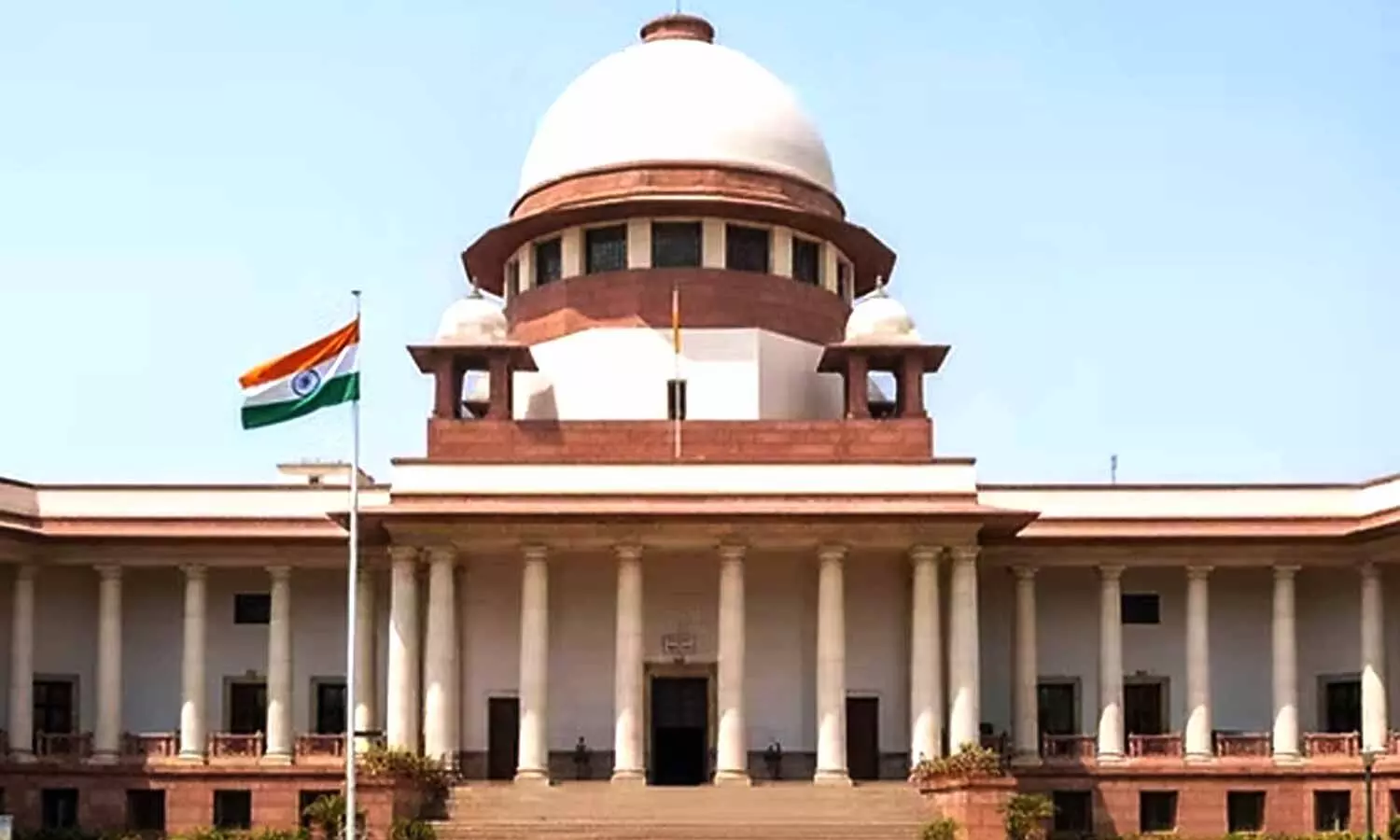
Supreme Court of India
New Delhi: The Supreme Court has ruled that the 24-hour constitutional deadline for producing an arrested person before a Magistrate begins from the moment of actual detention, when the person's liberty is curtailed, and not from the time of formal arrest recorded by the police.
The judgment came on appeals filed by four persons challenging a Tripura High Court decision denying them bail in a case registered under the Narcotic Drugs and Psychotropic Substances (NDPS) Act.
A Bench of Justices Ujjal Bhuyan and Atul S. Chandurkar held that the period of 24 hours prescribed under Article 22(2) of the Constitution must be calculated from the date and time when a person is actually detained, and not from the time when the investigating agency formally records the arrest.
Article 22(2) mandates that every person arrested and detained in custody must be produced before the nearest Magistrate within 24 hours of arrest, excluding the time necessary for the journey from the place of arrest to the court. It further prohibits detention beyond this period without the authority of a Magistrate.
Rejecting the distinction between detention and formal arrest for computing the constitutional deadline, the Justice Bhuyan-led Bench said that treating the period of 24 hours as commencing only after the completion of search and seizure and from the time of arrest formally recorded by the arresting authority was "not only unsustainable in law but is entirely unconstitutional".
The Supreme Court further clarified that if a person's detention continues beyond 24 hours without production before a Magistrate, the person must be released forthwith. It said that while computing the period, no time can be excluded except that which is necessary for the journey from the place of arrest to the Magistrate's court.
The Justice Bhuyan-led Bench also stressed that compliance with the 24-hour constitutional limit alone would not automatically justify detention, as the investigating agency must ensure that the period of custody remains reasonable under Section 58 of the Bharatiya Nagarik Suraksha Sanhita (BNSS).
Section 58 of the BNSS provides that a police officer cannot detain a person arrested without a warrant for longer than is reasonable under the circumstances of the case, and, in the absence of a special order of a Magistrate, such detention cannot exceed 24 hours, excluding the necessary journey time.
The apex court said that a Magistrate, at the time of production of an accused, is duty-bound to record the actual date and time when the person's liberty was curtailed and independently examine whether the constitutional deadline has been complied with.
It further held that even where the detention is within the 24-hour period, the Magistrate must examine whether the duration of custody was reasonable in the circumstances of the case. If the Magistrate finds that the detention has exceeded a reasonable period, he may decline to authorise further remand.
Setting aside the Tripura High Court's judgment, the Supreme Court directed that the appellants be released on bail, subject to conditions imposed by the Special Court.
Bihar woman approaches police after panchayat attempts to broker compromise with rapist in Araria district
Three-storey building collapse in Delhi's Chawri Bazaar; many feared trapped
Two killed in building collapse in Delhi's Chawri Bazaar
ECI Removes SIR Declaration From Online Form 6 After Objections By Two Election Commissioners


