




- BSF, cops raid house belonging to transgender community member in north Bengal's Jalpaiguri
- Vande Mataram row: Cong slams Nitin Nabin over remarks against Rahul Gandhi, BJP backs party chief
- PM Modi invites global partners to join India's next space frontier at Paris summit
- ‘Exemplary performance’: Ganguly congratulates Kishan-led East Zone on Duleep Trophy triumph
- Red Fort Blast: NIA Chargesheet Says Lal Mandir Was Bomber’s Original Target
- Pic Talk: CM Revanth Reddy Also Joins The 80s Trend
- Assam has changed meaning of govt schools with Adarsha Vidyalayas: Himanta Sarma
- Under-construction bridge launcher crashes in Bihar, rescue efforts underway
SC Notice on Plea Seeking Pension, Social Security for Private School Teachers
In Short
The Supreme Court has sought responses from the Centre and states on a plea seeking a national policy and statutory framework to ensure welfare, social security, pension, and post-retirement benefits for private school teachers across India.

Share :
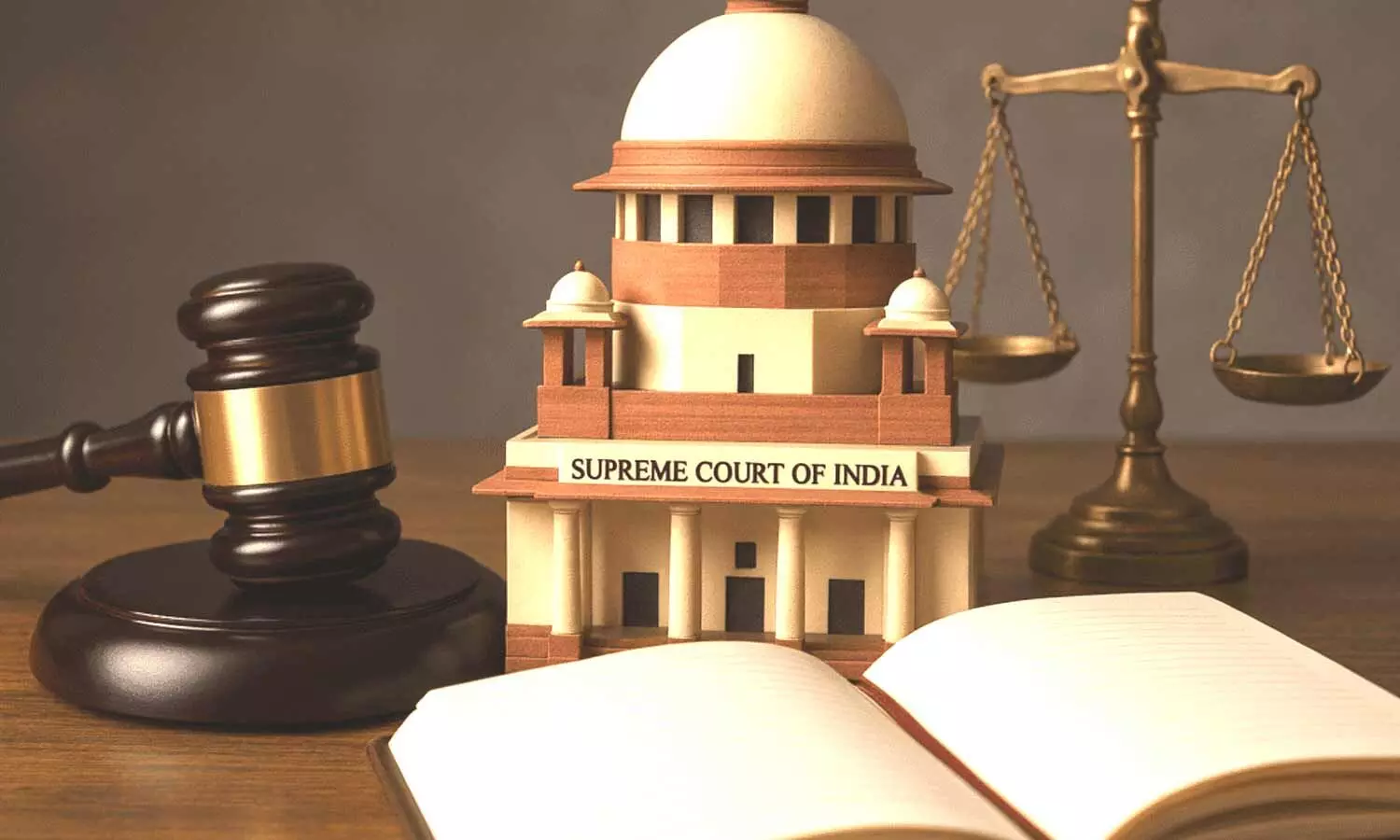
Supreme Court of India
New Delhi: Supreme Court would hear a petition filed by Kerala based petitioner Ligimol George who seeking direction to Centre to formulate a comprehensive national policy and appropriate statutory framework for ensuring the welfare, social security and post-retirement protection of private school teachers in the country. The bench posted the petition, filed by Kerala-based petitioner Ligimol George, for hearing after four weeks.
A bench of Justices Vikram Nath and Sandeep Mehta issued notice to the Centre, all states and Union Territories and others, including the National Council for Teacher Education, seeking their responses on the plea.
The plea, also sought a direction to the Centre to consider establishing a national private school teachers welfare board or other appropriate institutional mechanism for coordinating, implementing and monitoring uniform welfare measures, including pensionary benefits, provident fund and gratuity compliance, and an effective grievance redressal mechanism for private school teachers.
According to the petitioner, the plea raises an issue of national importance concerning the absence of a comprehensive national framework for the welfare, social security and post-retirement protection of teachers employed in recognised private educational institutions across the country. The petitioner said that these teachers, despite playing a vital role in the education system, lack uniform statutory safeguards and adequate social-security measures post-retirement.
The plea referred to the data published by the Ministry of Education under the Unified District Information System for Education Plus (UDISE+).
It said the UDISE+ 2023–24 report records that India has approximately 14.72 lakh schools, over 98 lakh teachers and nearly 24.8 crore students.
"Significantly, 37,30,047 teachers are employed in recognised private unaided schools alone, constituting a substantial segment of the national teaching workforce," the plea said.
It said that despite their indispensable contribution in implementing the constitutional mandate under Article 21A, there exists no dedicated national statutory welfare mechanism or comprehensive institutional framework exclusively addressing their welfare and post-retirement social security.
"The continuing legislative and policy vacuum has resulted in arbitrary disparities between teachers performing substantially identical educational functions across different states and institutions," it said.
The plea said despite discharging the vital public function of imparting education and contributing to the realisation of the constitutional mandate under Article 21A of the Constitution, these teachers continue to remain "deprived of a comprehensive, uniform and effective statutory welfare framework".
"Although education has consistently been recognised as a matter of paramount national importance and forms an integral part of the welfare obligations of the State, there exists no comprehensive central legislation or uniform national policy specifically providing for the long-term welfare, social security and post-retirement protection of private school teachers throughout the country," the plea said.
It said the existing legal framework remains fragmented, inconsistent and largely dependent upon varying State laws, institutional practices and contractual arrangements, resulting in substantial disparities in service conditions and welfare benefits among similarly situated teachers across different states and educational institutions.
It said the petition does not seek interference with the service administration or management of private educational institutions, nor does it seek adjudication of individual service disputes.
"Rather, it seeks formulation of an appropriate national policy and institutional framework to address a long-standing legislative and administrative vacuum concerning the welfare and social security of private school teachers across India, consistent with constitutional principles...," it said.
TMC leader Abhishek Banerjee’s aide arrested
Surge in Dengue cases-Ahmedabad on Health Alert
SC Notice on Plea Seeking Pension, Social Security for Private School Teachers
Telangana minister Ponnam Prabhakar says elections will be held soon for RTC
EU needs to follow UK template to cut dependence on China, diversify trade ties with India: Report
India, Russia hold talks on joint production of civil passenger planes


