




- Sundar Pichai Welcomes Meta’s AI Models to Google Cloud
- Google Unveils New AI Chips in Major Challenge to Nvidia
- Kia Car wrecked in PVNR Expressway Accident in Hyderabad
- Deepavali pollution pushes two AP cities into ‘poor’ air category
- Vizag gears up for CII Partnership Summit
- Supervisory failure under scrutiny as official avoids transfer proceedings
- Eight Nandyal students complete state-level Red Cross training programmes
- Onions to be sold at Rs 35 per kg in Madanapalle, Rayachoti
Sonia’s Memoir: Selective Memories, Convenient History
In Short
Sonia Gandhi's memoir Belonging: A Journey of Love has sparked a political controversy, with the BJP accusing her of selectively presenting historical events and attempting to justify the Emergency while discussing Manmohan Singh's appointment as Prime Minister.

Share :
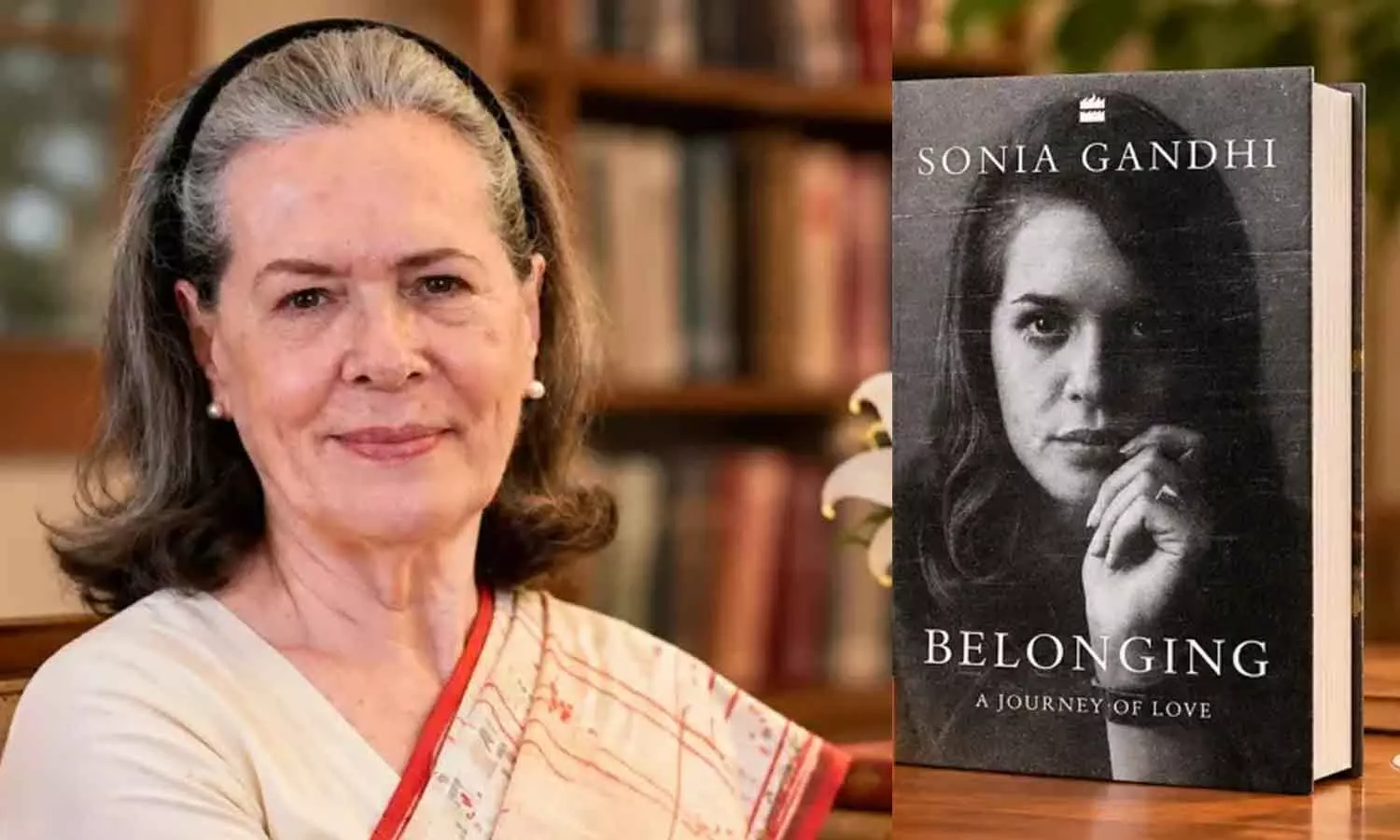
Sonia’s Memoir: Selective Memories, Convenient History
Sonia Gandhi’s long-awaited memoir— “Belonging: A Journey of Love”—has hit the book stalls on Tuesday and drew sharp criticism from the BJP on several counts.
In her book, Sonia Gandhi credited the economic reforms introduced during former Prime Minister P V Narasimha Rao's tenure to an experienced economist who served as his finance minister in the early 1990s. She was apparently referring to Manmohan Singh. In her account, she attributed the introduction of the landmark economic reforms to the then Finance Minister under Narasimha Rao's leadership.
The memoir recounts her marriage to Rajiv Gandhi and her introduction to her mother-in-law, former prime minister Indira Gandhi, as well as her efforts to adjust to life in India, including learning Hindi, wearing saris and adapting to Indian food and culture.
It covers the major tragedies that transformed the Gandhi family, including the death of Sanjay Gandhi in a plane crash, Indira Gandhi's assassination in 1984 and Rajiv Gandhi's assassination in 1991.
The memoir delves into political events surrounding the Congress-led alliance's victory in the 2004 elections, when Sonia Gandhi declined to become prime minister and instead led the party and its alliance, which governed India for a decade.
She said, "Some months before the election, my children and I had discussed the issue of my possible prime ministership. One of them asked me straight out whether I would accept the post, just in case our party pulled off a victory. 'Absolutely not!' I'd said, almost indignantly. 'Are you sure?' they pressed me. 'I'm very clear,' I said emphatically. Neither Rahul nor Priyanka felt that I should become prime minister. They'd lived through the trauma of their grandmother's assassination and the brutal murder of their father. In their minds, holding that office was intrinsically linked with heightened danger," Sonia Gandhi wrote.
She said that after she finally decided to turn down the post of prime minister, the question was who would become the PM.
"There were several senior colleagues, seasoned and qualified for the post, who would have been more than willing to accept it but amongst all of them was one who had long been in my sight as a person above reproach, and possessed a deep and consummate understanding of governance. That was Dr Manmohan Singh, a member of the Congress Working Committee," Gandhi says in the book.
Sonia said, "He was not allied to any camp in the party. Over a period of time, the Congress had been painted as being left of centre, and our government would now be supported by the Communist parties as well. I thought Dr Manmohan Singh would assuage the doubts of many about our ability to manage and continue the policies that had been begun years ago," she says, elaborating on the reasons why Singh was chosen to lead the country. She said she felt that he was a man with unquestionable integrity and a deep understanding of governance.
"His keen intellect and hard work had taken him from a remote village school to the universities of Oxford and Cambridge, and on from there to international fora. Aside from all his accomplishments as a scholar and technocrat, what I knew best about Dr Singh was that he had a kind and compassionate heart, and his integrity unquestionable," she says.
"I knew that our beloved country would be safe in his hands. I held consultations with my senior colleagues, and they seemed more reconciled to my decision now. They didn't oppose Dr Manmohan Singh's name when I suggested it to them; no one could contest the depth of his experience or his reputation as an honourable man who would do right by India," she says.
However, the BJP on Tuesday hit out at former Congress president Sonia Gandhi for trying to "justify" the Emergency in her memoir, "Belonging: A Journey of Love", and said the book should instead have been named "whitewashing".
The BJP national spokesperson C R Kesavan on his X post said it appears that the book appears to be "sugar-coating the historical wrongs perpetrated" by the Nehru-Gandhi family.
He said she has weighed in on the Emergency imposed in the country in 1975 and called it a mistake. Gandhi said she believes that her mother-in-law and former prime minister Indira Gandhi also came to feel the same.
The Congress Parliamentary Party chairperson also wrote that keeping her husband Rajiv Gandhi's brother Sanjay Gandhi "in check" could have prevented much of the damage that followed the imposition of the Emergency.
Kesavan said, "Sonia Gandhi appears to have sugar-coated the historical wrongs perpetrated by the Nehru Gandhi family and camouflaged the cardinal sins committed by the Congress party."
"She says she cried for Babri Masjid. Did Sonia Gandhi shed even a drop of tear when Gurudwaras were targeted and thousands of innocent people were violently killed during the 1984 Sikh Massacre which happened during the Congress rule?
"Sonia Gandhi cried profusely for the Batla House terrorists, but did she weep for the brave CRPF jawans who were martyred in the line of duty protecting our nation and people?" the BJP leader said.
"Did Sonia Gandhi cry for the innocent lives lost in the 26/11 Mumbai terror attacks which happened under the Congress Govt. Will her book answer why the cowardly Congress-led UPA Govt failed to retaliate?" he asked.
Kesavan said the way Gandhi has tried to "justify and normalise the notorious Emergency", which murdered the Constitution and suspended fundamental rights, is truly appalling.
"The Congress regime at the Centre for nearly 55 years inflicted unfathomable damage and scars on Indian polity and our democracy. The nation is thankful to PM Modi ji for effectively course correcting the historical sins and wrongs committed by the Congress party," he said.
Sonia’s Memoir: Selective Memories, Convenient History
AP Cabinet to meet today, to discuss major investment proposals
‘May your lives overflow with health, joy and enthusiasm’: PM Modi extends Gujarati New Year wishes
Telangana Minister Thummala Nageswara Rao asks banks to support farmers
Pawan Kalyan pays tribute to forest nartyrs on State Forest Martyrs’ Day
85 pc of Maharashtra gripped by drought as rural belt struggles during Diwali: Shiv Sena(UBT) in 'Samaana'


