




- Holy Darbha mat procession taken out in Tirumala
- Communities opt for planet-friendly Ganesh Chaturthi celebrations
- NDA forms 9-member panel for NTR local body polls
- APSRTC MD stresses quality bus maintenance and efficient resource utilisation
- Vijayawada drainage system to get Rs 600 cr makeover
- Heavy rain, 60-kmph winds forecast for AP coast
- PanIIT summit to position AP as DeepTech hub
- Brahmotsavams: A living tradition of Tirumala
Brahmotsavams: A living tradition of Tirumala
In Short
- The annual Srivari Brahmotsavams will be held from Sept 15 to 23
- The utsavams are believed to have been conducted at Tirumala for more than 1,000 years

Share :
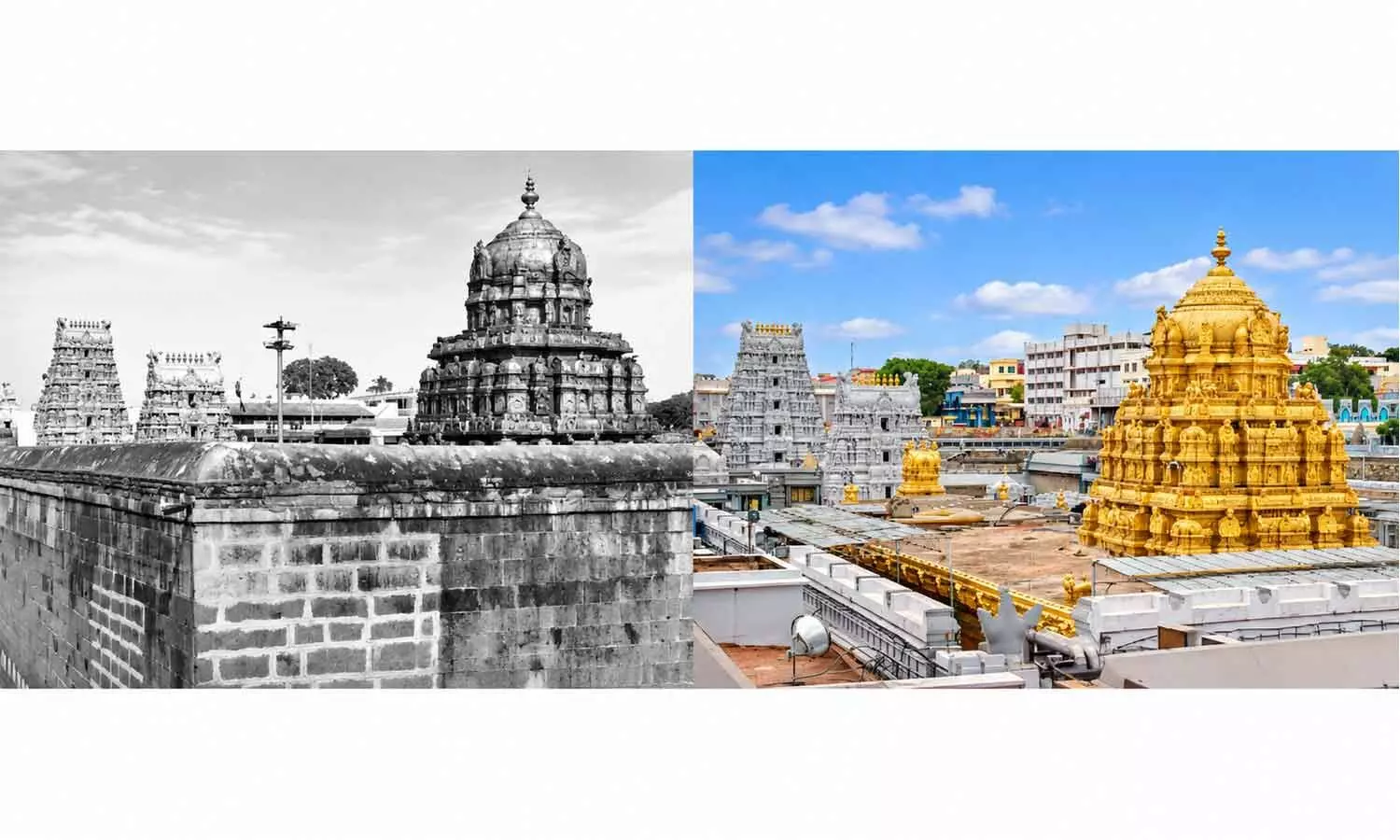
Srivari temple in Tirumala-then and now
Tirupati: When the annual Srivari Brahmotsavams begin at Tirumala, the Seven Hills witness the continuation of a religious tradition that has evolved over centuries. The nine-day festival this year will be held from September 15 to 23, with Ankurarpana scheduled for the evening of September 14. The celebrations bring together age-old rituals, vahana sevas and thousands of devotees who gather to witness Lord Malayappa Swamy in procession.
Among the daily, weekly, monthly and annual rituals conducted at Tirumala, Brahmotsavams occupy a special place.
Lord Malayappa Swamy is taken out on different vahanams during the festival, each having its own religious significance. The Garuda Seva on the fifth day evening is the major attraction and is expected to draw more than three lakh devotees.
The festival’s history is believed to stretch back more than 1,000 years. Temple tradition holds that Lord Brahma conducted the first Brahmotsavam after Lord Venkateswara manifested on the Seven Hills, giving the festival its name.
Inscriptions on the temple walls provide important evidence of the festival’s evolution. An inscription on the northern wall of the first prakaram records the contribution of Pallava Queen Samavai Sri Perundevi in 966 CE. She donated a silver idol of Bhoga Srinivasa Murty, ornaments and land for conducting festivals at Tirumala.
The inscription also indicates that Brahmotsavams were being conducted in the Purattasi and Margazhi months by the 10th century.
The tradition expanded during the Chola and Yadavaraya periods, with Brahmotsavams being conducted in Panguni, Chittirai and Aadi. During the Vijayanagara era, inscriptions dating from 1539 to 1616 mention as many as ten annual Brahmotsavams.
Royal patronage contributed significantly to the development of the festival. Sri Krishnadevaraya is recorded as having instituted the Thai Brahmotsavam in 1513 following his visit to Tirumala. Records also refer to the Kartika Brahmotsavam during the reign of Achyutaraya and the Aani Brahmotsavam instituted under Tallapaka Pedha Tirumalayyangar in 1539.
Another important milestone came around 1339, when Sri Malayappa Swamy, along with Sri Devi and Bhu Devi, became the utsava murtis. Their role became central to the vahana processions that continue to form the main feature of Brahmotsavams.
The temple administration also changed over time. The Mahants of Hathiramji Mutt managed the temple from 1843 to 1933. Following the formation of Tirumala Tirupati Devasthanams in 1933, the administration shifted to an institutional system. Under TTD, Brahmotsavams have developed into a large-scale event requiring arrangements for accommodation, transport, security, medical services, annaprasadam, information dissemination and live telecasts.
This year, the celebrations will have an added significance as Tirumala will host two Brahmotsavams due to Adhika Masam. The second Brahmotsavam is scheduled from October 12 to 20, giving devotees another opportunity to participate in a tradition that has continued across generations.


