






- Trinamool MP Abhishek Banerjee appears before Kolkata Police for questioning over CEC post
- Thanjavur farmers carry water in pots to save withering Samba crops
- Elon Musk Joins 43,000 Signatures Seeking Jensen Huang’s Return to Nvidia
- Happy Children's Day 2026: History, Significance, Wishes and Quotes
- Petrol and diesel prices today in Hyderabad, Delhi, Chennai and Mumbai on 14 November 2026
- US grounds flights nationwide over air traffic communication outage
- 2nd day of Chhath Puja: Devotees prepare to observe 'Kharna' ritual
- No compromise on devotees' safety: CM Yogi Adityanath directs officials to ensure elaborate Chhath arrangements
Political obedience takes precedence over competence in China's bureaucracy: Report
In Short
It noted that by centralising power and restricting independent decision-making, Beijing risks creating a bureaucracy more focused on avoiding political errors than resolving complex governance challenges.

Share :
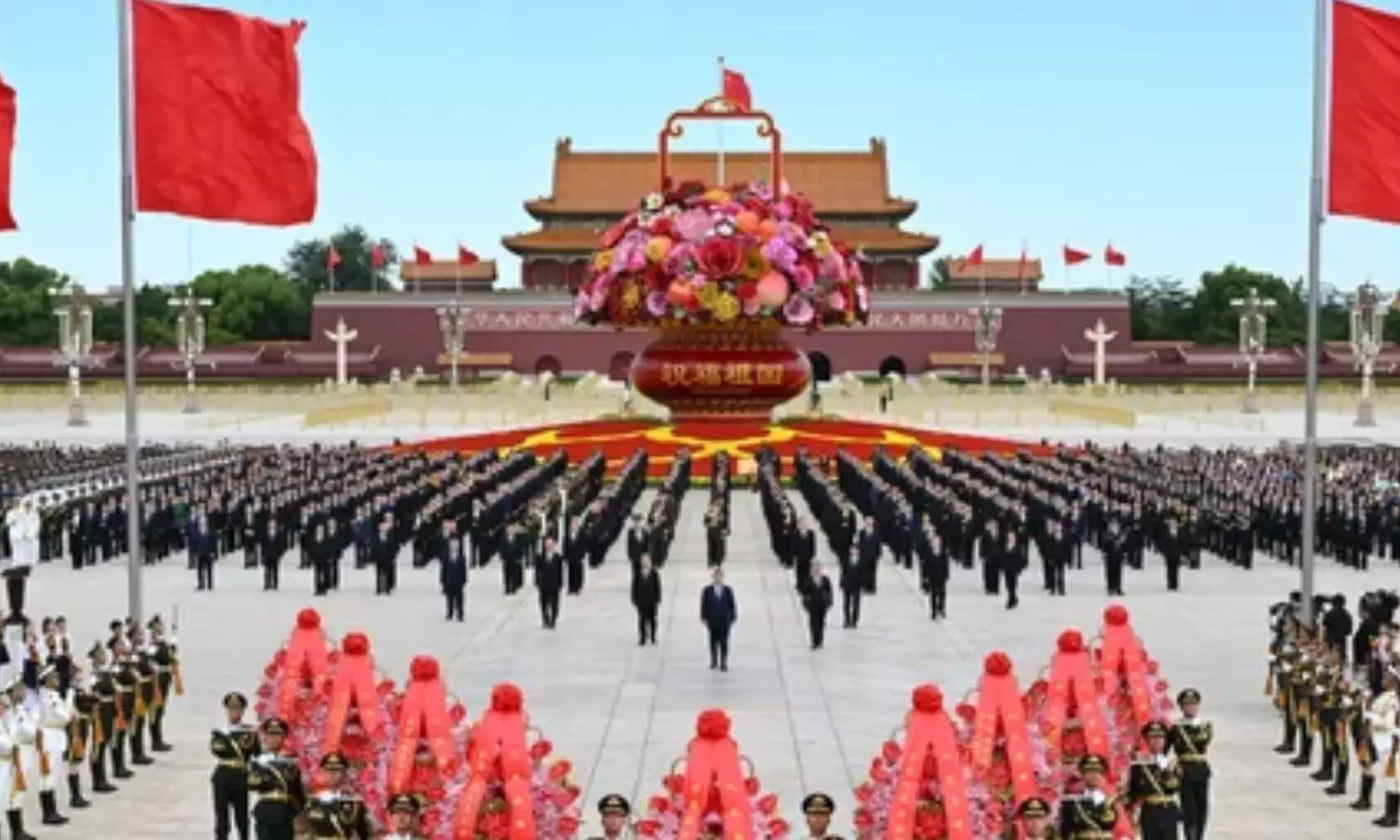
Chinese Communist Party’s ability to probe officials
Naypyidaw: The Chinese Communist Party’s ability to probe officials and enforce political discipline does not necessarily translate into good governance, a report has stated.
It noted that by centralising power and restricting independent decision-making, Beijing risks creating a bureaucracy more focused on avoiding political errors than resolving complex governance challenges.
The more the party tightens its grip on officials, the greater the risk that political obedience will take precedence over administrative competence, weakening the system's ability to identify shortcomings and respond to ground realities, according to a report in ‘Ayeyarwaddy Times’.
“Political control in China is often measured through the authority concentrated at the top of the Communist Party. But the durability of that authority depends on what happens further down the hierarchy, where officials manage public resources, implement central directives and translate political priorities into everyday governance. Recent developments in Beijing offer a glimpse into how the Party is trying to manage this challenge,” the report detailed.
“A widening anti-corruption campaign, the investigation of a senior municipal leader and the appointment of a propaganda veteran to head Yunnan suggest that the demands placed on officials are evolving. Administrative competence remains important, but it operates within a system increasingly concerned with discipline, political alignment and the Party’s ability to maintain control over its own machinery,” it added.
According to the report, intensified scrutiny under China's anti-corruption campaign is not a recent development. Since Chinese President Xi Jinping assumed power in 2012, the campaign has remained a central pillar of his leadership, expanding its reach across government departments, state-owned enterprises and local administrations.
However, the latest figures, the report said, revealed that the “campaign remains a central instrument of Party governance rather than a corrective exercise approaching completion.”
It observed that corruption can have far-reaching consequences for the Chinese state, undermining procurement processes, misallocating public resources, eroding regulatory accountability and allowing private interests to interfere in official decision-making.
The report stated that in a political system where the Party maintains extensive control over public institutions, corruption and misconduct among its officials can undermine the credibility of an organisation that claims to act in the public interest.
It further argued that an effective disciplinary mechanism to investigate officials across different levels of the system therefore serves an important purpose.
“But enforcement figures alone cannot establish whether corruption is declining, whether public administration is improving or whether officials are becoming more accountable to citizens. A high number of investigations may reflect extensive misconduct, stronger detection, more intensive enforcement, or some combination of the three. Without greater transparency on the underlying offences, investigative outcomes and recurrence of misconduct, the numbers reveal the reach of the campaign more clearly than its effectiveness,” the report mentioned.
Chhath Puja begins with 'Nahay Khay'; devotees prepare for four-day festival
AICWA's appeal to Bollywood: Give Sharad Kapoor the work he deserves
Political obedience takes precedence over competence in China's bureaucracy: Report
Four earthquakes jolt Jammu and Kashmir in 12 hours, Doda-Kishtwar belt epicentre
BJP chief Nabin, CM Yogi Adityanath to attend party's core group meeting in Mathura on Nov 16-17
After overnight stay at Lok Bhavan, PM Modi reviews key projects before leaving Gujarat
India continues to provide fuel to citizens at one of the lowest prices in world: Hardeep Puri
Rahul's Gig Workers' Meet: More Optics and Lecture, Less Delivery
Air Travel Goes Beyond Middle-Class Reach as CTI Flags Fare Surge, Demands Cap
Bharat Summit Under Fire: Congress Agenda Questioned, BJP State Chief Put Under House Arrest


