




- Exalogic payment case: CMRL CFO seeks to withdraw ED statement; claims threat, coercion
- Meta Launches Meta One: Instagram, Facebook, WhatsApp Plans, Features and Prices
- Surjewala accuses Centre of betrayal of citizens over proposed UPI transaction charges
- BJP not against Muslims; protest was against cop's remarks: K'taka MP on Ganesh procession row
- PM Vishwakarma scheme achieves registration target of 30 lakh beneficiaries
- UPI MDR changes: Govt debunks 'foreign influence' claims
- Deputy CM Bhatti Vikaramarka emphasises energy conservation for sustainable development
- Deandra Dottin re-signs with Melbourne Renegades for WBBL 12
25 Years of Seva — Narendra Modi’s Journey from Gujarat to Viksit Bharat
In Short
From Gandhinagar to New Delhi, from the challenges of state administration to the responsibility of leading the world’s largest democracy, Narendra Modi’s political journey has been defined by a central philosophy: public office as an instrument of Seva, development and nation-building.

Share :
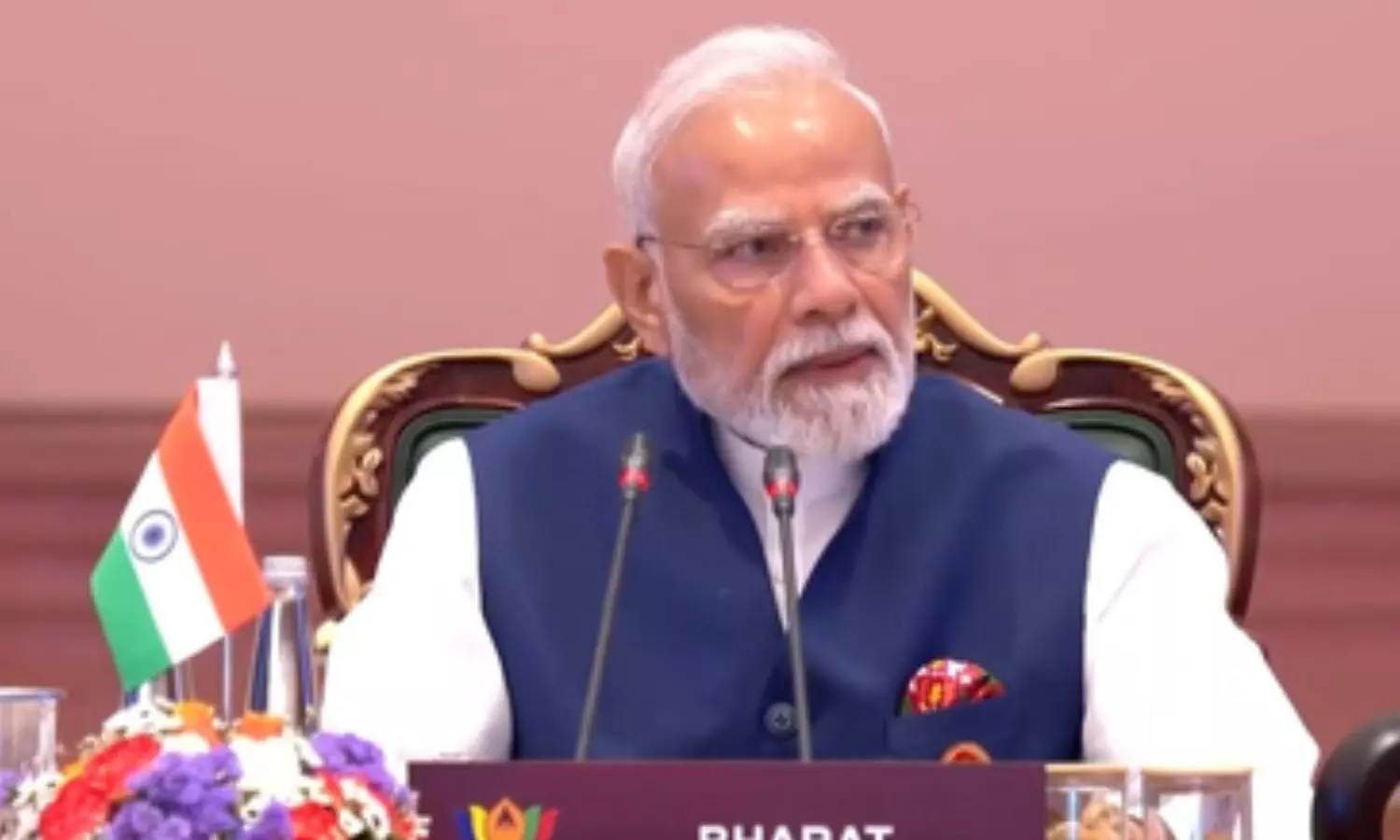
Prime Minister Narendra Modi
Narendra Modi took oath as the Chief Minister of Gujarat. Twenty-five years later, that moment stands as the beginning of one of the longest continuous journeys of public leadership in contemporary Indian governance.
From Gandhinagar to New Delhi, from the challenges of state administration to the responsibility of leading the world’s largest democracy, Narendra Modi’s political journey has been defined by a central philosophy: public office as an instrument of Seva, development and nation-building.
The Prime Minister has consistently described his public life as a commitment to serving the people, improving their quality of life and contributing to India’s progress. The 25-year milestone is therefore not merely a political anniversary. It provides an opportunity to examine the evolution of a governance philosophy—from the transformation of Gujarat to the larger national ambition of Viksit Bharat 2047.
From Gujarat’s Challenges to a Governance Model
When Narendra Modi assumed office in Gujarat in 2001, the state was dealing with the aftermath of the Kutch earthquake, recurring drought, infrastructure deficiencies and economic challenges. During his nearly 13 years as Chief Minister, the administration placed strong emphasis on infrastructure, agriculture, electricity, water management, industrial development, investment and administrative efficiency.
Gujarat increasingly became associated with an approach that sought to combine development, technology, infrastructure and citizen participation.
The larger lesson was that governance should not be measured only by announcements or expenditure, but by outcomes visible in the lives of citizens.
2014: From State Leadership to National Leadership
In 2014, Narendra Modi moved from Gandhinagar to New Delhi after receiving a historic electoral mandate. His approach to national governance was articulated through the idea of being a “Pradhan Sevak”—a servant of the people.
The philosophy was expressed through the principle:
“Sabka Saath, Sabka Vikas, Sabka Vishwas, Sabka Prayas.”
Over the following years, welfare and development programmes expanded dramatically in scale and reach. Governance increasingly focused on direct delivery, financial inclusion, digital platforms, infrastructure creation and saturation of welfare programmes.
Governance with Speed, Scale and Technology
One of the defining characteristics of the Modi era has been the integration of technology with governance.
The Pradhan Mantri Jan-Dhan Yojana, Aadhaar-enabled systems, Direct Benefit Transfer and the broader JAM architecture have transformed the way government benefits reach citizens. By June 2026, more than 58.63 crore Jan-Dhan accounts had been opened, with deposits exceeding ₹3 lakh crore. More than 32.68 crore accounts belonged to women, while 45.62 crore were in rural and semi-urban areas.
Digital India, UPI, Aadhaar-enabled services and digital public infrastructure have further transformed the relationship between citizens, businesses and the State.
The significance is not simply that millions of people have been connected digitally. It is that India has built delivery systems capable of operating at unprecedented scale.
The Poor at the Centre: Antyodaya
At the heart of the governance philosophy is Antyodaya—the commitment to reach the last person in the queue.
This is visible across housing, sanitation, clean cooking fuel, food security, healthcare, drinking water, financial inclusion and livelihoods.
Under PMAY-Gramin, the cumulative target allocated to States and Union Territories has reached approximately 4.18 crore houses, with around 3.92 crore sanctioned and 3.11 crore completed as of 2026.
Under PMAY-Urban, approximately 1.25 crore houses had been sanctioned, with around 98.10 lakh completed by May 2026.
The Swachh Bharat Mission has resulted in the construction of more than 12.11 crore individual household toilets under rural sanitation programmes. Rural sanitation coverage rose from approximately 39% in 2014 to 100% in 2019, followed by the expansion of ODF Plus and waste-management initiatives.
Under Pradhan Mantri Ujjwala Yojana, more than 10.57 crore LPG connections had been provided to women from economically vulnerable households by May 2026.
The Pradhan Mantri Garib Kalyan Anna Yojana continues to provide free foodgrains to more than 81 crore beneficiaries, reinforcing India’s food-security architecture.
Healthcare has also been transformed through Ayushman Bharat–PM-JAY. By June 2026, more than 44 crore Ayushman Cards had been created, with approximately 12.03 crore hospitalisations receiving treatment worth around ₹1.80 lakh crore through more than 36,000 empanelled hospitals.
Together, these programmes illustrate the practical meaning of Antyodaya: welfare reaching the bottom of the socio-economic pyramid.
Water Security: From Har Ghar Jal to Water-Secure Cities
Water security has emerged as a critical component of India’s development strategy.
Under the Jal Jeevan Mission, rural tap-water coverage increased from approximately 3.23 crore households in 2019 to around 15.91 crore households by August 2026.
Jal Jeevan Mission 2.0, approved in March 2026 and extended up to December 2028, carries a total outlay of approximately ₹8.69 lakh crore, including ₹3.59 lakh crore in Central assistance. Its emphasis extends beyond infrastructure creation to reliable service delivery, source sustainability, water quality, community ownership, operation and maintenance, and digital governance.
In urban India, AMRUT 2.0 has an indicative outlay of approximately ₹2.99 lakh crore, including a Central share of ₹76,760 crore.
Together, JJM and AMRUT reflect a broader objective: safe, reliable and sustainable water security for rural and urban India.
Women, Farmers and Youth: Engines of New India
The emerging development framework places Nari Shakti, Yuva Shakti and Annadata at the centre.
Women are increasingly being positioned not merely as beneficiaries but as entrepreneurs, asset owners and economic participants. The Lakhpati Didi initiative seeks to strengthen the income-generating capacity of women associated with Self-Help Groups.
Young Indians are being encouraged to become innovators, entrepreneurs, skilled professionals and leaders in technology.
Farmers, meanwhile, are increasingly being viewed as partners in agricultural modernisation, natural farming, technology adoption, value addition and export-oriented agriculture.
The PM Dhan-Dhaanya Krishi Yojana, covering 100 districts with low agricultural productivity, low cropping intensity and lower credit availability, seeks to improve productivity, crop diversification, irrigation, storage, credit access and sustainable agriculture through convergence of 36 existing schemes across 11 departments.
Development of the Last Mile
The Aspirational Districts Programme, covering 112 districts, represents a significant shift towards outcome-based development. Its focus includes health, education, agriculture, financial inclusion, infrastructure and social development.
The Aspirational Blocks Programme extends this approach to 500 blocks.
The PM JANMAN initiative focuses on the socio-economic development of Particularly Vulnerable Tribal Groups, with an outlay of approximately ₹24,000 crore covering housing, drinking water, roads, healthcare, education, electricity and other essential facilities.
These programmes embody a fundamental principle: geography should not determine the quality of development available to a citizen.
Clean Energy and Infrastructure
India’s energy transition is another important dimension of the Viksit Bharat journey.
Under PM Surya Ghar: Muft Bijli Yojana, more than 50 lakh households had benefited from rooftop solar installations by August 2026, with approximately 14.8 GW of rooftop solar capacity commissioned. The scheme carries an outlay of ₹75,021 crore and aims to cover one crore households.
Under PM-KUSUM, the Government’s framework targets 34,800 MW of solar capacity, supported by Central Financial Assistance of ₹34,422 crore.
Infrastructure has simultaneously expanded at a remarkable scale.
The National Highway network increased from 91,287 km in 2014 to approximately 1,46,572 km in March 2026. Four-lane-and-above National Highways increased from 18,371 km to 45,516 km.
Railway electrification reached approximately 99.6% by July 2026, while Vande Bharat and Amrit Bharat services represent a new generation of railway mobility.
Under the Amrit Bharat Station Scheme, 1,340 stations have been identified for redevelopment, with 261 completed by July 2026.
The number of operational airports increased from 74 in 2014 to 165 in 2026.
These developments demonstrate that welfare alone cannot create a developed nation. World-class infrastructure, connectivity and logistics are equally fundamental to Viksit Bharat.
Reform to Perform
The Modi years have also witnessed major structural reforms, including GST, the Insolvency and Bankruptcy Code, JAM, formalisation of the economy, Production Linked Incentive schemes and Digital Public Infrastructure.
The objective has been to make the Indian economy more formal, competitive, transparent and investment-oriented.
At the grassroots level, initiatives such as MUDRA, Start-up India and PM Vishwakarma have strengthened entrepreneurship.
Under PM Vishwakarma, approximately 30 lakh artisans had registered by July 2026, with more than 26.95 lakh completing skill verification and approximately 24.30 lakh completing basic training. More than 6.10 lakh loans worth about ₹5,235.8 crore had been approved.
This reflects an important change: traditional skills and small enterprises are increasingly being integrated into India’s modern economic growth story.
A New Confidence in India
Over the past 25 years, India’s global profile has also changed.
India’s G20 Presidency, engagement with BRICS, leadership in the International Solar Alliance, strategic partnerships and growing participation in global economic and technological discussions have contributed to a more confident international presence.
The philosophy of “India First” has increasingly been combined with “Vasudhaiva Kutumbakam”—national interest accompanied by a larger responsibility towards the global community.
India’s aspiration is increasingly not merely to participate in the global order, but to help shape it.
Viksit Bharat 2047: The Next Destination
The larger national vision is Viksit Bharat 2047—an India that becomes a developed nation by the centenary of Independence.
It means higher productivity and incomes, world-class infrastructure, quality education and healthcare, women-led development, prosperous farmers, manufacturing excellence, global exports, clean energy and technological leadership in areas such as AI, quantum technologies and deep technology.
It also means stronger institutions, social inclusion, digital transformation and greater global leadership.
The objective is not simply to make India economically larger. It is to make India more prosperous, capable, innovative, inclusive and self-confident.
Seva Before Power
The significance of Narendra Modi’s 25-year journey is therefore not simply the number of elections won or years spent in office.
It is the continuity of a governance philosophy centred on Seva.
The journey began with the responsibility of transforming Gujarat. It expanded into the transformation of India’s governance architecture after 2014. Today, it is linked to the much larger national mission of building Viksit Bharat by 2047.
There have been achievements, challenges, debates and criticisms—as there are in every democracy. Yet the scale, continuity and institutional impact of this 25-year journey constitute a significant chapter in India’s contemporary governance history.
The first phase was the transformation of Gujarat.
The second phase has been the transformation of India’s governance and development architecture.
The next phase is to transform India’s economic, technological and human capabilities into those of a developed nation.
That is the larger meaning of Viksit Bharat.
As Narendra Modi completes this historic milestone, the central message of his public life can be expressed in three simple principles:
Nation First. People First. Seva First.
Twenty-five years of public service and governance is a remarkable milestone.
But the ultimate measure of this journey will be whether the India of 2047 becomes more prosperous, more inclusive, more capable, more innovative and more self-confident.
That is the unfinished mission.
That is the journey from 25 Years of Seva to Viksit Bharat 2047.


