




- YSRCP demands fresh nomination process in 22 urban local bodies
- Rakhigarhi a legacy of craftsmanship, advanced civilisation: Haryana CM
- Centre launches portal to give farmers access to agri schemes on mobile phones
- RBI's 'Samvad 2026' kicks off, focuses on monetary policy, AI and financial stability
- ECI accepting SIR irregularities is PDA alliance’s greatest achievement: Akhilesh Yadav
- India condemns OIC's 'malicious' agenda, exposes 'desperate attempt' by Pakistan to divert attention from chaos at home
- 'Should face same punishment as adults': Abu Azmi demands lowering of age of juvenile offenders to 14
- Tiger Shroff Biography: From Jackie Shroff’s Son To Bollywood’s Action Star
Delimitation Showdown: Can the Government Turn the Tables? Will Numbers Add Up
In Short
The government is trying to assess the prospects of getting the bill passed without much difficulty and is working out the numbers to determine which members would support it and which would oppose it.

Share :
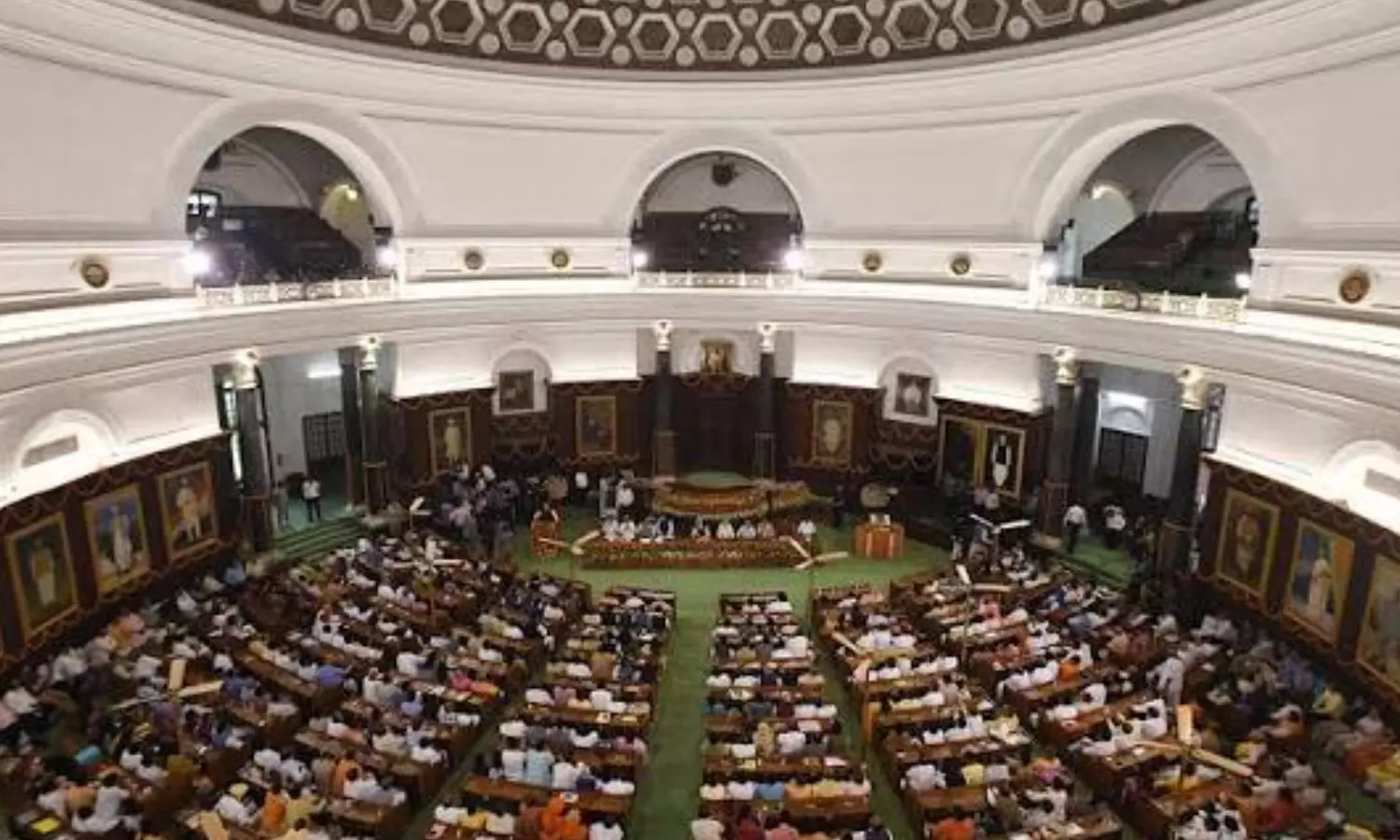
A face-off between the Congress and the government over the delimitation bill appears inevitable
A face-off between the Congress and the government over the delimitation bill appears inevitable, as a special session of Parliament to discuss the women’s reservation and delimitation bills is likely to be convened soon.
The government is trying to assess the prospects of getting the bill passed without much difficulty and is working out the numbers to determine which members would support it and which would oppose it.
Since the bill involves a constitutional amendment under Article 368, it requires a majority of the Lok Sabha’s total membership and at least two-thirds of the members present and voting.
The INDIA bloc and other parties, including the DMK, are opposed to the proposal. The YSRCP, which had supported the bill in the past, has now made a U-turn, saying it regrets its earlier decision. YSRCP president Y. S. Jagan Mohan Reddy, who appears to be moving closer to the INDIA bloc, said at a press conference that his party opposes the current system of appointing the Chief Election Commissioner (CEC). He said the party wants the earlier system, which included the Chief Justice of India (CJI) in the selection process, to be restored.
It may be recalled that the CJI’s involvement was introduced by the Supreme Court in 2023 as an interim arrangement, rather than as a longstanding practice. Parliament subsequently enacted a law excluding the CJI from the selection committee, and the law’s validity has been challenged in the Supreme Court.
Before 2023, the CJI had no formal role in the appointment of the CEC. The President appointed the CEC and other Election Commissioners on the advice of the government of the day.
The Chief Minister also accused YSRCP president and former Chief Minister Y. S. Jagan Mohan Reddy of adopting double standards on the Election Commission.
He said Jagan’s party had earlier supported the process for selecting the CEC but was now making various allegations after suffering electoral setbacks.
Meanwhile, the DMK has declined to clarify its position, although it had opposed the bill in the past. When asked about the party’s stand, a DMK spokesperson said it would make its position clear in Parliament.
Interestingly, Congress president Mallikarjun Kharge has written to Prime Minister Narendra Modi seeking an all-party meeting before the Constitution Amendment Bill is taken up for consideration in Parliament.
Union Parliamentary Affairs Minister Kiren Rijiju questioned the Congress’s demand for an all-party meeting. On Monday, he asserted that the government had consistently sought dialogue with the Opposition to secure the passage of the delimitation-linked women’s reservation bill. What was now required, he said, was constructive cooperation from all parties.
In his letter to Kharge, Rijiju underlined that the government valued the participation of all political parties in deliberations on matters of national importance. He expressed the hope that the Congress would play a constructive role rather than obstruct important legislation.
In the letter, Rijiju wrote: “I am writing to you to clarify certain points and place on record the facts regarding the efforts made by the government to engage with the Opposition on this subject.”
“First, with regard to your observation that Parliament has not been prorogued even though 64 days have elapsed since the House was adjourned sine die on 13 August 2026, I would like to clarify that there is no constitutional requirement prescribing a specific period within which a House must be prorogued following its adjournment sine die,” he said.
The Parliamentary Affairs Minister said that the mere fact that a House had not been prorogued during such an interval did not, by itself, constitute any constitutional or procedural impropriety or irregularity.
He added that there had been numerous instances in the past when Houses remained unprorogued for extended periods, sometimes for as long as 87 days.
In 2008, the Lok Sabha sat for two days, July 21 and 22, to consider the confidence motion. The House was then kept unprorogued, reconvened on October 17, 2008, and adjourned on October 24, with the next sitting scheduled for December 10.
“Second, the government has consistently sought the Opposition’s support and cooperation for the consideration and passage of the Delimitation Amendment Bill. The government has reached out to the Congress party, being the principal Opposition party, on several occasions,” Rijiju said.
He further stated that he had written to Kharge on March 16, March 26 and April 12 this year. He had also discussed the matter with him personally and sought his support and cooperation. In addition, he said he had met Rahul Gandhi, the Leader of the Opposition in the Lok Sabha, and sought his cooperation.
“However, despite repeated requests, the Congress party did not provide dates for a discussion, following which the government extended its outreach to other political parties,” he said.
Rijiju added that consultations had been held with representatives of several parties, including the DMK, Samajwadi Party, YSRCP, NCP, Shiv Sena (UBT), AIMIM and BJD, with a view to facilitating dialogue and building a broader consensus in support of the proposed legislation.
Under these circumstances, the minister said, it was unclear why the demand for consultation was being repeatedly raised when the government had already made sustained efforts to engage with the Opposition.
What was now required, he said, was constructive cooperation from the Opposition parties rather than a repetition of the same demand without due regard for the consultations already undertaken
Is Gen Z Being Drawn Into a Power Struggle in Andhra Pradesh?
Microsoft accounts for 33 pc of brand phishing attacks in Q3, Apple, Google trail: Report
Telangana asks govt offices to use electricity economically
Delimitation Bill talks: Rijiju writes to Kharge, hopes Congress won’t obstruct future bills
Kota Police’s Dramatic 15-Minute Operation Leads to Arrest of Shroff Shooting Suspects
BJP Chief Slams Rahul for Repeated ‘Vote Chori’ Claims; Rahul Dares Govt to Act Against Him
Telangana asks govt offices to use electricity economically
President Murmu extends greetings on the eve of Vijayadashami
No one from Bihar will be forced to migrate for manual labour by 2030: Samrat Choudhary
SP neglects Dalits, backwards: UP ministers on Akhilesh Yadav's manifesto release announcement on Constitution Day


