




- Bihar MLC polls: Nitish's son rallies behind JD-U's Neeraj Kumar after Anant Singh's support for JSP nominee
- Pawan Kalyan responds on 3D-printed rural houses, says new era begins
- Satavahana University Students Demand Better Hostel Facilities
- Good governance, an invisible infrastructure that sustains investors' faith: V-P Radhakrishnan at ICSI foundation day
- Major Fire at Plastic Scrap Godown in Warangal; MLA KR Nagaraju Inspects Site
- Asian Games gold medalists from Jharkhand return home, get warm welcome at Ranchi airport
- vHigh command’s decision final on alliance, says new UP Cong chief amid seat-sharing concerns with SP
- CEC Gyanesh Kumar must resign immediately: KR Nagaraju
From chaos to cheers: Aichi-Nagoya bows out, leaving India with memories, medals and a lesson
In Short
The Aichi-Nagoya Asian Games have come to an end.

Share :
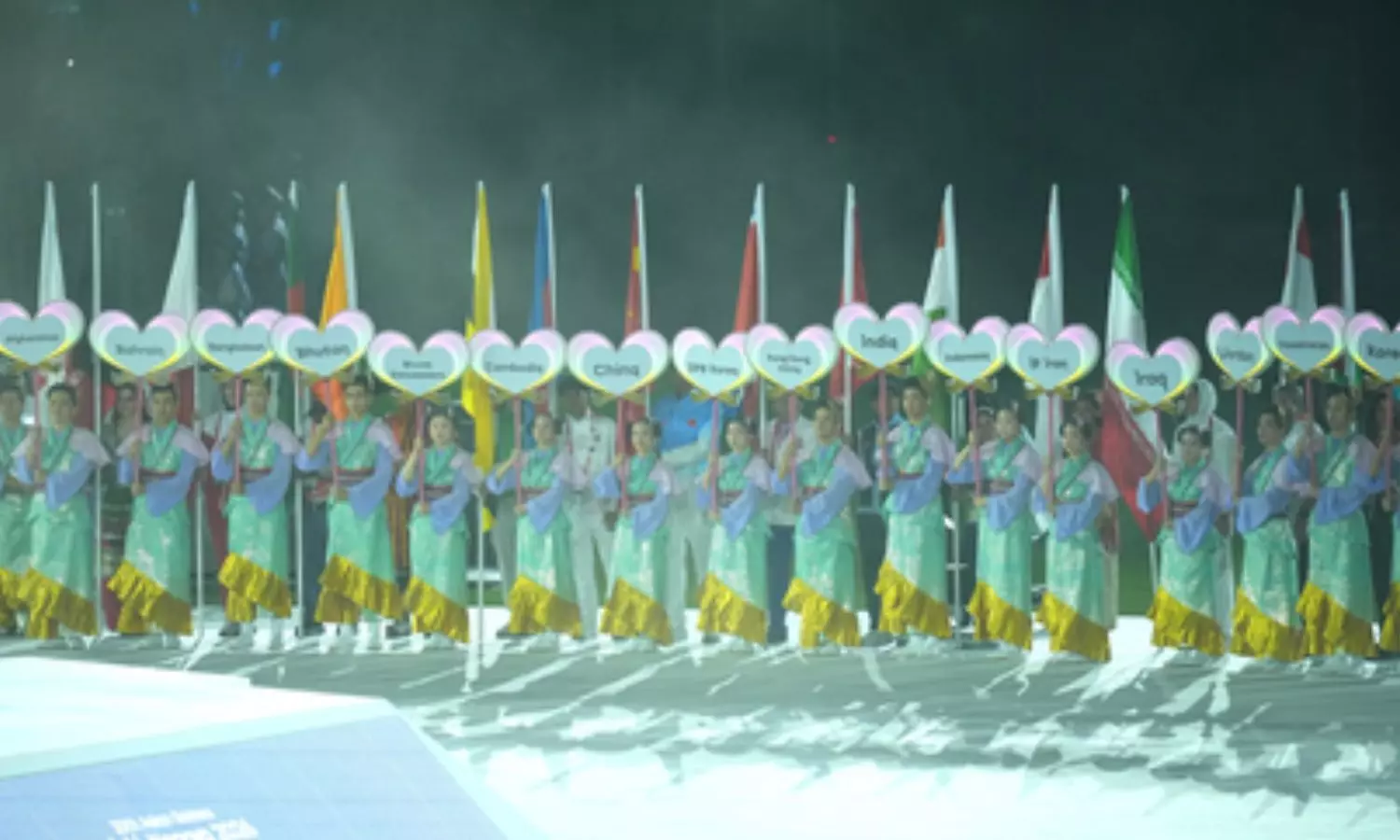
airports will once again replace the colourful chaos of the past two weeks
Nagoya: The buses will stop running, accreditation cards will soon become souvenirs, and athletes rushing through airports will once again replace the colourful chaos of the past two weeks.
The Aichi-Nagoya Asian Games have come to an end.
It was a simple farewell, much like the opening ceremony. There was music, colour, dancing, flags and athletes enjoying perhaps their first opportunity in days to simply breathe and take in what they had achieved.
For India, it was a closing night filled with pride.
Shooter Neeru Dhanda led the Indian contingent as flagbearer, carrying the Tricolour into the stadium after an exceptional campaign for the country. Yet her presence was just one part of a much bigger Indian story.
India finished fourth in the medal table with 85 medals — 21 gold, 27 silver and 37 bronze.
China dominated the Games, followed by Japan and South Korea, while India’s medal haul once again highlighted its growing presence across a wide range of sports.
And some of the loudest celebrations came from a sport that needs little introduction in India — cricket.
Cricket once again proved that its place in the Asian Games is no longer merely symbolic.
India’s men’s and women’s teams both returned with gold medals.
The women’s team set the tone, managing the pressure of being among the competition’s biggest names and delivering when it mattered. The men’s team followed with another gold, bringing India’s cricket campaign to a close with two gold medals.
For Indian cricket, these were not just two more medals on a crowded tally.
The Asian Games offered another reminder of how far the sport has reached beyond its traditional boundaries—and of the weight the Indian jersey carries even outside the world’s biggest cricket tournaments.
For some Indian athletes, however, there was no glamour attached to their journey.
There were early morning starts, long journeys to venues and hours spent waiting for competition. Some travelled hundreds of kilometres simply to compete for a medal that may never make the front pages.
Yet they kept showing up.
That perhaps became the defining characteristic of India’s campaign.
Archery produced a stunning five gold medals. Boxing added three golds, while wrestling contributed two. Hockey and kabaddi brought the familiar roar of team triumphs, with both men’s and women’s teams winning gold.
Athletics again produced its share of drama, with India’s runners and field athletes battling through pressure and weather to add precious medals.
Golf created history too, with Pranavi Urs winning India’s first women’s individual Asian Games gold in the sport.
Shooting remained one of India’s strongest medal-producing disciplines, while weightlifting, badminton, squash, rowing, table tennis, sailing, wushu, kurash, MMA, soft tennis and other sports also contributed to the final tally.
The numbers tell one story. The athletes tell another.
Behind India’s 21 gold, 27 silver and 37 bronze medals are stories of athletes who trained for years for a few minutes of competition. Some arrived as favourites and delivered. Others arrived almost unnoticed and left as household names.
Japan’s difficult fortnight
Away from the competition venues, Aichi-Nagoya was rarely free from criticism.
Transport became a recurring frustration. So did the distances between venues. The absence of a traditional athletes’ village created its own challenges, while sparse crowds at some events did little to create the atmosphere usually associated with the Asian Games.
For journalists, photographers and support staff, travelling between venues sometimes became an event in itself.
Japan, a country known for precision and efficiency, was therefore under an unusually bright spotlight.
But the Games also showed the other side of the story.
Despite the problems, competitions were completed. Athletes competed. Medals were won. Records were broken. And, eventually, the closing ceremony arrived.
That is perhaps the fairest way to judge a sporting event.
Not everything went according to plan. But the sport survived the imperfections.
And in the end, that is what the athletes will remember.
Soon, the venues will become quiet again.
The banners will come down. The temporary signs will disappear. The medal ceremonies will become photographs on athletes’ phones.
For India, the 85 medals will remain in the record books. But the memories will be more personal.
A victory celebrated with teammates. A defeat followed by a hug. A coach wiping away tears.
A parent watching nervously from the stands. An athlete hearing the national anthem for the first time.
And, on the final evening, a contingent walking together behind the Tricolour.
Aichi-Nagoya may not have been a perfect Asian Games. But sport rarely is.
It is messy, unpredictable and sometimes brutally unforgiving.
And that is precisely why, after all the criticism, long journeys, rain, empty seats, unexpected defeats and glorious victories, the Games still managed to leave behind what every sporting festival ultimately seeks — memories that outlive the closing ceremony.
FSSAI orders recall of Everest cumin powder batch over excess pesticide residues
India, Canada to kick off 5th round of trade talks tomorrow
Australia launches probe into flydubai incident following reports of co-pilot's link
Bihar MLC polls: Nitish's son rallies behind JD-U's Neeraj Kumar after Anant Singh's support for JSP nominee
Should be CM Chandrababu and Union Minister Shivraj Singh Chouhan Launch Rural Housing Program
Flydubai Crew, Israeli Passengers Clash After Attack on Smit Machchaar
UBT Morcha Against CEC In Mumbai
Poll Heat Picks up in UP. Cong-SP Differ on Seat Sharing
Rains likely in AP, Telangana amid cyclonic circulation
TN bypolls: CM Vijay to hold 40-km roadshow in Dharapuram as campaign ends today


