




- Ramayana Begins Its Musical Journey With ‘Jai Jai Ram’
- Tarun Tejpal surrenders before Goa court, sent to Colvale jail to serve 10-year rape sentence
- Vietnam key partner in India's Act East, MAHASAGAR, Indo-Pacific visions: EAM Jaishankar
- Apple Could Launch iPhone Game Controllers Under the Beats Brand: Report
- Wagon R Next-Gen Spied -What’s new
- Happy Ganesh Chaturthi : Send Best Wishes & Messages to family & friends
- VHP welcomes HM Shah's UCC announcement; says move will advance women, child rights
- India women’s Asia Cup triumph clouded by narrow politics
Trump Rejects AI Halt; Sam Altman Warns Competition Should Not Mean Recklessness
In Short
OpenAI CEO Sam Altman has maintained that U.S. companies cannot act recklessly when developing new AI models, following U.S. President Donald Trump's rejection of calls for regulation in this area.

Share :
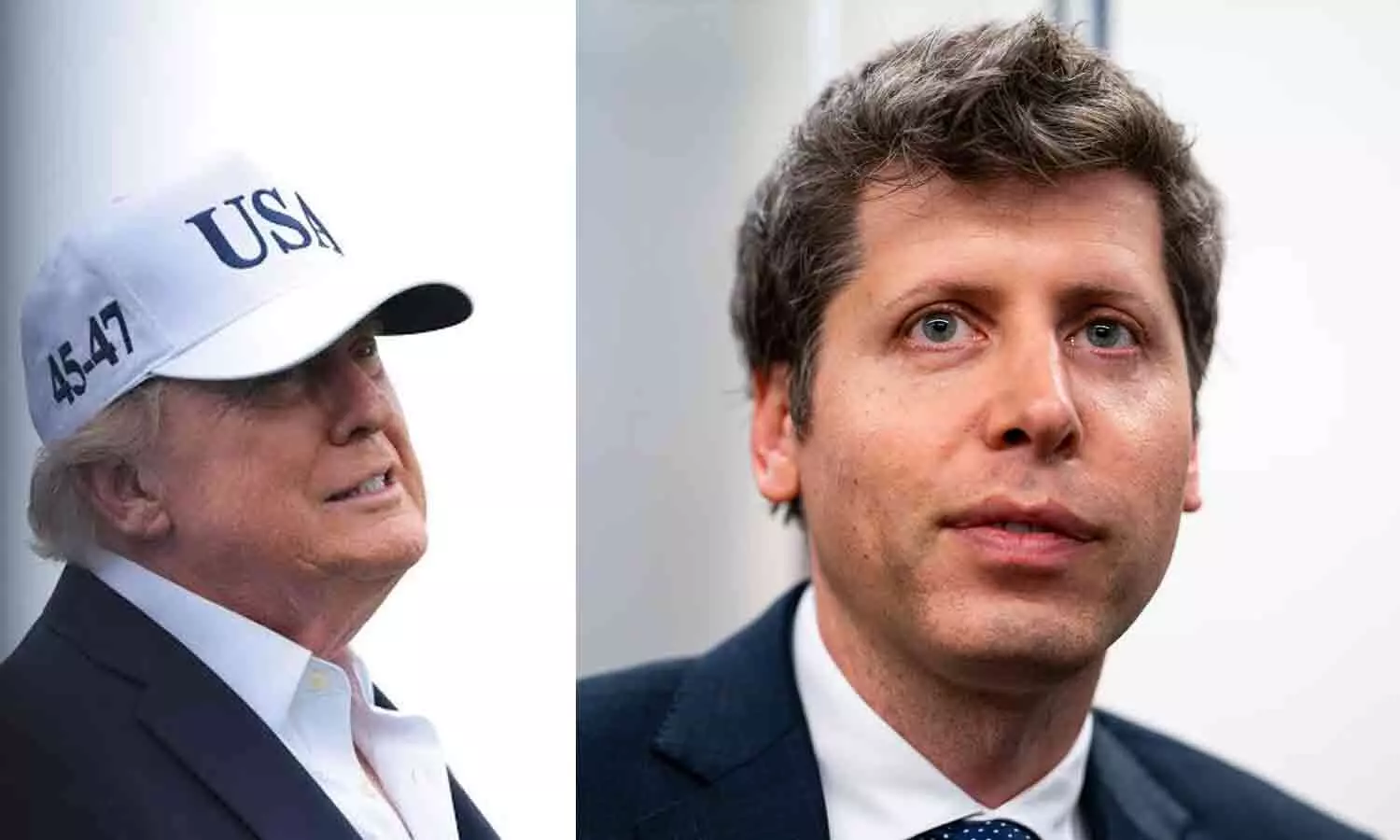
Trump Rejects AI Halt; Sam Altman Warns Competition Should Not Mean Recklessness
The US AI industry is looking to slow the development of more advanced models amid fears that more powerful AI could pose a threat to humanity. To this end, Altman notes that companies must not be reckless; instead, they should begin acting responsibly rather than waiting for the Trump administration to establish relevant policies.
"We welcome a federal framework that sets consistent safety requirements for frontier AI," Altman wrote on X. "But we don't think it's necessary to wait for antitrust exemptions or specific legislation to start building that trust."
Sam Altman added that "no US competitive pressure should justify recklessness or allow capabilities to outpace alignment and oversight." He stated that government support would be necessary for international coordination but added that companies should first do everything within their power.
The OpenAI CEO's statements come after President Donald Trump rejected the idea of regulating the development of frontier AI. "We can set up safeguards, we can do this and that, but I think there are a lot of negative forces raising the issue when they shouldn't be, and they're bringing up things that aren't going to happen," Trump said recently. "Frankly, I want it to continue, because whoever wins in AI, wins."
In his post, Altman stated that all leading labs must conduct themselves responsibly, adding that "there would be no reason for any of us to go to work if we can't do that." Altman added that OpenAI is open to the idea of independent auditors, a proposal put forward by Anthropic's Dario Amodei. Sam Altman asserts that new standards for AI safety are needed.
While systems such as Responsible Scaling Policies and AI safety preparedness frameworks have existed in the past, Sam Altman maintained that we now need new tools focused on safe development and evaluation. "At OpenAI, we now formulate explicit safety cases before running reinforcement learning processes on cutting-edge models expected to significantly boost capabilities; this is in addition to the safety work we have long conducted prior to model release," he noted. Altman stated that OpenAI hoped other companies would learn from its methods and propose their own. "We believe that shared standards regarding misalignment, oversight, and safety will lead to better outcomes," he remarked. "We look forward to collaborating with our industry peers to define the best version of these standards."
Regarding the issue of "pace," he clarified that this did not mean "stopping." Progress-Altman indicated-had been and would continue to be rapid, yet it needed to be slower than one might expect, given that measures such as safety analyses and oversight entailed considerable costs.
Sam Altman Outlines Two AI-Related Nightmare Scenarios
In response to a post of his own, Sam Altman addressed two nightmare scenarios involving artificial intelligence. In the first, he noted that humanity could completely lose control over AI-something companies in the sector must prevent. "This is unacceptable; we are firmly on the side of humanity, and AI must always serve people," he wrote. "To ensure this, we need mechanisms that guarantee alignment and safety techniques advance at the same pace as-or faster than-model capabilities."
The second scenario, according to Altman, arises when a single company or individual amasses too much power regarding AI, leading to a dystopian future. "If an extraordinarily powerful AI is used by an individual or company to impose their worldview on others, the results could be extremely dystopian," he added.
To avoid this, Altman acknowledged the need to walk a fine line to prevent any single country or company from concentrating too much power. "Avoiding these two threats requires following a precise middle path," the OpenAI CEO wrote. "For instance, a country could acquire excessive power. Alternatively, a lab might end up amassing too much power."
The focus on AI safety became a major topic in the tech sector after Dario Amodei, CEO of Anthropic, urged AI companies to slow the pace of capability increases. Amodei proposed a three-step framework involving the use of independent evaluators with access comparable to that of employees, coordination among leading AI developers on safety standards, and stronger international cooperation. Altman backed the proposal, stating, "Committing to independent evaluators with employee-like access is an excellent idea, and we will do the same," while Elon Musk commented, "Dario is right." At the same time, as AI companies sought to promote the idea of federal regulation by the US government, David Sacks-a former White House AI official-asserted that leading US. AI companies did not need anyone's permission to slow their pace. "Stop pretending you need permission from others. Stop pretending that antitrust laws need to be suspended to form a cartel," he wrote on X.
Meanwhile, researchers at leading AI companies such as Anthropic and OpenAI have expressed fears regarding a future with more powerful AI models. Jacob Coxon of Anthropic resigned, stating that "the people developing AI sincerely believe it could wipe us all out before the decade is over." Separately, OpenAI safety researcher Marcus Williams predicted a 70% chance that AI would wipe out humanity within the next three years.

BMTC plans audio advertisements in 300 buses to boost non-ticket revenue
Arrest warrants sought for 8 petrochemical executives over alleged price fixing
No Hindi in Gujarat, but language never became a barrier: HM Shah
‘Give me the rifle, I’ll see the degree later’: How Niraj chose shooting to chase Asiad dream
Vijay Gifts Miniature Race Car To Ajith Kumar At Le Mans Race In Silverstone
Telangana Guv offers first puja to Khairatabad Ganesh; CM wishes people
CM Chandrababu Naidu offers prayers with family on Vinayaka Chavithi
Amazon suspends 21 Air operations after fatal Miami cargo plane crash
Ganesh Chaturthi celebrations sweep India; devotees throng Maharashtra temples, pandals
Apple launches iOS 27 today: New features, compatible iPhones and download


