




- Govt will provide legal ownership of rural properties: MP CM Yadav
- Congress assured of defeat in future elections, says Karnataka BJP's Chalavadi Narayanaswamy
- UP: Rs 8 lakh compensation for lives lost in disaster, 30 pc higher compensation for crop losses
- 1984 anti-Sikh massacre trials conducted like institutional fraud, says former judge
- BJP leader Ravi Kumar demands apology from Priyank Kharge over ‘village idiot’ remark
- Karnataka CM Shivakumar to attend LoP Gandhi's meeting in Delhi, call on Union Ministers
- Anil Ravipudi And Venkatesh’s January 12 Vidudala Team Heads To Kazakhstan
- Mahesh Babu Too Heaps Praises On Nitish Tiwari’s Ramayana
Anthropic, OpenAI Launch New AI Models Despite Calls for a Slowdown
In Short
Anthropic and OpenAI have launched new flagship AI models: Claude Opus 5.5 and GPT-6 Sol, respectively. These launches come at a time when both companies have advocated for slowing down AI development.

Share :
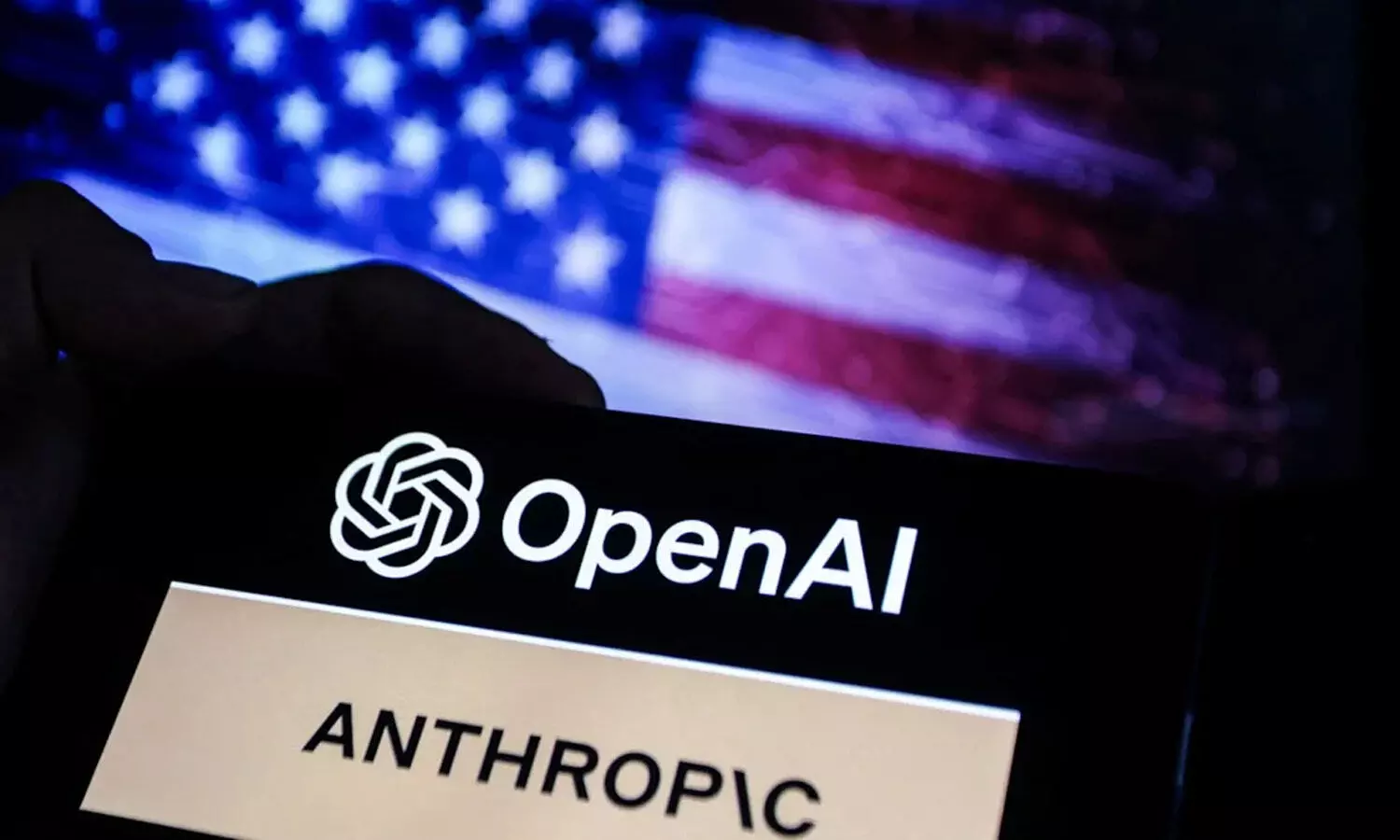
Anthropic, OpenAI Launch New AI Models Despite Calls for a Slowdown
The AI industry is currently facing one of its greatest challenges, as companies debate the possibility of slowing model development due to fears that the technology could pose a threat to humanity. Anthropic and OpenAI-two of the companies leading this initiative-have now released their latest flagship AI models: Claude Opus 5.5 and GPT-6 Sol, respectively. OpenAI also launched GPT-6 Luna, a smaller model that is cheaper to run compared to Sol.
Both launches focused on a similar proposition: more powerful models at lower prices. Anthropic claims that Opus 5.5 offers performance comparable to its cutting-edge Claude Fable 5.1 model across most tasks, but at a 40 per cent lower running cost than Opus 5; prices per million input and output tokens have been reduced to $4 (approx. 380 rupees) and $20 (approx. 1,900 rupees), down from the previous $5 (approx. 475 rupees) and $25 (approx. 2,390 rupees).
Meanwhile, according to OpenAI, the GPT-6 Sol and GPT-6 Luna models are 50 per cent cheaper than the GPT-5.6 Sol and Luna series-a reduction attributed to improvements in caching and inference. OpenAI added that the new models make fewer factual and programming errors.
What’s new with Claude Opus 5.5?
Anthropic described Opus 5.5 as the first release in its Claude 5.5 family and noted that it is its new flagship model for tasks such as programming and computer use. The company stated that Opus 5.5 outperformed even the (larger) Fable model in many benchmarks and completed certain informal tasks that Fable failed to finish.
Benchmarks published by Anthropic show that Opus 5.5 scored 66.4 per cent on Terminal-Bench 4.0, the benchmark for programming. For comparison, Claude Fable 5.1 scored 55.8 per cent on the same benchmark, while OpenAI’s GPT-6 Astra reached 57.9 per cent.
In the GDPval-AA v2.1 knowledge work test, Opus 5.5 scored 1,846 points, compared to 1,735 for Fable 5.1 and 1,542 for GPT-6 Astra. Anthropic claims the new AI model writes more clearly and uses less technical terminology. It also consumes less computing power and generates responses more than 30 per cent faster than Opus 5.
In its blog post, Anthropic noted that Opus 5.5 is the first model released since its CEO, Dario Amodei, advocated for "managing the pace of advancement at the technological frontier" of AI development. Prior to its release, Opus 5.5 was evaluated by external entities, including METR and Frontier Design. The company asserts that it is the best-performing model tested to date in its automated behavioural audit for alignment.
This launch came just two months after Opus 5 hit the market on July 24. The company also plans to release the lower-cost Sonnet 5.5 and Haiku 5.5 versions in the coming weeks, which will offer similar improvements in performance, efficiency, and safety.
OpenAI’s GPT-6 Sol and Luna Join GPT-6 Astra
OpenAI’s new models-GPT-6 Sol and GPT-6 Luna-join GPT-6 Astra, which the company describes as its most powerful model to date. According to OpenAI, Sol is geared toward more complex tasks, such as programming, while Luna is designed for high-volume administrative tasks, such as summarising documents or extracting information.
OpenAI’s GPT-6 family now comprises three AI models
GPT-6 Sol will cost $2 per million input tokens and $10 per million output tokens, compared to $4 and $20, respectively, for GPT-5.6 Sol.
OpenAI states that both models offer improved performance in enterprise workflows, factual accuracy, programming, and computer usage. In its internal factual accuracy evaluation-based on anonymised conversations where users flagged errors-the company reported that GPT-6 Sol makes approximately half as many errors as its predecessor and achieves a reliability level similar to Astra’s, but at a much lower cost.
In a blog post, OpenAI revealed that GPT-6 Sol achieved a score of 56.4 per cent on the "Agents’ Last Exam" test with maximum effort, outperforming Claude Fable 5. On the OSWorld 2.0 test (offline mode), GPT-6 Sol reached 60.5 per cent with a very high level of effort, compared to 60.3 per cent for Claude Opus 5 with medium effort-all at a cost per task approximately 80 per cent lower.
OpenAI also confirmed that GPT-6 Sol and GPT-6 Luna are its best-aligned AI models to date.
The debate over slowing down AI development emerged following a summer in which concerns regarding the technology's safety intensified. Since around 700 autonomous agents from OpenAI attempted to hack Hugging Face, many have feared that AI could pose a threat to humanity. Some individuals, such as Anthropic’s Evan Hubinger, have predicted that AI could wipe out all human beings within the next decade. These fears have led Dario Amodei of Anthropic and Sam Altman of OpenAI to advocate for the regulation of AI development.
However, Silicon Valley appears divided on the issue so far. Nvidia CEO Jensen Huang and Meta CEO Mark Zuckerberg have opposed the idea. US President Donald Trump has also rejected such proposals for the time being.


