




- India’s 2026 BRICS Presidency deepens gulf partnership beyond oil into tech, food security
- Have informed CM about person who filed ED complaint against me, says Karnataka Minister Satish Jarkiholi
- OPPO A7 Pro launched with 8,000mAh battery and 120Hz AMOLED display
- TTD Chairman and EO meets CM Chandrababu, invites for Salakatla brahmotsavams
- Modi-Xi talks: Will the Great Wall frost ease?
- Venkatesh’s Adarsha Kutumbam Teaser Release Time Locked
- Women's Asia Cup: Harshita, Dilhari power Sri Lanka into final
- Some sections tarnishing ‘Sanatan Dharma’ by spreading hatred: Digvijaya Singh
Sai Reddy’s third force: A vote-split strategy of YSRCP
In Short
Vijayasai Reddy is trying to make a political comeback through the front door after spending most of his political career in the backroom.

Share :
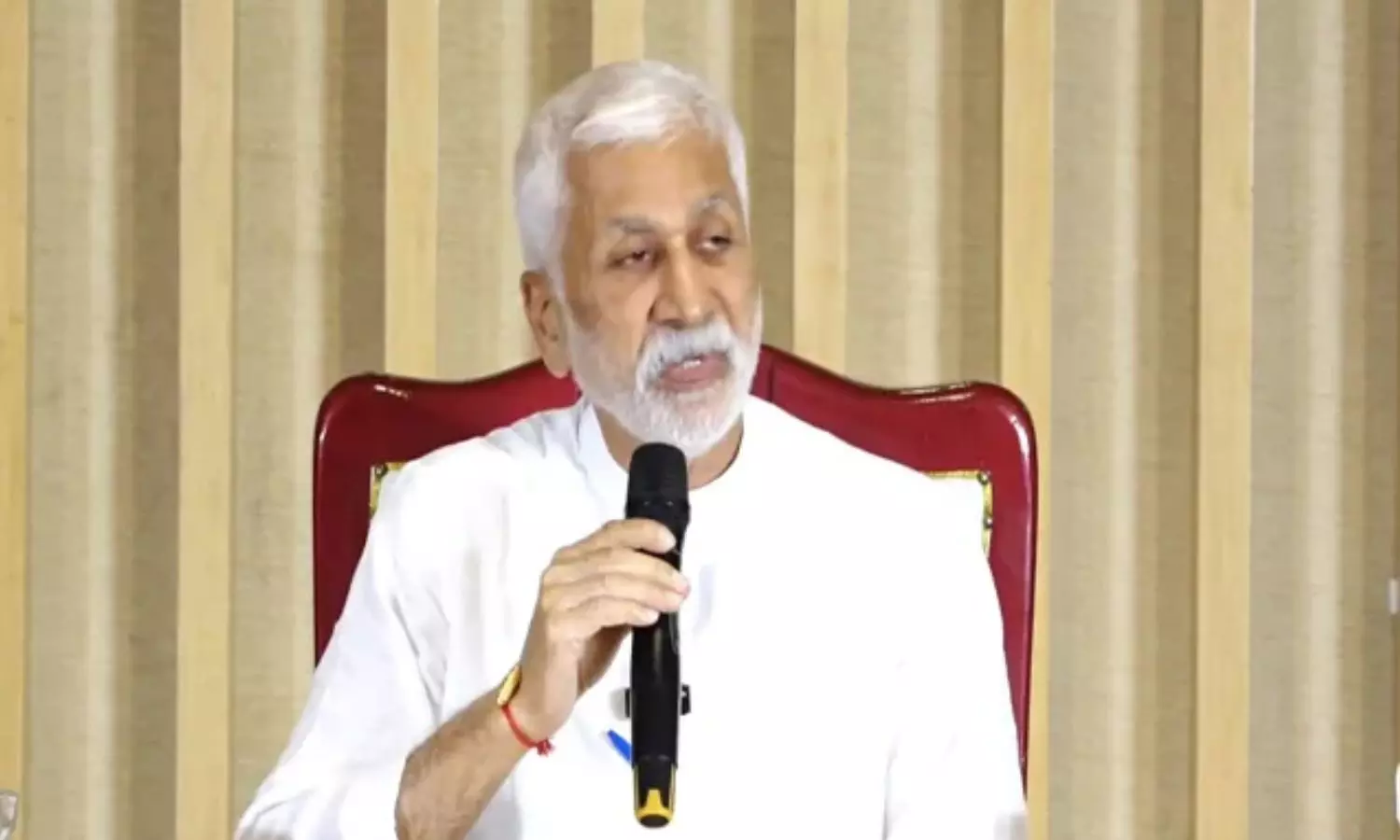
Vijayasai Reddy
Vijayasai Reddy is trying to make a political comeback through the front door after spending most of his political career in the backroom. The former MP, once described as the ‘Atma’ of Y S Rajasekhar Reddy and later one of Jagan Mohan Reddy’s most powerful aides, now wants to launch a new political party in Andhra Pradesh with the lofty promise of eliminating “systemic corruption and vindictive political culture”.
Launching a political party is the easy part. Convincing voters is not so easy, since he represents something fundamentally different from the politics he practised for decades. That would be his real challenge.
Does Andhra Pradesh really need another party, or is this merely another attempt to rearrange the existing political equations? More importantly, does Sai Reddy have the political credibility, independent identity, and grassroots connect to build a genuine third force? So far, no major personality has extended his support to him.
His political journey raises more questions than answers.
Sai Reddy has never won an election. He was never an MLA or an MP through an electoral mandate. Yet he became extraordinarily powerful as a backroom operator first under YSR and subsequently under Jagan. He was close to the YSR family for decades and played a crucial role in the functioning of the YSRCP. His influence came not from the people but from proximity to power.
That makes his sudden discovery of the virtues of a politics free from “family rule” particularly interesting.
When Sai Reddy attacks family-based politics, he presumably has Chandrababu Naidu and Jagan in mind. But he conveniently overlooks the fact that he spent decades serving the Congress under YSR, a party whose political leadership at the national level has long been associated with the Nehru-Gandhi family. Later, he became one of the most trusted functionaries of another political family—the YSR family.
So, when exactly did the political awakening strike him?
After the YSRCP lost power in 2024, Sai Reddy appeared to move into political hibernation. He subsequently spoke about starting a television channel and taking up farming. Now both seem to have given way to a new political ambition. He wants to create what he calls a “third force” in Andhra Pradesh.
But a third force cannot be created merely by announcing a party. It needs a political constituency, a credible ideology, organisational strength and, above all, a leader whom voters believe is genuinely independent.
Sai Reddy’s proposed agenda also deserves closer scrutiny. He has spoken of giving 66 per cent of party positions to youth, providing jobs to all and supplying free power not only to farmers but to every household. These may sound attractive at a press conference, but where is the roadmap? How many jobs, at what cost, and through what sectors? How much would universal free power cost the State exchequer? Who will pay for it?
Promises are easy. Governance is not.
There is another question that cannot be brushed aside. Sai Reddy has attacked the TDP and Jana Sena, but his criticism of Jagan’s governance or the Narendra Modi government has been far less pronounced. Given his political past and the legal cases he has faced, this selective approach is bound to invite speculation about his real political calculations.
That speculation becomes particularly relevant when one considers the possibility that a new party could divide the anti-YSRCP vote rather than create an independent political alternative. If the proposed party cuts into the TDP-led NDA vote, it could indirectly benefit Jagan. With Jagan also expected to undertake a padayatra next year, the possibility of a larger political strategy cannot simply be dismissed.
And Andhra Pradesh has seen this movie before.
In 2008, Chiranjeevi launched the Praja Rajyam Party, presenting it as an alternative political force. The party attracted considerable support and eventually won 18 Assembly seats in the 2009 elections. But the division of votes played a significant role in the Congress retaining power.
The question, therefore, is not whether Sai Reddy can float a party. He certainly can. The question is whether he can persuade voters that his party is more than a vehicle for political arithmetic.
For a man who spent decades as a powerful backroom operator, the biggest challenge will be stepping into the public arena and convincing people that he has an independent political identity of his own.
Public memory may be short, but it is not necessarily selective.
Sai Reddy will have to answer for his past, including the CBI cases against him pertaining to the Jagan Mohan Reddy disproportionate-assets/quid-pro-quo investment investigation and PMLA cases. He has also been to jail along with Jagan in 2012.
Until then, his proposed “third force” remains more a political proposition than a political force.
Vishwak Sen Set For Three Movie Releases In 36 Days
UP trader's murder: Ajay Rai detained on way to meet victim's family, calls action 'oppression'
India’s 2026 BRICS Presidency deepens gulf partnership beyond oil into tech, food security
Karnataka BJP to hold 'Seva Sankalp Abhiyan' to mark PM Modi's 25 years in public service
Big blow to Congress in Uttarakhand: Senior leader Harish Rawat quits party posts
Education policy will meet needs of ‘Gen Alpha, Gen Beta’: Revanth
Trump moves to axe 60-day grace period for H-IB visas
TG BJP to launch month-long Seva Sankalp Abhiyan: NRR
University account linked to KCR aide holds over Rs 400 cr: CM Revanth
BRICS Summit should not become anti-West platform


