




- Internal rifts rock Cong; take toll on governance
- BRS trying hard to get back its mojo to reconnect with people
- Decoding AIMIM-Congress frenemy relationship in TG
- It’s Shree 420 govt in TG: Kishan Reddy
- As Prof Haragopal sees it …
- Huge inherited debts hobble govt achievements
- All eyes on Konda Surekha ahead of Assembly session
- KCR talks ‘direct fight’ but stays in farmhouse, says Adi Srinivas
Domestic strength cushions markets as global risks mount
In Short
GDP growth, GST collections and DII buying limit downside

Share :
Domestic strength cushions markets as global risks mount
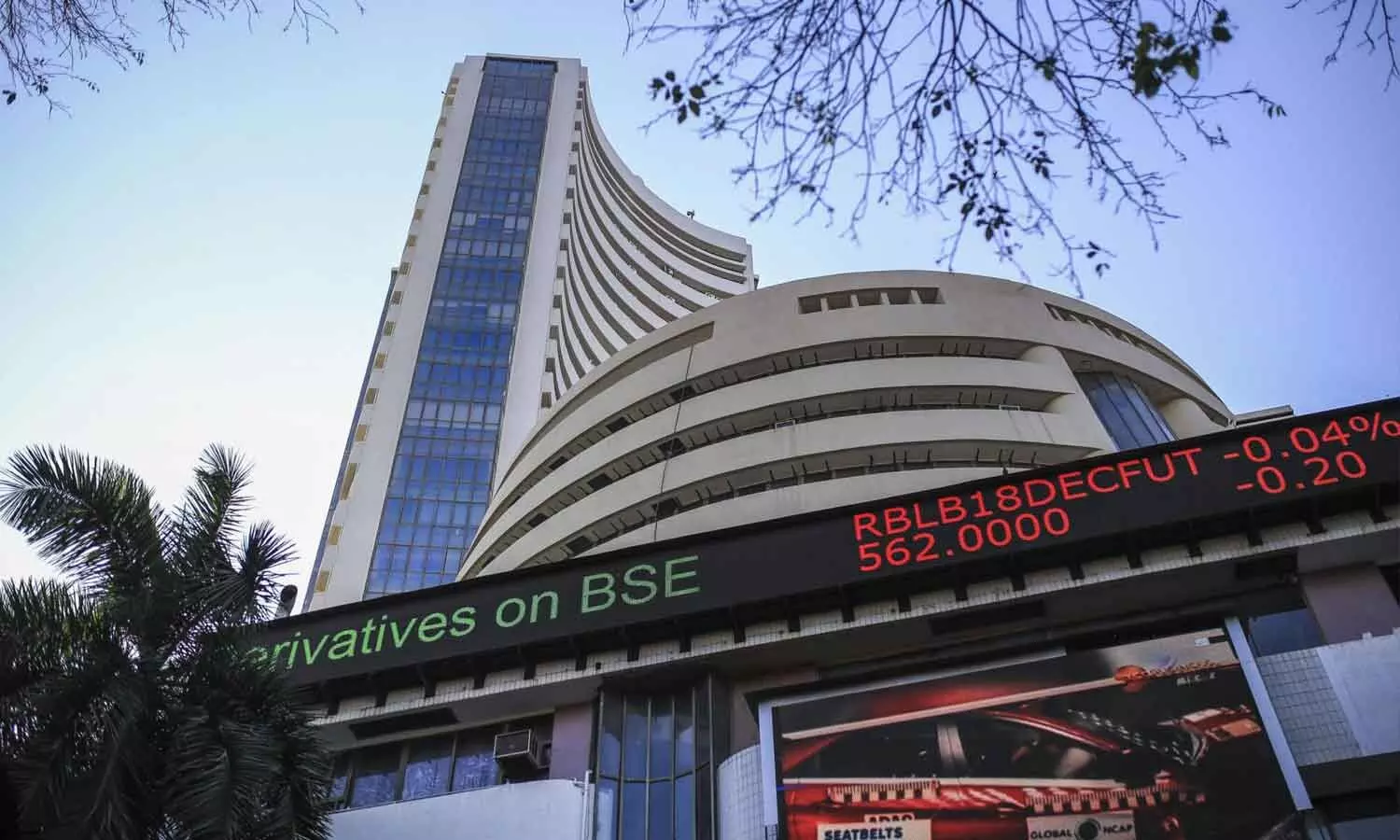
Unnerved by elevated global bond yields, renewed tensions in West Asia resulting in rising international crude oil prices and continued FII selling; markets ended lower for the fourth consecutive week. The downside was limited by rupee appreciation, resilient GDP numbers, persistent DII support and robust GST collections.
For the week, the Sensex declined 749.08 points, or 0.96 per cent, to 76,515.43, while the Nifty fell 277.95 points, or 1.14 per cent, to 23,897.70. In the broader market, while the Nifty Midcap 100 index fell 1.5 per cent, the Nifty Smallcap 100 index touched a fresh high of 20,187.80. It is pertinent to observe that the Nifty Smallcap 100 significantly outperformed the frontline indices, ending the week in positive territory and scaling a fresh all-time high.
FIIs extended their selling for the third consecutive week, offloading equities worth Rs 5,611.94 crore. However, DIIs continued to provide strong support to the market, investing Rs 23,156.38 crore in equities over the week. The FPI flows will be primarily influenced by the bond yields which are rising globally. It would be irrational to expect significant FPI flows into India when the U.S. 10-year bonds and 30-year bonds are yielding 4.78 per cent and 5.27 per cent respectively.
Following the successful mop up of FCNR(B) deposits and RBI intervention in forex market, the Indian rupee extended the gaining streak for the second week, rising to two-month high during the week. The rupee rose 89 paise against the US dollar to close at Rs 94.49. Q1 FY27 real GDP grew 7.8 percent, with GVA at 8.2 percent, gross fixed capital formation up 11.9 percent and services at 10 percent, a strong start to the year.
However, it is wise to recall that the RBI itself projects FY27 growth at 6.7 percent, with Q2 at 6.4 percent, Q3 at 6.5 percent and Q4 at 6.8 percent. Base effects also turn less favourable from here, since Q4 FY26 was already a high 8.6 percent, making this year’s comparisons tougher.
A 6.5 to 7 percent range is a more realistic path for the rest of the year, and that would still make India the fastest among large economies. The US job market rebounded in August as employers added a surprising 162,000 jobs.
The unemployment rate stayed at a low 4.1 per cent. Despite President Trump’s tweet to reduce interest rates, US Fed Governor Warsh has tried to avoid overcommitting himself to future decisions. An explicit reaction function “works better in theory than in practice, better in the lab than in the field”.
Presidential preference is not a policy input. The FOMC votes on inflation data, and on that data the bar for a hike has been lowered rather than raised. In near-term heightened volatility could persist due to global cues, crude prices, US monetary policy and foreign fund flows. Domestic-focused sectors are likely to remain relatively resilient, while improving global sentiment and a revival in foreign inflows could support a broader recovery in domestic markets.
Market outlook remains cautiously positive, supported by strong GDP growth, healthy government revenues and continued investment activity. Going forward, global markets are likely to remain volatile and largely data-driven, with US employment and inflation readings playing a key role in shaping expectations around the Federal Reserve’s next policy move.
Closing Auction Session: SEBI attempts to protect retail traders are backfiring.
The large Indian middle class always dreams of mobility to upper middle class which often requires winning a lottery. Hundreds of thousands apply for the H1-B sweepstakes, hoping to land a skilled-worker visa to America. Millions sit exams for one of a few thousand coveted government jobs. And now in recent times, millions more are trying their luck in the derivatives market. Options, which confer the right to buy or sell an asset at a given price in the future, are particularly popular. Because investors can gain large notional exposure for a small premium, the fortunate can turn a 2 per cent move in a benchmark index into “multi-bagger” that returns many times the original investment.
Most punters, though, are not fortunate. A study by the SEBI found that nine in ten traders lose around Rs1,17,000 a year, a vast sum by Indian standards. SEBI has tried to discourage novices by raising the minimum contract size, stopping brokers from offering credit and other restrictions. It has also targeted market-makers it sees as taking advantage of unsophisticated patsies. It has pursued a case against Jane Street, an American hedge fund, which it accuses of market manipulation. More recently, it banned a Mauritius-based vehicle owned by JPMorgan Chase, an American bank, for similar offences. All this has taken some of the steam out of the options boom.
In the past year or so volumes of index options, the most popular sort, have fallen by 52 per cent and the number of registered derivatives traders is down from nearly 1 crore to 79 lakhs. On August 3rd the NSE and the BSE introduced at the end of the session a 20-minute “closing auction” for the 200 or so stocks on which options (and futures) are written. The closing price for a stock is one that matches all orders in the auction so as to maximise the volume of trades. It replaced the old system, in which closing prices reflected a stock’s volume-weighted average price in the last half-hour of continuous trading. The rationale behind the change was in part to prevent big traders “marking the close”.
This is when someone places timed trades just before the market shuts, when most traders are gone for the day and liquidity is low, to move the closing price and pocket a derivatives win. It is this sort of manipulation which SEBI alleged against Jane Street. (Jane Street insists what it did was ordinary market-making.) Whether or not the auctions keep manipulators away, they are causing havoc for options traders. Because participants see only their own bids and offers, market-makers, who exploit the publicly known spread between the two, tend to sit it out.
Without their liquidity, trading is thin and volatile. In several sessions, share prices on the Nifty and the Sensex indices collapsed by 3 per cent in moments during the closing auction. For owners of related options, such swings can mean a blow-out or a blow-up. Another effect is to push the very Indians SEBI aims to protect to seek multi-baggers elsewhere. Total margin loans that brokers extend to traders who want to amplify gains (but risk compounding losses) grew by 50 per cent between mid-2025 and mid-2026, to $15bn.
Observers have called margin trading “scary”. Market participants expect engagement between regulator and exchange members for addressing concerns. Optimism is also driven by the view that the slowdown in volumes may prove temporary rather than structural The crackdown might, though, have gone too far. But looking at the rally in mid and small cap stocks, Indian fortune-seekers will not easily be frightened away.
Do your homework before making a decision. Once you’ve made a decision, make sure to re-evaluate your portfolio on a timely basis. A wise holding today may not be a wise one in the future.
FUTURES & OPTIONS / SECTOR WATCH
Mirroring the cash markets and troubled by CAS mechanism, derivative segment witnessed heightened volatility. The Nifty declined more than 1 per cent. And the Bank Nifty showing relative strength ended with a modest loss of around 0.25 per cent. Sector-wise, Oil & Gas, Private Banks and PSU stocks posted healthy gains. In contrast, Auto, Consumer Durables and Media stocks remained under pressure and ended the week with modest losses.
In the Options segment, strong Call open interest for Nifty was observed at the 24,000 and 24,100 levels while major Put open interest was concentrated at the 23,800 level. For Bank Nifty, significant Call open interest was seen at 57,500 level whereas notable Put open interest was also placed at the 57,500 level indicates an important level for upcoming sessions.
Implied volatility (IV) for Nifty’s Call options settled at 9.98 per cent while Put options concluded at 10.56 per cent. The India VIX, a key indicator of market volatility concluded the week at 11.34 per cent. The Put-Call Ratio Open Interest (PCR OI) stood at 1.13 for the week. Chartists say broader technical setup continues to favour the bears.
Nifty is trading below its key short and medium-term moving averages, while the 20, 50 and 100-day EMAs have started to slope lower, reflecting weakening price strength. Traders should closely monitor the 24,000 level in Nifty futures. For the Nifty spot, support is placed at 23,600–23,500 while resistance is seen in the 24,200–24,300 zone.
Stocks looking good are APL Apollo, Coal India, IDFC First, Kaynes, MCX, Oberoi Realty and Sagility. Stocks looking weak Adani Enterprises, BDL, Dr Reddy, Laurus Labs, Mankind, Radico and SBI.
STOCK PICKS
Balaji Amines Limited
The company is engaged in the business of manufacturing of Aliphatic Amines. The company specializes in manufacturing Methyl Amines, Ethyl Amines, Derivatives of Aliphatic Amines and Specialty Chemicals. The company’s segments include Chemicals and Hotel. It also owns a five-star Hotel in Solapur, Maharashtra.
The company offers a diverse product portfolio, including methylamines, ethylamines, and a wide range of downstream derivatives such as Dimethyl Amine Hydrochloride (DMA-HCl), choline chloride, morpholine, and various speciality chemicals. These products cater to a broad spectrum of end-use industries, including pharmaceuticals, agrochemicals, water treatment, personal care, rubber chemicals, and coatings, ensuring diversified revenue streams and demand resilience.
It has established a strong global presence, with its products meeting stringent international quality standards and being exported to multiple countries across North America, Europe, Asia, and other regions. Its focus on quality is reinforced by internationally recognised certifications. Balaji Amines’ growth strategy is anchored in continuous capacity expansion, value chain integration, and increasing share of high-value speciality products.
With a strong emphasis on research and development, the company continues to enhance its product offerings and improve process efficiencies, positioning itself to capitalise on emerging opportunities in the global speciality chemicals and amines market. Buy on declines for medium term target of Rs4000.


