




- Govt will provide legal ownership of rural properties: MP CM Yadav
- Congress assured of defeat in future elections, says Karnataka BJP's Chalavadi Narayanaswamy
- UP: Rs 8 lakh compensation for lives lost in disaster, 30 pc higher compensation for crop losses
- 1984 anti-Sikh massacre trials conducted like institutional fraud, says former judge
- BJP leader Ravi Kumar demands apology from Priyank Kharge over ‘village idiot’ remark
- Karnataka CM Shivakumar to attend LoP Gandhi's meeting in Delhi, call on Union Ministers
- Anil Ravipudi And Venkatesh’s January 12 Vidudala Team Heads To Kazakhstan
- Mahesh Babu Too Heaps Praises On Nitish Tiwari’s Ramayana
No euphoria, no panic as Markets navigate headwinds
In Short
Investors track crude, US-Iran tensions and economic data for near-term cues

Share :
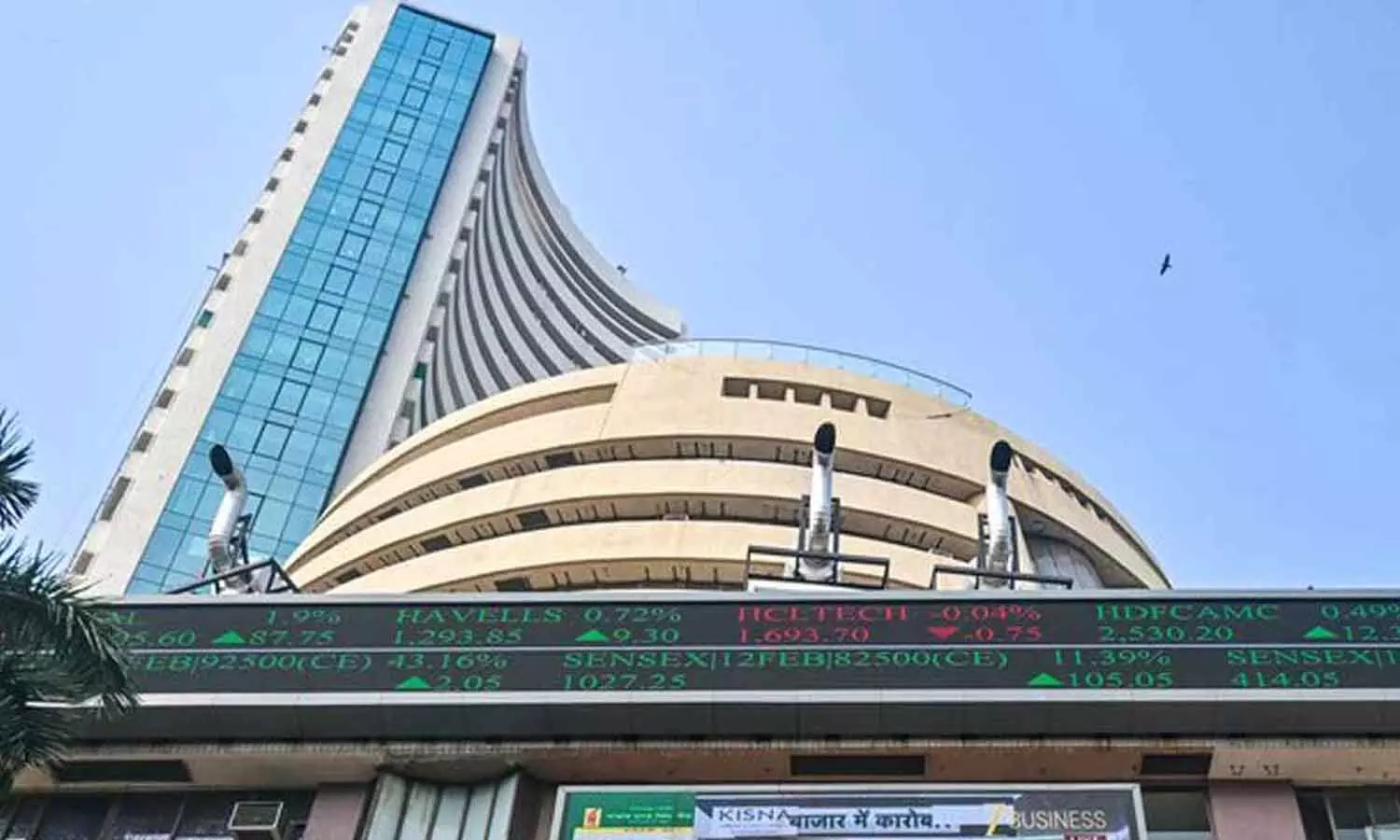
Sensex, Nifty post early gains over correction in crude prices
Fears of elevated crude prices, soaring inflation, continued FII selling and global monetary tightening weighed on sentiment and stock market corrected for sixth consecutive week.
Despite mild recovery during the later part of the week ended, benchmark indices the Sensex and the Nifty fell by over 0.5 per cent to close at 74295 and 23346 respectively. Broader market witnessed pockets of profit taking.
FIIs remained net sellers for the fifth straight week, offloading Rs 7,620 crore. DIIs extended their buying streak with net purchases of Rs 11,232 crore, helping the index recover from its mid-week lows. FIIs have been net sellers of approximately Rs 7,041 crore in September so far, while DIIs have invested around Rs 36,219 crore in the month.
Market sentiment was also weighed down by the US Congress passing the “Lindsey O’Graham Sanctioning Russia and Iran Act of 2026,” which provides the US President with the authority to impose tariffs of up to 100 per cent on countries purchasing Russian energy.
While the legislation does not automatically impose a 100 per cent tariff on Indian goods, it increases the potential trade and geopolitical risks for India, given its continued imports of Russian crude, with the possibility of higher tariffs remaining a key overhang for market sentiment. The external position of India has strengthened materially.
Forex reserves rose to a record $785.7 billion, aided by dollar inflows through RBI measures, while India’s net US Treasury purchases surged to a record $15.2 billion in July from $3.39 billion in June, highlighting improved reserve adequacy and providing a cushion against rupee volatility.
After rate hike by the US Fed, global monetary policy remains a key focus after the Bank of Japan raised rates by 25 bp to 1.25 per cent, a 31-year high, while the Bank of England kept rates unchanged at 3.75 per cent in a hawkish hold, signalling it could raise rates soon if energy-driven inflation persists. This hawkish tilt across major central banks, alongside persistent inflation concerns from elevated energy prices, could keep global bond yields and currency markets volatile.
Moody’s Ratings has raised its growth forecast for India for the current financial year by a full per centage point to 7 per cent, citing stronger-than-expected economic momentum and the economy’s resilience to disruptions triggered by the conflict in the Middle East.
Moody’s expects India to continue growing faster than all other G20 economies. Small and Mid-cap stocks remain the most interesting part of the market, offering stronger earnings growth and access to a pool of entrepreneurial young companies that is increasingly being overlooked elsewhere in the world.
The attraction is not just the size of the universe but the quality of the growth opportunities. In many markets in the world, the small-cap sector is being ignored. People across the world are investing more and more just in the big caps, “Whereas in India, it’s the opposite.” The large-cap segment no longer offers the same growth profile that it did during some of India’s strongest structural growth phases. The mood is not euphoric, but it’s not gripped by fear. Going ahead, sustained FII selling and global headwinds are likely to keep markets volatile, while steady domestic institutional buying should continue to limit the downside. Market participants will need to closely track Brent crude prices, US-Iran geopolitical developments, and upcoming US and domestic PMI data for cues on the near-term direction.
Follow market trends and history. Don’t speculate that this particular time will be any different. For example, a major key to investing in a specific stock or bond fund is its performance over five years.
FUTURES & OPTIONS / SECTOR WATCH
Unnerved by the developing “imbroglio” in Tata Group and negative global cues, benchmark indices marked their sixth consecutive weekly decline. Despite recovery from weekly lows, sentiment is weak and market players lack confidence over near-term direction of market. Among sectors, FMCG and Health Care were among the few to post gains on the weekly chart. Consumer Durables, Chemicals and PSUs were the major underperformers during the week. In the options segment, strong Call open interest for Nifty was observed at the 23,500 and 23,700 levels while major Put open interest was concentrated at the 23,300 and 23,000 levels. For Bank Nifty, significant Call open interest was seen at 57,000 level whereas notable Put open interest was also placed at the 56,000 level. Implied volatility (IV) for Nifty’s Call options settled at 11.29 per cent while Put options concluded at 12.37 per cent. The India VIX, a key indicator of market volatility concluded the week at 12.29 per cent. The Put-Call Ratio Open Interest (PCR OI) stood at 0.84 for the week. Spot Nifty oscillated in a 476.75-point range before settling at 23,346.40. The close near the lower half of the weekly range reflects renewed selling pressure, although the index continues to hold above the important 23,000–23,100 support zone created by the most recent swing low. Markets are likely to see a tentative and largely range-bound start to the coming week unless either boundary of this immediate trading zone is violated. Resistance is expected at 23,500 and 23,780; support is placed at 23,100 and 22930. For Bank Nifty the 56,800–57,000 zone is likely to act as an immediate hurdle, while a sustained move above 57,000 could extend the pullback towards the 57,300 level. Market players are advised to take a measured, stock-specific approach while avoiding aggressive directional exposure. Fresh buying may be kept selective while Nifty remains below 23,500, and existing profitable positions should be managed with appropriate protection.
Stocks looking good are APL Apollo, Alkem, Colgate, RVNL, Tata Steel and Mankind. Stocks looking weak Ather Energy, Bajaj Auto, NTPC, Sagility, SBI Cards and TCS.
West Coast Paper Mills Limited
The company is a producer of paper for printing, writing and packaging in India. The company’s segments include Paper and Paper Board and Optical fiber cable. In Paper division, its product categories include Premium Printing Papers, Business Stationary, Printing & Writing Papers, Security & HI-Value Grades Paper, Cup Stock & Coated Duplex Board and MG Varieties. Its product line features all grades of paper and boards ranging from 52 to 600 grams per square meter (Gsm). The Company offers WESCO-brand premium printing paper to suit high-end printing applications. It presents a wide range of WESCO brand specialty and value-added products to the packaging industries, viz. cup stock varieties, folding box board and single and double-coated board with gray back & kraft back. West Coast Optilinks (WCO), the company’s cable division and formerly known as Sudarshan Telecom, is a prominent Indian manufacturer and exporter of optical fibre cables. WCO runs a state-of-the art production facility located in the high-tech electronics zone of Mysore, manufacturing a wide portfolio of optical fibre cables catering to diverse applications. In response to growing global demand driven by 5G deployments, West Coast Optilinks has expanded its production footprint by commissioning a new manufacturing unit at Fab City, Hyderabad, Telangana, effectively doubling its optical fibre cable capacity. Commercial operations at this facility commenced on February 14, 2024. Buy on declines for medium term target of Rs1,250.
Social harmony can’t be achieved through political slogans
Punjab and UP elections: A litmus test for Congress: Beyond SIR, where is the development agenda?
Devices aren’t lasting as long as they should, here’s why
BHEL targets Rs 3,000 crore profit; HMT factory to be revived soon: Kumaraswamy
K’taka govt dealing with Centre in name only over drought: Kumaraswamy
Chhattisgarh govt announces 1,703 govt jobs ahead of Diwali


