






- Rs 32.49L cr bet post CII Partnership Summit 2026: Naidu with a fire in the belly nudges AP towards an industrial revolution
- Name Of The Game Is Speed Of Doing Business...State gets into mission-mode to emerge as industrial juggernaut
- Wealth needs health: the missing line in your retirement plan
- New HMDA chief urges inter-departmental synergy
- 57 ancient temples brought under Hyderabad-based trust initiative
- Gujarat CM attends hospitals and healthcare expo 'Hospica 2026', confers excellence awards
- Erode's organic palm jaggery reaches Europe for the first time, India's chocolate exports rise 25 pc
- Delimitation Bill a victory for South India, says BRS leader KTR
Oil, inflation and tariffs test Dalal Street’s nerve
In Short
Resilient growth and robust earnings are opening fresh opportunities across sectors

Share :
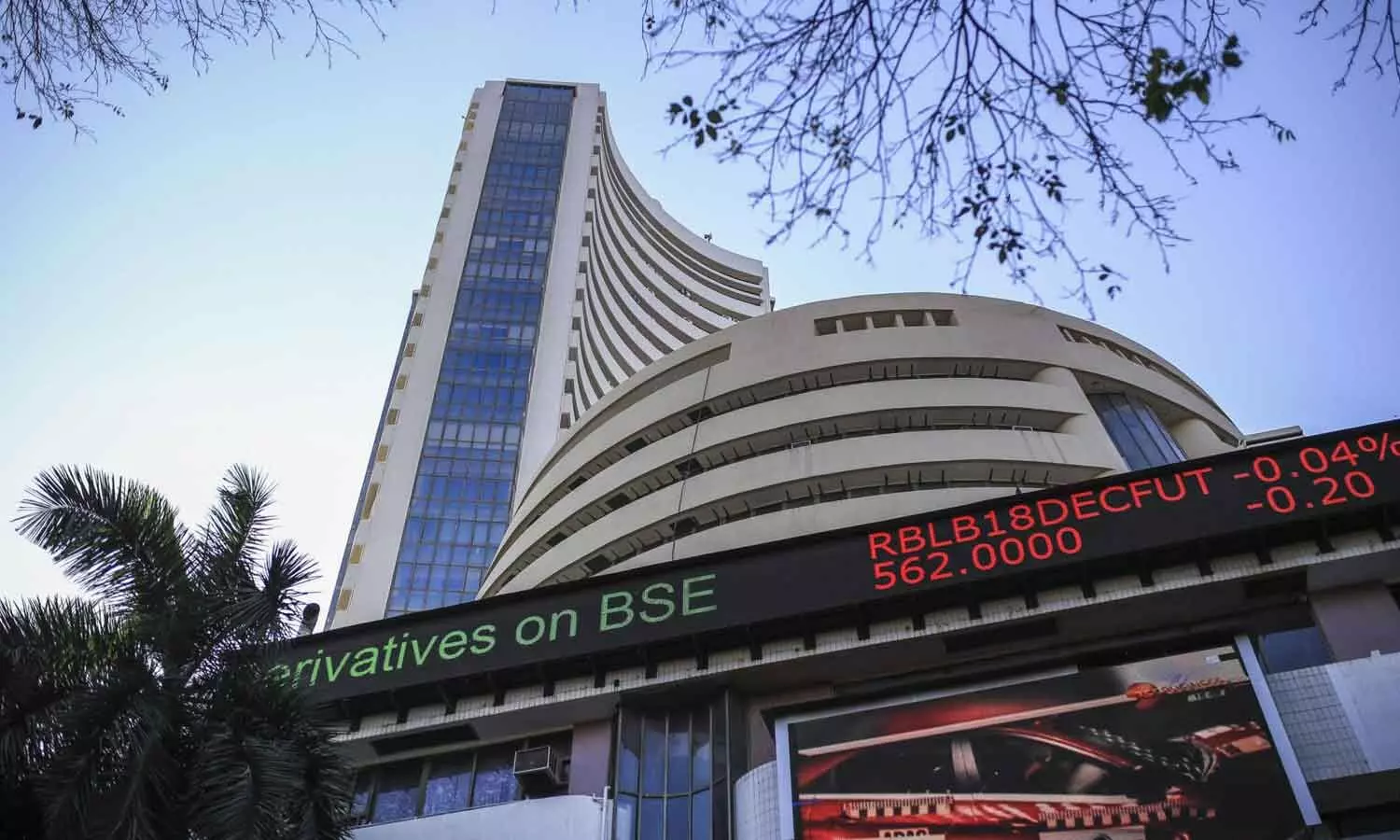
Oil, inflation and tariffs test Dalal Street’s nerve
Weighed down by rising crude oil prices, concerns over inflation and rupee depreciation; equities snapped a four-week winning streak.
The Nifty and the Sensex declined 0.7-0.8 per cent to settle at 25,607.20 and 83,339.26 during the week. Broader market outperformed moderately with the Nifty Midcap 100 index declining just 0.3 percent and the Nifty Smallcap 100 index ending marginally higher.
Despite moderating their buying, FIIs extended their buying streak for the fifth consecutive week, purchasing equities worth Rs17,629.73 crore. Meanwhile, DIIs snapped their three-week selling streak, turning net buyers with equity purchases worth Rs6,332.9 crore. The Indian rupee ended lower at 92.99 per US dollar, declining 32 paise (0.34 per cent) from the previous week’s close of 92.67.
During the week, the domestic currency traded in a range of 92.18–93.01 against the US dollar. Domestic inflation continued to be a concern, with October CPI inflation rising to 6.09 per cent and food inflation reaching 8.94 per cent. On the positive side, industrial activity remained encouraging, with September IIP growth at 6.7 per cent, supported by manufacturing.
Oil prices posted first weekly gain in November as relentless attacks raise supply worries. Escalation of the conflict could have substantial long-term consequences for global oil supplies with geopolitical uncertainty to contribute a larger risk premium to oil prices.
Attention will now shift towards the RBI’s Monetary Policy Committee meeting scheduled for December 2–4, with investors assessing the possibility of another rate increase amid elevated inflation. Near term market direction will be influenced by macroeconomic factors from both domestic and abroad.
Globally, China’s manufacturing PMI, upcoming US economic releases, the Federal Reserve’s December policy outlook, Bank of Japan rate expectations and developments in US-China trade relations are factors to watch out for. The Office of the US Trade Representative (USTR) has proposed tariffs of up to 25 per cent on Indian goods over alleged structural excess manufacturing capacity, with an offer to lower the rate to 17 per cent if India and the U.S. conclude a bilateral trade.
It is pertinent to observe that USA has specifically flagged the Make in India initiative, Atmanirbhar Bharat and the PLI schemes for promoting manufacturing and exports without necessarily being aligned with market demand. Sources however indicate that India and the United States are close to wrapping up a long-anticipated trade deal. Indian equity markets are navigating an evolving business cycle, with resilient economic growth, improving earnings and relatively lower valuations creating fresh opportunities across sectors.
With the terrain shifting from Midcap / Smallcap universe to Largecap, the challenge for investors is not just identifying the next market leaders; it is also recognising when yesterday’s winners may no longer offer the same risk-reward potential. Don’t chase market leaders blindly; focus on sustainable earnings growth and reasonable valuations with disciplined approach. A transformative shift in retail investment behaviour is evident from the growing popularity of Systematic Investment Plans (SIPs) indicating a resilient, disciplined and informed approach adopted by retail investors. The annual SIP contributions increased by 3.5 times to Rs. 3.5 lakh crore in FY2026 over the past six years, while the monthly contributions reached a new high of Rs 32,297 crore in August 2026.
SEBI advisory directing registered intermediaries and market participants to stop publishing, displaying, or circulating unofficial IPO Grey Market Premium (GMP) figures and warning investors against GMP-linked transactions is very good step in right direction. Grey market transactions take place outside recognized stock exchanges without settlement guarantees or formal price discovery.
You’re an investor, not someone who can predict the future. Base your decisions on real facts and analysis rather than risky, speculative forecasts.
FUTURES & OPTIONS / SECTOR WATCH
Mirroring the cash market, the derivative segment witnessed healthy market participation and sustained confidence. However, open interest trends point to profit booking and position lightening following the sharp rally in the preceding weeks. Concerns over the Trump administration’s proposed increase in import tariffs capped market gains.
Continued FII buying is acting as “oxygen” to markets. Among sectoral indices, IT, Capital Market and Defence stocks emerged as major gainers while profit booking was seen in Media, Metal and PSU Bank stocks. In the options segment, significant Call open interest in Nifty was observed at the 26,000 and 25,800 levels while major Put open interest was concentrated at 25,700 and 25,500 strikes.
In Bank Nifty, substantial Call open interest was seen at 64,000, while significant Put open interest was concentrated at 63,000 highlighting these levels as important resistance and support zones respectively. Implied volatility (IV) for Nifty’s Call options settled at 14.23 per cent while Put options concluded at 15.45 per cent. The India VIX, a key indicator of market volatility concluded the week at 16.83 per cent. The Put-Call Ratio Open Interest (PCR OI) stood at 1.31 for the week.
Nifty witnessed a strong rally during the November series, advancing 11.4 per cent on a series-on-series basis to close at 25,369. The rollover percentage stood at 75.54 per cent, higher than both its three-month average of 74.80 per cent and six-month average of 74.39 per cent, indicating healthy rollover participation. Bank Nifty staged a sharp rally during the November series, surging 15 per cent on a series-on-series basis to close at a fresh lifetime high of 62,600.
Despite the strong price performance, rollover participation moderated to 70.30 per cent, significantly lower than the previous expiry and below both its three-month average of 77.92 per cent and six-month average of 77.74 per cent. Rollover costs moderated across both benchmarks compared with the previous expiry. Nifty rollover cost eased to 0.53 per cent from 0.78 per cent, while Bank Nifty rollover cost declined to 0.52 per cent from 1.10 per cent.
Most rollovers in Nifty were concentrated in the 25,500–25,550 futures zone and in Bank Nifty were concentrated in the 64,300–64,400 futures zone. The coming week is likely to see a stable start, with the levels of 25,950 and 26,300 acting as potential resistance points. The supports come in at 25,350 and 25,100. It would be prudent to focus on stocks displaying strong relative strength and avoid excessive leveraged exposures. A cautiously positive, stock-specific approach is advised for the coming week.
Stocks looking good are Angel One, BDL, Data Patterns, MCX, Solar Inds and TCS. Stocks looking weak are Ashok Leyland, Kaynes, RVNL, Shriram Finance, SBI Cards and Unominda.
(The author is a senior maket analyst and former vice-chairman, Andhra Pradesh State Planning Board)
STOCK PICKS:
E.I.D. – Parry (India) Limited (E.I.D. Parry)
The company is engaged in the business of Sweetness and Nutraceuticals. Amongst the leading sugar manufacturers in India, E.I.D. Parry’s 7 sugar plants are spread across South India. These state-of-the-art plants with a total sugarcane crushing capacity of 40,300 TCD, co-generation capacity of 140 MW and Distillery capacity of 598 KLPD. The company is a pioneer and world leader in organic spirulina and micro algal products in the Nutraceuticals space. ‘Parrys Spirulina’, with 3 major international certifications, is sold in more than 41 countries across the globe.
The company expanded into the Fast-Moving Consumer Goods (FMCG) segment in 2023 and has since broadened its footprint by introducing a premium range of super grains, including millets, dals, and rice. With over 235 years of heritage and trust, E.I.D. Parry is redefining sweetness for the modern consumer through a differentiated portfolio of sweeteners and value-added products. E.I.D. Parry is transitioning beyond traditional sugar towards a higher-value portfolio led by premium sweeteners, brown sweeteners, jaggery-based products and adjacent value-added products.
The company’s equity stake in Coromandel International Limited continues to provide substantial financial flexibility and strategic optionality, enabling it to mobilise resources for growth initiatives and manage financial commitments effectively. This was demonstrated during the year through the Company’s ability to fund the closure of PSRIPL without undue financial strain. Buy on declines for surprising target of Rs1,000 in medium term.
AP Panchayat elections live updates: Second phase of Andhra panchayat polls begins
Around 9336 contestants to fight third phase panchayat polls
Congress’s ‘Brother Stalin’ Outreach Fails; No Rethinking ‘Brother Stalin’ Tells ‘Brother Rahul’
Last-Minute Damage Control: Embarrassed Congress Runs to Allies
‘Death of democracy’: Rahul Gandhi on BJP ‘bid to redraw’ India's electoral map
President Murmu visits tribal freedom fighters’ museum, typical Mizo village in Mizoram


