






- Rs 32.49L cr bet post CII Partnership Summit 2026: Naidu with a fire in the belly nudges AP towards an industrial revolution
- Name Of The Game Is Speed Of Doing Business...State gets into mission-mode to emerge as industrial juggernaut
- Wealth needs health: the missing line in your retirement plan
- New HMDA chief urges inter-departmental synergy
- 57 ancient temples brought under Hyderabad-based trust initiative
- Gujarat CM attends hospitals and healthcare expo 'Hospica 2026', confers excellence awards
- Erode's organic palm jaggery reaches Europe for the first time, India's chocolate exports rise 25 pc
- Delimitation Bill a victory for South India, says BRS leader KTR
Between deluge and drought: Charting a resilient water future for the Telugu states
In Short
From Cyclone Murasu in Andhra Pradesh to prolonged dry spells in Telangana, erratic weather is testing the Telugu states. Discover how data-driven, integrated water management can secure their future.

Share :
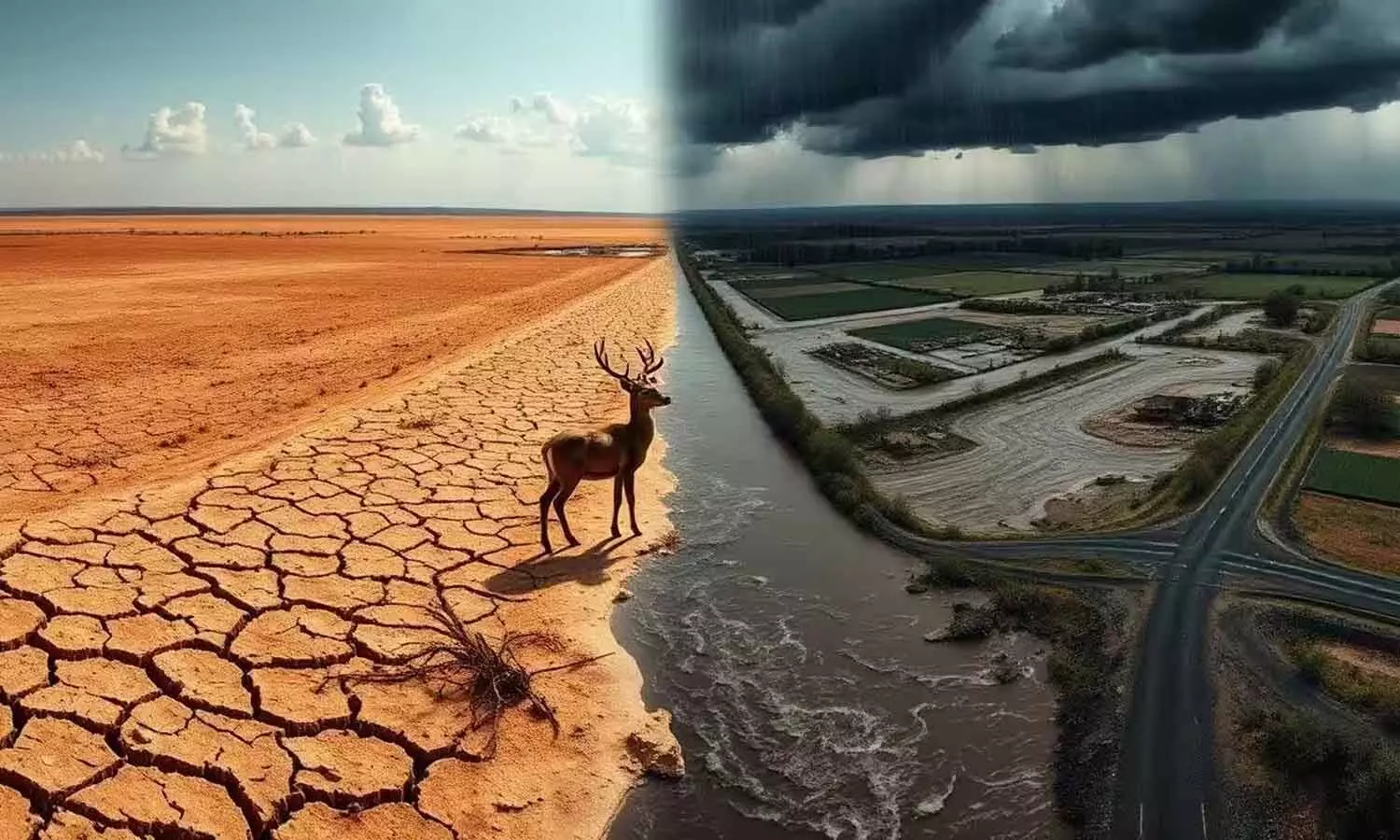
Between deluge and drought: Charting a resilient water future for the Telugu states
“Water is the driving force of all nature.” — Leonardo da Vinci
Across the Deccan plateau and the eastern coastline, Andhra Pradesh and Telangana share more than a linguistic heritage and the winding arteries of the Krishna and Godavari rivers. Today, the two Telugu states share an escalating vulnerability to a volatile climate.
While Andhra Pradesh frequently absorbs the violent fury of the Bay of Bengal—seeking substantial relief and infrastructure restoration in the wake of severe weather events like Cyclone Murasu—Telangana grapples with the slow-motion emergency of prolonged dry spells, rainfall deficits, and mounting financial pressures to complete and maintain capital-intensive irrigation projects.
Though one state battles sudden inundation and the other chronic scarcity, both confront the same underlying crisis: water governance systems built for a predictable climate are faltering in an era of extremes.
As El Niño patterns disrupt monsoon rhythms and erratic rainfall swings between cloudbursts and prolonged dry spells, existing infrastructure is being pushed to its limits. Simultaneously, rapid urbanisation—led by Hyderabad’s explosive demographic and industrial expansion—is placing unprecedented stress on municipal supplies. Navigating this dual threat requires a decisive shift from reactive crisis management to integrated, data-driven, and depoliticised water security.
Embracing integrated water management
For decades, water planning in the region has operated in silos—treating surface water, groundwater, urban supply, and flood control as separate domains. In reality, they form a single hydrological continuum. Coastal Andhra Pradesh’s cyclone resilience is directly linked to how upstream reservoirs in both states manage flood cushions and siltation. Conversely, Telangana’s dry-land agriculture depends on capturing sudden, high-intensity monsoon downpours before they run off into the sea.
Integrated Water Resources Management (IWRM) offers a vital corrective. By viewing the Krishna and Godavari basins as unified ecological units rather than contested political territories, both states can optimise reservoir operations. Real-time telemetry, shared meteorological forecasting, and coordinated dam release protocols can simultaneously mitigate downstream flood damage during cyclonic surges and maximise water storage for lean months.
Reviving the underground buffer
Beneath the surface lies the Telugu states’ most critical—and most neglected—insurance policy: groundwater. Over-extraction driven by free or heavily subsidised agricultural power, coupled with the encroachment of traditional water bodies, has severely depleted aquifers across Rayalaseema and northern Telangana. In booming urban hubs like Hyderabad, concretisation has choked natural percolation, turning moderate rains into urban floods while leaving borewells dry by summer.
Reversing this trend demands aggressive aquifer recharge. Telangana’s Mission Kakatiya demonstrated the potential of restoring traditional tanks (cheruvus) to revive rural water tables, while Andhra Pradesh’s groundwater monitoring networks have highlighted the need for community-led extraction discipline. Scaling up rainwater harvesting mandates in cities, protecting urban lakes from encroachment, and incentivising micro-irrigation—such as drip and sprinkler systems—can transform depleted aquifers back into resilient underground banks capable of buffering multi-year droughts.
Drought-proofing irrigation and prioritising drinking water
Mega-irrigation projects remain central to the developmental vision of both states, yet cost overruns, delayed timelines, and erratic inflows threaten their viability. Drought-proofing these projects requires moving beyond concrete canals to smart command-area development. Lining distribution networks to prevent seepage, adopting pressurised pipe irrigation, and aligning cropping patterns with local agro-climatic realities—such as encouraging millets and pulses over water-guzzling paddy in water-stressed zones—will ensure that every drop yields maximum agricultural value.
Crucially, climate-adaptive planning must establish a non-negotiable hierarchy of water allocation: drinking water first, ecological flows second, and agriculture and industry thereafter. As Hyderabad’s population swells and industrial corridors expand across both states, municipal water security cannot remain hostage to seasonal reservoir levels. Diversifying urban supply through treated wastewater recycling, industrial zero-liquid-discharge mandates, and dedicated drinking water reserves is essential to prevent acute urban water crises without starving rural farms.
Data over politics
Perhaps the greatest obstacle to long-term water security in the Telugu states is the politicisation of river waters and project financing. Inter-state disputes, shifting electoral priorities, and populist promises often overshadow hydrological science. When irrigation projects become political trophies rather than engineering and ecological assets, maintenance suffers and timelines slip.
(The writer was former OSD to Union Civil Aviation Minister)
AP Panchayat elections live updates: Second phase of Andhra panchayat polls begins
Around 9336 contestants to fight third phase panchayat polls
Congress’s ‘Brother Stalin’ Outreach Fails; No Rethinking ‘Brother Stalin’ Tells ‘Brother Rahul’
Last-Minute Damage Control: Embarrassed Congress Runs to Allies
‘Death of democracy’: Rahul Gandhi on BJP ‘bid to redraw’ India's electoral map
President Murmu visits tribal freedom fighters’ museum, typical Mizo village in Mizoram


