






- Vaccinate on time and stay protected for a lifetime: Dr Bharath Reddy
- Dumping yard on Ravvala Konda to be shifted soon
- Collector Himanshu Shukla issues panchayat poll guidelines
- SP encourages students to focus on studies, maintain discipline and aim high
- Dedicated sanitation efforts earn Atmakur hospital state-level recognition
- Libraries are true treasure of knowledge: Waqf Board chief
- Prevent public hardships and protect public property: MLA
- Childrens’ Green Festival celebrated
An unconventional voice in Indian poetry
In Short
Romanticism remains central to Choudhary’s poetic imagination. Love, melancholy, nature, beauty, mythology and sensuousness frequently find expression in his work.

Share :
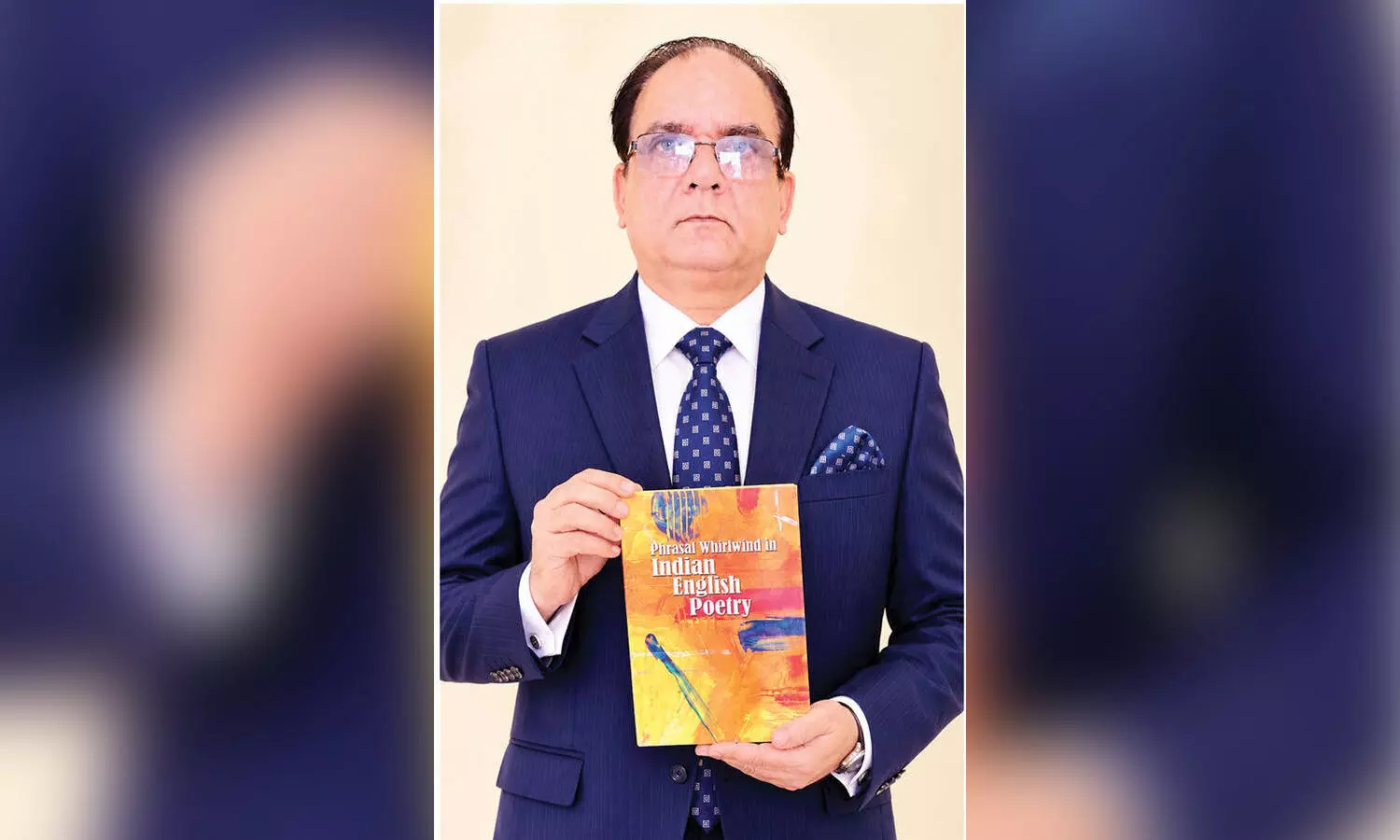
An unconventional voice in Indian poetry
Arbind Kumar Choudhary, known as ‘The Phrasal King’, has carved a distinctive place in Indian English poetry through his experimental sonnets and innovative use of language. His literary journey blends romanticism, Indian cultural heritage and a constant search for new forms of poetic expression
Arbind Kumar Choudhary, founder of the Phrasal Movement and widely recognised as ‘The Phrasal King’, has developed a distinctive identity in Indian English poetry through his experiments with sonnets, language and cultural expression. His literary journey reflects a commitment to innovation while remaining rooted in India’s rich literary and spiritual traditions.
Arbind Kumar Choudhary has carved a distinct place for himself in contemporary Indian English poetry. As the founder of the Phrasal Movement, the Indianised Version of Arbindonean Sonnets and the Arbindonean Racy Style of Verification, he has consistently explored new possibilities in poetic expression.
Reflecting on his literary journey, Choudhary says, “Poetry should never be restricted to established forms. It must have the freedom to experiment with language, structure and ideas while remaining connected to its cultural roots.”
His literary presence extends beyond India, with seven published interviews across America, Romania, Malta, Albania and Ethiopia, besides nearly sixty interviews in English-language publications. His recognition as an Ambassador of Peace by Poetry by Gabriel Simond and the introduction of the ‘The Phrasal King Arbind Choudhary Poetry Award’ by the Mahatma Gandhi Education and Welfare Society, Mumbai, have further strengthened his literary standing.
Romanticism remains central to Choudhary’s poetic imagination. Love, melancholy, nature, beauty, mythology and sensuousness frequently find expression in his work. His use of sensuous imagery has invited comparisons with John Keats, while the poetic philosophy expressed in ‘The Poet’ recalls the romantic principles articulated by William Wordsworth in the preface to ‘Lyrical Ballads’.
“Romanticism has always been an important part of my writing. Nature, love, beauty and human emotions provide endless possibilities for poetic expression. At the same time, I enjoy experimenting with mythology, imagery and language to create something distinctive,” he says.
His literary approach goes beyond conventional romanticism. By bringing together Indian, Greek and Roman mythology, proverbial expressions, inventive linguistic formations and culturally rooted imagery, Choudhary has developed an experimental style of his own.
One of his significant contributions is the Indianised Version of Arbindonean Sonnets, which seeks to move beyond established Shakespearean, Petrarchan and Spenserian traditions. His collections ‘Mother India’ and ‘The Forgotten Champion’ showcase this approach through a structure comprising three rhymed phrasal quatrains followed by a rhymed phrasal couplet.
“I have always wanted to explore a poetic structure that reflects my own literary vision. The sonnet has a rich tradition, but there is also room to experiment with its form, rhyme and rhythm,” Choudhary explains.
His hundred sonnets celebrating Veer Lachit Borphukan further demonstrate his engagement with Indian history and cultural identity. In ‘Majuli: The Vatican City of Assam’, he brings Christian symbolism into conversation with the Vaishnavite traditions of Majuli’s Satras. The collection establishes an interesting connection between two spiritual worlds, with Vatican representing the form and Majuli embodying the soul.
Another distinctive feature appears in ‘The Forgotten Champion’, where recurring concluding lines in the stanzas create a recognisable rhythmic and phrasal identity. These elements also invite critical exploration through linguistic, phonetic and subaltern perspectives.
Choudhary’s philosophical interests emerge through works such as ‘Melody’, ‘Love’, ‘Nature’ and ‘The Poet’. Together, these poems explore suffering, affection, the natural world and the purpose of poetry.
“Poetry gives us an opportunity to look beyond everyday concerns and understand human emotions more deeply. It preserves imagination, cultural memory and sensitivity, especially in a world increasingly occupied with material pursuits,” he says.
His literary contribution has also attracted academic attention. Seven critical anthologies have been devoted to his poetry, while doctoral research titled ‘Aspects of Love and Relationship in the Works of A.K. Choudhary’ is being pursued at Pacific University, Rajasthan. His collections ‘Majuli: The Vatican City of Assam’, ‘Mother India’ and ‘The Forgotten Champion’ have also found a place in graduate and postgraduate curricula at Sibsagar University, Assam.
With twelve poetry collections and an expanding body of critical scholarship, Choudhary continues to explore the relationship between poetic innovation, cultural identity and human experience. His work represents an unconventional presence in Indian English literature, driven by a continuing interest in expanding the possibilities of poetry while preserving its emotional and cultural depth.
PM Modi to mark Janjatiya Gaurav Diwas in Maha today; inaugurate projects worth Rs 3,000 crore
May Lord Surya, Chhathi Maiyya bring happiness, peace into your lives: CM Yogi extends greetings
AP sets up special panels to combat human trafficking
AP Municipal Polls: Nominations open for 25 ULBs amid tight security
Cyclone ‘Akvan’ likely to hit AP coast on Nov 18
Special Security Scheme launched for gig workers


