






- Ten years after demonetisation: Time for an honest assessment
- We went for a peaceful protest: Shiv Charan
- Congress approaches Women’s Commission against Owaisi
- Telangana: Rs 5L cover for 1 member aged between 18 and 59
- Shared civilisational heritage key to stronger SCO cooperation: Gajendra Singh Shekhawat
- PM Modi praises Nitish Kumar's leadership, says Bihar's development journey continues under CM Samrat Choudhary
- ‘It was a great pleasure’: PM Modi after meeting Nitish Kumar at Patna airport
- Google Creates a Fake Internet to Test Its AI
When history meets poetry
In Short
The collection’s distinctive literary identity rests on its extensive use of phrasal expressions and linguistic experimentation.

Share :
When history meets poetry
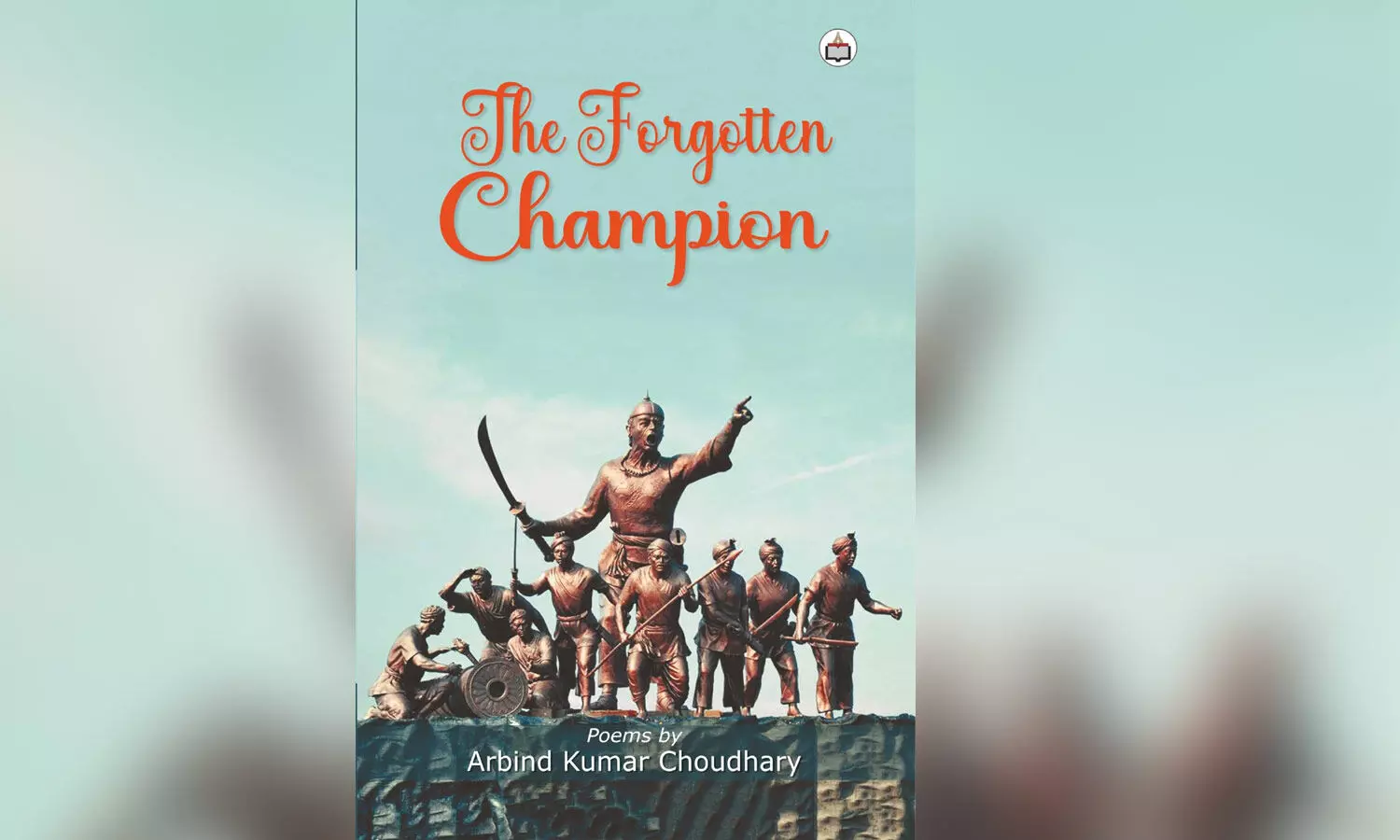
History remembers some heroes through monuments and textbooks, while others survive largely through regional memory. In ‘The Forgotten Champion’, Arbind Kumar Choudhary turns to Ahom General Lachit Borphukan, whose leadership during the Battle of Saraighat in 1671 helped halt the Mughal advance into Assam. The book’s 118 Indianised versions of what the poet calls Arbindonean Sonnets place military courage alongside duty, sacrifice and collective identity. The episode of Lachit ordering the punishment of his own maternal uncle, who had neglected his responsibilities, reinforces the central message that national duty must take precedence over personal relationships. Choudhary goes beyond historical narration to explore the deeper significance of patriotism, cultural identity and the preservation of India’s lesser-known historical legacies. Through this collection, Lachit Borphukan emerges not merely as a military commander but as an enduring symbol of courage, discipline and devotion to the motherland.
The collection’s distinctive literary identity rests on its extensive use of phrasal expressions and linguistic experimentation. Phrases such as ‘rule with a rod of iron’, ‘blank cheque of nation’ and ‘press the button of sensation’ demonstrate Choudhary’s fascination with the creative possibilities of English phraseology. Phrasal verbs such as ‘abide by’, ‘hanker after’, ‘strike out’ and ‘save the situation’ contribute to the distinctive linguistic texture of his poetry. His wordplay, including expressions such as ‘compulsion of repulsion’, ‘action of reaction’ and ‘cultivation of salvation’, reflects an imaginative engagement with sound, rhyme and meaning. Another significant aspect is the blending of Indian and Western mythological traditions. Greek and Roman figures such as Titan, Vulcan, Orion, Samson and Satan appear alongside Indian figures, including Hanuman, Drona, Murugan, Shaktiman and Shravan. This cultural convergence creates an expansive literary landscape in which diverse civilisations and traditions find a common poetic expression.
Choudhary’s engagement with Indian geography and cultural heritage further strengthens the collection’s identity. Majuli, associated with Assam’s Vaishnavite traditions, Sonitpur, rooted in mythological narratives, and Jatinga, known for its unusual bird phenomenon, become important geographical and cultural references. Expressions such as ‘Sher-e-Vatan’, ‘Shaheed-e-Vatan’, ‘Gaddar-e-Vatan’ and ‘Khuddar-e-Hindustan’ introduce an Urdu-inflected vocabulary that enriches the Indian character of the poems. Equally interesting is the poet’s attempt to establish an independent sonnet structure. While Shakespearean sonnets are celebrated for their dramatic imagery and exploration of love, Petrarchan sonnets frequently employ the octave and sestet to develop emotional and philosophical arguments, and Spenserian sonnets are distinguished by their interlinked rhyme scheme, Choudhary’s Arbindonean form emphasises Indian idiom, proverbial expressions and moral reflection. Its three linked movements of three lines each, followed by a closing couplet, are supported by recurring refrains. The line ‘Amidst many a turn of the Saturn’ functions as a recurring poetic anchor, lending musical continuity and philosophical direction to the compositions.
What makes ‘The Forgotten Champion’ particularly interesting is its effort to bring together historical consciousness, Indian cultural traditions and formal innovation within the framework of English poetry. Choudhary’s Arbindonean sonnet represents his attempt to create a distinct poetic identity rooted in Indian sensibilities while engaging with an established European literary form. His preference for rhymed phrasal passages, recurring refrains, musical patterns and inventive expressions reflects a sustained interest in expanding the possibilities of Indian English poetry. The collection also celebrates the idea that literature can preserve historical memory and introduce forgotten personalities to new generations of readers. Veer Lachit Borphukan’s extraordinary contribution to Indian history thus becomes the emotional and intellectual centre of a larger literary experiment. With ‘The Forgotten Champion’, Arbind Kumar Choudhary brings together the language of poetry, the spirit of patriotism and the richness of cultural inheritance in an ambitious tribute to a remarkable son of India.
(The writer is an Internationally Acclaimed Literary Critic, an eminent Columnist and the Founder of Authors Paradise Literary Group.)
An autobiography without introspection: A journey of lies
It has damaged trust and credibility of Hyderabad: KTR
AICC summons Raj Gopal Reddy
French co to invest Rs 4K cr in Telangana
Maha CM Fadnavis inaugurates high-tech facilities for Brihanmumbai Police Commissionerate
PM Modi says appeal to cut gold purchases helped bring down prices, credits citizens for heeding advice


