




- SIT questions Kodanda Reddy in phone-tapping case
- GHMC green lights 4.3km elevated corridor to unclog KBR-NFCL stretch
- With two days left, officials ask people to submit details ASAP
- Country moving in a democratic way: BJP
- CEC changed Form 6 illegally, unilaterally
- SC: Will annul EC decisions not taken by unanimity or majority
- Power consumers to bear true-up charges
- Anurag Kashyap joins Chiranjeevi’s ‘Kaaka’
A Life Well Planted
In Short
Jyothi Reddy’s journey from education to organic farming reflects a lifelong commitment to nature, simplicity and community. At Uma Retreat near Mulugu, the values she has nurtured over decades are taking root in a space created to reconnect people with the land

Share :
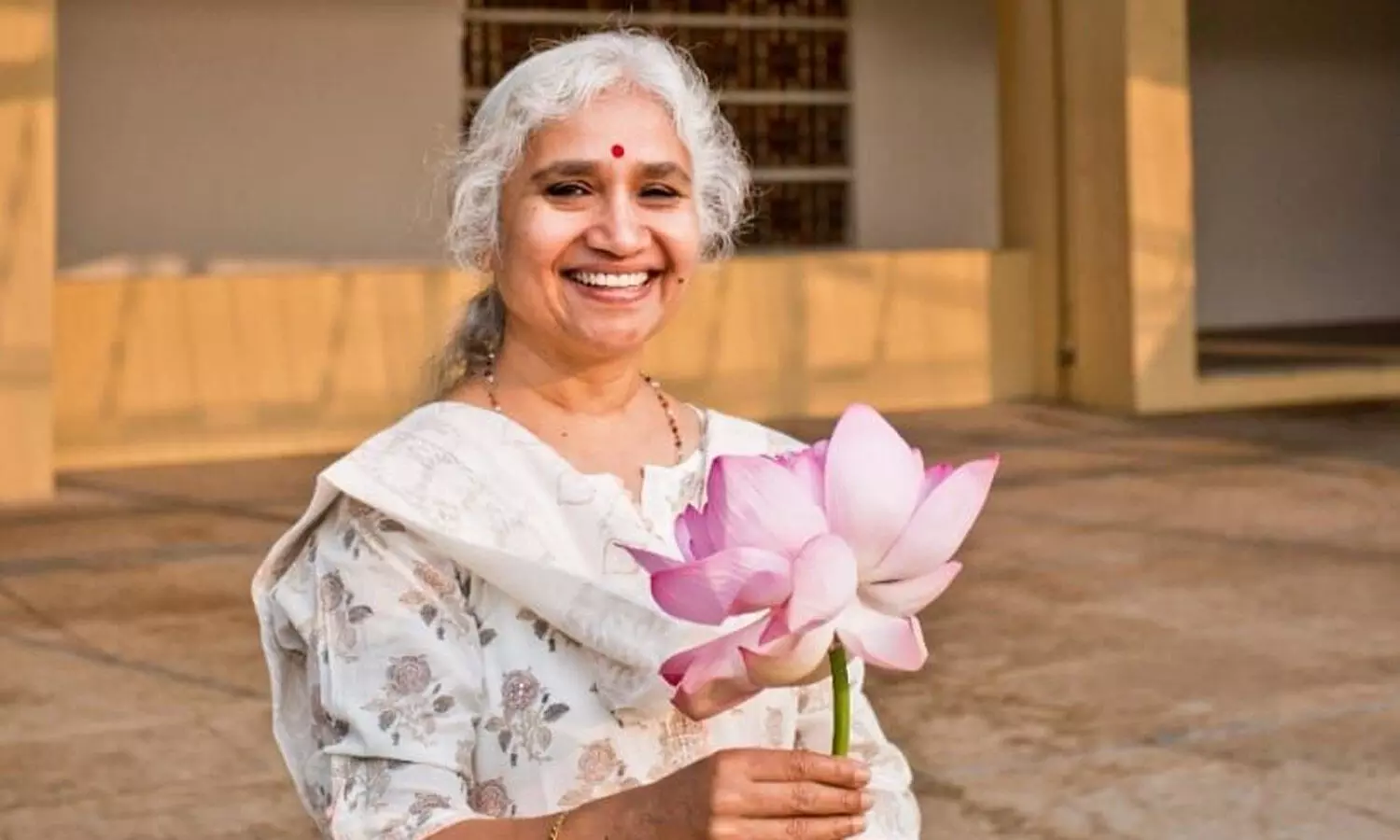
Jyothi Reddy
“Uma Retreat”, Jyothi Reddy’s yet-to-open retreat near Mulugu, outside Warangal, is spread across a green, carefully nurtured landscape of lotus ponds, birdsong and old trees, dominated by a magnificent banyan. It is a far cry from what the land must have been when she first began working here.
We walked along the wooded bund she had created, with Dheera and Sapora, her two cheerful dogs, following close behind, their tails wagging. The conversation unfolded naturally as we walked. “I love animals and nature. That has always been my first love,” she told me. Her affection for the land was evident in the way she spoke about it, without fuss or self-importance.
Her life, however, has not been an easy one. After graduating from Osmania University, Jyothi spent 23 years running a school in a village, often working under the shadow of opposition and the fear of Naxalites. What kept her going?
“I strongly believed in education. I felt it was almost a divine science — a guiding force that helped me move forward, whatever the challenges.”
The village taught her as much as she taught its children. “There is a natural rhythm in village life. People depend on nature and on each other. That itself creates a sustainable community.”
She admired the people around her, particularly the women. “Nothing is handed to them on a platter. They have to strive for everything. Yet they move forward with faith and trust in their community.” Their hard work and dependence on nature left a lasting impression on her.
Her own ideas about simplicity were also shaped by Father Bede Griffiths, the Benedictine monk who later became known as Swami Dayananda. “He deeply moved me. I learnt from him that simplicity in life is truly beautiful.”
Her ecological journey began taking shape in 1992. Influenced by Jiddu Krishnamurti’s writings and her practical learning in organic farming at the Aurobindo Ashram, she began planting trees and farming organically on this land. The response from local farmers was hardly encouraging.
“They told me, ‘Nothing will grow here.’”
She carried on regardless.
Through the educational and ecological foundation she established, children learnt natural farming, waste segregation and composting. Tree-planting drives were taken to 14 neighbouring villages that had no fruit trees. She wanted children to learn not merely from books but by caring for the soil and plants around them.
Years later, the same farmers who had doubted her came to her door. “They told me I was a pioneer in organic farming in the district and that my success had inspired them.” She smiles at the memory.
There were darker moments, too. At one point, people tried to shut down her school. When they could not find Jyothi, they harassed the teachers instead. “I felt completely defeated. I thought 12 years of hard work were going down the drain.”
Help came unexpectedly. The local administration and the Superintendent of Police intervened. The SP, who had never met her, came to the school, barricaded the property and brought people from three neighbouring villages inside. Looking around, he told them that even he, an IPS officer, had not studied in such a beautiful school and asked why they were trying to destroy it.
“He could feel the love and care that had gone into the place,” Jyothi recalled. “You can have passion, but it is very difficult to build and sustain something without true love.”
Her years at Schumacher College in Dartington, South Devon, further widened her thinking. Studying under environmental thinkers such as Jonathan Porritt and others influenced by designer Victor Papanek, she returned with an even stronger desire to create spaces where people could learn from nature and from one another.
That led to projects such as her month-long “Journey to the Known and Unknown”, which brought 24 international participants from 15 countries to India. Their journey took them to the Krishnamurti Foundation in Chennai, Kalakshetra, Mahabalipuram, Auroville and Gloria Farm, before culminating in 10 days in her village. The villagers welcomed the visitors with tea, warmth and even name tags for the trees they planted together.
The seeds Jyothi planted at the school have travelled far beyond the village. Former students are now nurses, chartered accountants and police officers. Some of her former girl students, after becoming financially independent, returned to the sitar and classical dance they had learnt at school.
As we walked back, Dheera and Sapora still happily at our heels, it became clear that Jyothi’s story is not really about one school or one property. It is about the values she has consistently lived by — education, simplicity, care for the land and respect for every living thing.
And now, with Uma Retreat, named after her mother Uma Devi, she hopes to offer this land to people who value those same things: a place for children and young people, for workshops and meditation, for writing or simply spending time in nature.
“I want people to feel what has gone into this place,” she said. “I want them to experience something beyond an ordinary stay.”
Perhaps that is exactly what the walk had already offered me.
Belt shops fuel social distress across erstwhile Karimnagar
CEC Gyanesh Kumar: Resignation or removal?
TVK and Vijay in a battle of prestige
CM Naidu assures safe drinking water to every household
From one-star to two-star: Lokesh directs schools’ upgrade within a year
Five new AP High Court judges take oath


