




- Anurag Kashyap joins Chiranjeevi’s ‘Kaaka’
- ‘418’ set for a chilling Dasara release
- ‘Potireddypalli’ movie launched with chocolate star Pawan in lead role
- Regular shoot of ‘Due Date’ begins in Hyderabad
- Vishnu Manchu seeks action against deepfakes
- Poojitha Ponnada’s Narthaki look unveiled
- A Life Well Planted
- Shilpa Shetty doles out Monday motivation, shows her focus and coordination with ball exercises
CEC Gyanesh Kumar: Resignation or removal?
In Short
The CEC therefore has no personal veto over a majority decision.

Share :
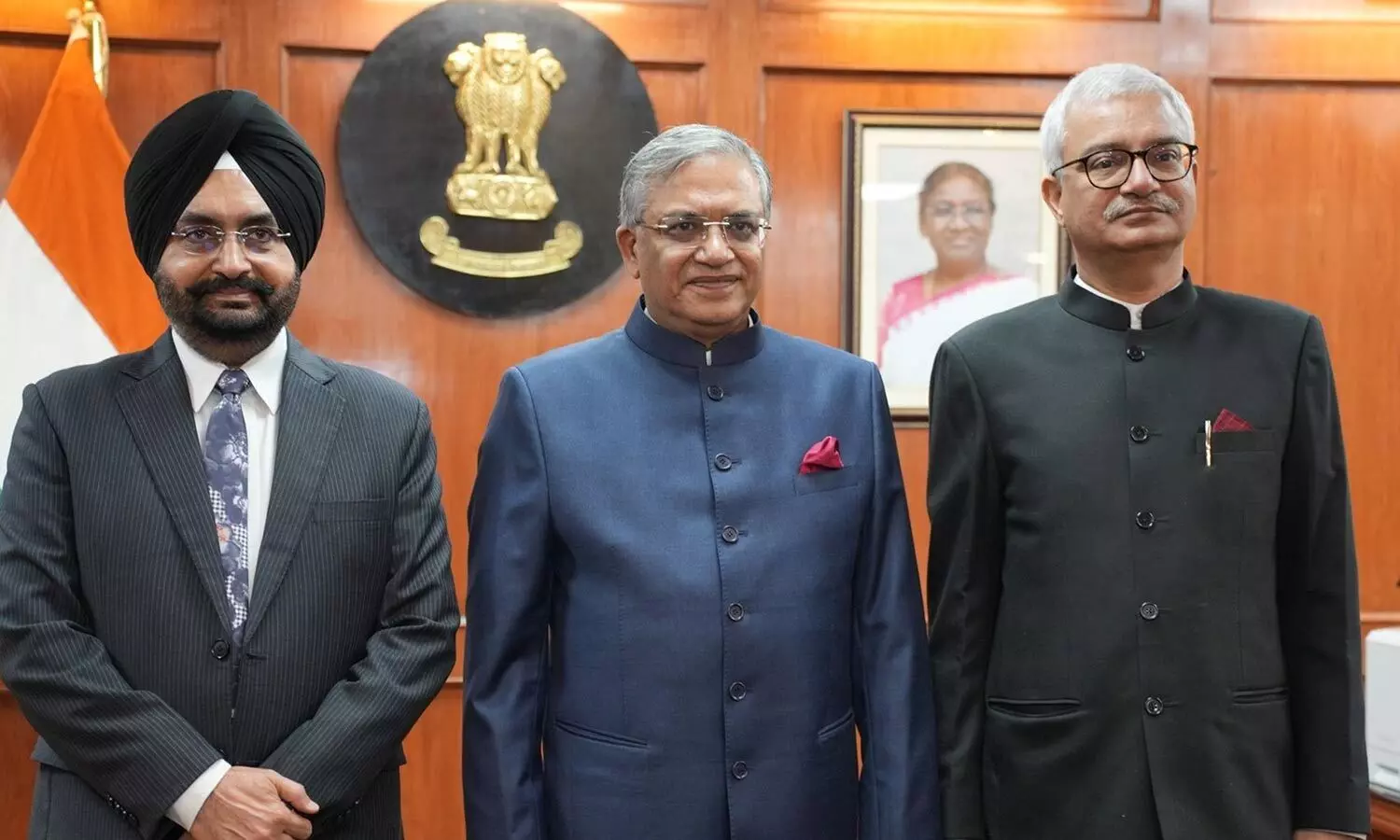
CEC Gyanesh Kumar: Resignation or removal?
The demand by the Congress and other Opposition parties for the resignation of Chief Election Commissioner Gyanesh Kumar raises a larger constitutional question: if the allegations against the CEC are serious enough to demand his exit, then why ask for his resignation rather than pursue his constitutional removal?
The answer requires distinguishing three separate issues: the legality of Election Commission (ECI) decisions, the Commission’s internal decision-making process, and the constitutional grounds for removing a CEC. Recent media reports indicate that Election Commissioners Sukhbir Singh Sandhu and Vivek Joshi recorded objections on at least 14
occasions in over ten months on matters like voter registration and deletion, Form 6, electoral-roll appeals, centralisation of the electoral database and aspects of the Special Intensive Revision (SIR).
The Election Commission, however, maintained that its actions were in accordance with law and that the final decisions, including those concerning SIR, were taken with the approval of all three Commissioners.
The crucial question, therefore, is not simply whether dissent existed, but what happened to those objections and how the final decisions were made.
CEC is not the Election Commission!
The Chief Election Commissioner is not the Commission by himself. The Supreme Court’s decision in T N Seshan v. Union of India recognised the multi-member character of the Commission and majority decision-making. The present statutory framework is even more explicit. Section 18 of the Chief Election Commissioner and Other Election Commissioners Act, 2023 provides that the Commission should transact business unanimously as far as possible. Where the commissioners differ, the matter is to be decided according to the opinion of the majority.
Thus, in a three-member Commission:
Unanimous agreement produces a unanimous decision; one commissioner may dissent while the other two prevail; if the CEC disagrees with the other two commissioners, the remaining two will naturally be the majority.
The CEC therefore has no personal veto over a majority decision.
Significance of the 14 objections
This makes the reported 14 instances important, but the number alone proves nothing. There is a fundamental difference between a commissioner recording an objection during internal deliberations and two commissioners formally constituting a majority against the CEC.
That is why the official records matter more than political assertions.
For each of the disputed matters, the Commission should, subject to legitimate confidentiality and privacy concerns, and clarify what was proposed; what objections were recorded; whether the matter was formally placed before all three Commissioners; whether there was a vote; whether the decision was unanimous or by majority; and how the final decision was implemented.
If the records show that the two commissioners were subsequently persuaded and the final decision was unanimous, their earlier objections do not establish misconduct.
If they formed the majority and their decision was disregarded, the constitutional issue is substantially different.
Why demand resignation and not removal?
A demand for resignation is fundamentally political; removal is constitutional. The Opposition may argue that the controversy has damaged public confidence sufficiently for the CEC to step aside voluntarily. But resignation does not require proof of constitutional misconduct. Removal does. Article 324(5) provides that the CEC can be removed only “in like manner and on the like grounds as a judge of the Supreme Court.” This means that the relevant constitutional threshold is proved misbehaviour or incapacity. Therefore, an incorrect decision, an administrative error, a disagreement between Commissioners, or even an unlawful decision does not automatically establish grounds for removal. The evidence must go further.
Does one’s conduct amount to “proved” misbehaviour?
Potentially yes, provided the facts establish something substantially more serious than disagreement. Questions relevant to such an inquiry would include: Was a statutory procedure deliberately ignored? Were the other Commissioners deliberately excluded from a decision? Was a formal majority decision knowingly disregarded? Were official records deliberately concealed or manipulated? Was there knowing and serious abuse of constitutional or statutory power?
The 14 reported objections may therefore be material evidence, but they are not themselves proof of impeachable misconduct.
What about SIR?
This is the same distinction that is vital when talking about the Special Intensive Revision.
If, in the end, a court ruled that some parts of SIR were unconstitutional or contrary to statute that would make the action that the court ruled on illegal. It would not necessarily mean that all three Election Commissioners had “proved misbehaviour.”
Judicial review is not the same as removal proceedings. The court does not have to declare that all officials involved in an administrative action were wrong. In the context of removal, evidence would need to show the specific office-holder’s actions were in violation of the constitutional standard of proved misbehaviour or incapacity.
So, even if there were ultimately found to be significant constitutional flaws in SIR, the correct order would be: identify the unlawful action → establish responsibility → examine intent and conduct → determine whether the constitutional threshold for removal is met.
Removing all three commissioners:
There’s another constitutional issue. Article 324(5) gives special protection to the CEC, which is the same as given to Supreme Court Judge. The Constitution stipulates that in the case of an election commissioner other than the CEC; the Commissioner may only be removed on the recommendation of the CEC. Therefore, the constitutional removal processes for the CEC and the other Election Commissioners are not the same. More significantly, collective responsibility does not imply individual responsibility for each Commissioner in respect of a Commission decision. If all three were aware that they were engaged in serious and illegal activity, evidence against each could be used. However, if one Commissioner were to dissent from the decision, it would need to be carefully argued that they were equally responsible.
What about “impeachment”?
In political discussion, the proposed removal of the CEC is often called “impeachment”. Strictly speaking, Article 324(5) incorporates the removal standard applicable to a Supreme Court Judge. Under the Judges (Inquiry) Act framework, a removal motion requires the support of at least 100 Lok Sabha members or 50 Rajya Sabha members.
If admitted, an inquiry committee investigates the allegations. If the allegations of misbehaviour or incapacity are established, the matter proceeds to the Parliament. Each House must then pass the removal address by a majority in the House; and the presence of a two-thirds majority and voting.
So, what should the Opposition demand?
If the allegations against the President are serious, and Congress and other Opposition parties think they are, the best constitutional remedy is to determine the facts first and then take the proper action. They might seek the publication or scrutiny of the records of the 14 issues in question.
They were given the option to request independent technical and legal audits of the challenged SIR processes and electoral database.
The real question: majority or bypass?
The controversy ultimately turns on one decisive factual issue: Were Sandhu and Joshi merely dissenting Commissioners, or did they constitute most of the Commission on any of the disputed decisions?
If the CEC and one Commissioner supported a decision against the other Commissioner, the majority rule settles the matter.
If the two Election Commissioners opposed the CEC and formally constituted the majority, Section 18 says their majority view should prevail.
The documentary record should therefore come first.
(The writer is a Professor and Advisor, School of Law, Mahindra University, Hyderabad)
CM Naidu assures safe drinking water to every household
From one-star to two-star: Lokesh directs schools’ upgrade within a year
CEC Gyanesh Kumar: Resignation or removal?
TVK and Vijay in a battle of prestige
Five new AP High Court judges take oath
Call for Trinamool rebels' return: Mamata Banerjee has reconciled earlier with certain defiant party leaders


