
Exploring shadows: Meera Bhansali’s paranormal poetry journey
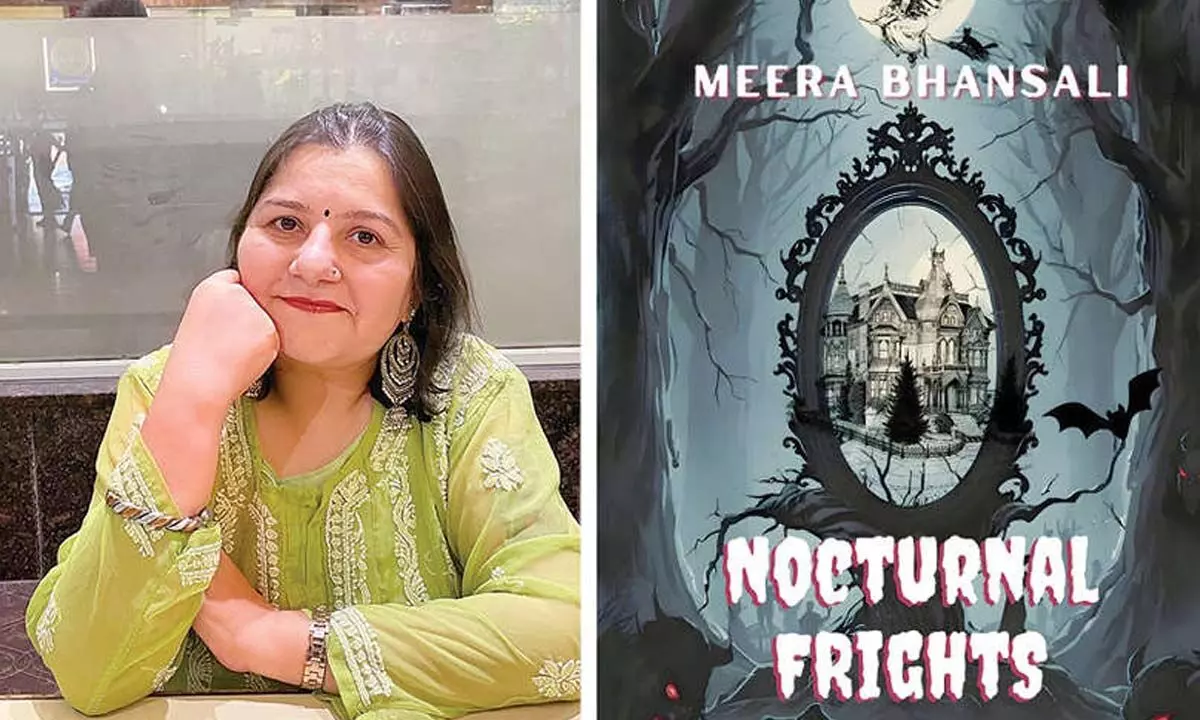
Meera Bhansali has steadily carved a unique space in Indian English poetry, blending myth, psychological inquiry, and the allure of darkness. Her latest collection, ‘Nocturnal Frights’, is being hailed as India’s first sustained paranormal poetry work, inviting readers into a realm where fear is both intimate and contemplative.
The collection was not conceived as a “first” in the genre. Bhansali explains that it “began as a natural progression” of her previous work. “Almost eighty percent was already written when the realisation struck that this could become something no one had attempted before. That is when it consciously turned into intention.”
Her fascination with dark poetry and the Gothic stems from a deep interest in flawed humanity. “I am drawn to the grey character—the misunderstood figure who is pushed into becoming the villain. Much like ‘Paradise Lost’, it is the flaw in humanity that fascinates me, not pure evil,” she notes.
In crafting the entities that populate ‘Nocturnal Frights’, Bhansali deliberately chose figures familiar across cultures and myths. “Most of them appear under different names. That familiarity creates an immediate connection while still allowing room for interpretation,” she says. The book is structured around thirteen such entities, a number she describes as “instinctive and symbolic; it has long been associated with the supernatural, the forbidden, and the unseen. It felt like the right vessel for a book that lives in the shadows.” Unlike many poetry collections that feel disjointed, Bhansali aimed for narrative continuity. “I wanted these poems to feel connected—to belong to something larger than themselves. Bindingeach set to a single entity allowed the poems to stand alone while still carrying a shared presence forward.” Some poems even adopt the cadence of short fiction. “Today’s readers have limited attention spans, yet they still want depth. Narrative poetry allows them to experience a full world in a compact form,” she observes.
Rhythm and rhyme are prominent in her work, though not as a calculated technique. “Certain rhythms simply stay with you. When they linger in memory, they naturally find their way into poetry,” Bhansali explains. As for the fear that permeates the collection, it is both psychological and supernatural, feeding into each other “like a vicious circle—one often giving birth to the other.”
Writing such intense material requires emotional grounding. Bhansali consciously steps back when overwhelmed. “Music, nature walks, and meditation help me ground myself and return with clarity,” she says. She also addresses a common misconception about the Gothic in India: that it is a Western concept. “Indian and Asian cultures have carried Gothic elements long before the word ‘Gothic’ was even coined.”
Looking ahead, Bhansali is already venturing further into the macabre. She is working on a series of horror stories and hints at a possible return to horror poetry, though she prefers to keep future projects under wraps for now.
With ‘Nocturnal Frights’, Meera Bhansali not only explores the liminal spaces of fear but also reclaims a Gothic and paranormal sensibility rooted in Indian cultural memory—proving that the shadows havealways belonged here.


