




- Assam Rifles showcases operational preparedness, capabilities in Agartala
- Court rejects BRS leader’s remand after dramatic arrest over social media post
- Beyond civic poll numbers: Rajasthan Congress leadership in focus again
- 'Not needed anymore': Maulana Shahabuddin Razvi Bareilvi on reservation debate
- Rahul Gandhi has ‘anarchic’ mindset: Maha CM
- India-Norway relationship growing, getting stronger: Outgoing Norwegian envoy
- Nagaon bypoll: Assam Minister targets Congress MP Rakibul Hussain
- With just a day left for contract to end, Kerala CM Satheesan caught in bind over chopper politics
Land Chori returns to haunt Telangana politics - Will 2028 throw up a hung Assembly?
In Short
Congress, BRS and BJP face a battle of credibility

Share :
Land Chori returns to haunt Telangana politics - Will 2028 throw up a hung Assembly?
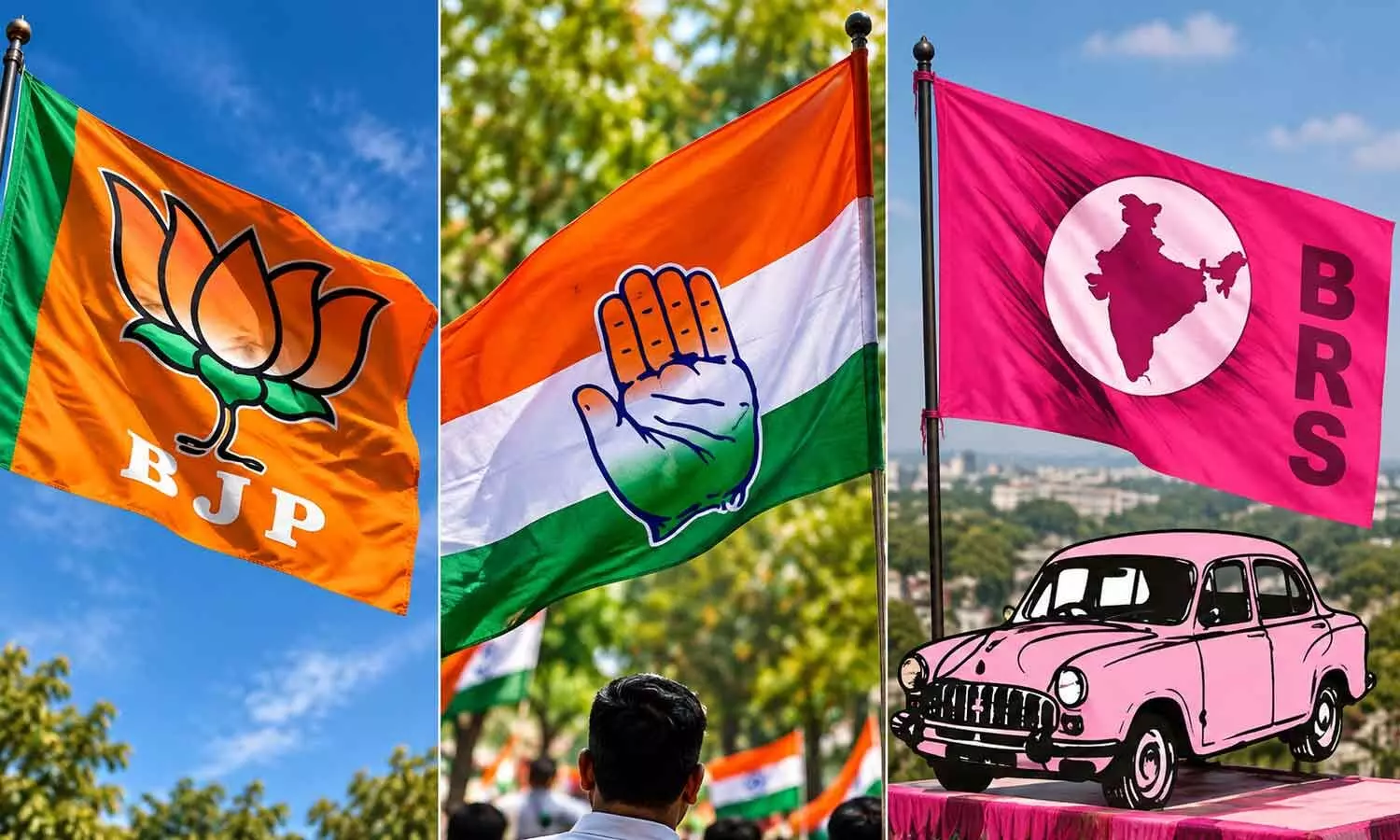
The battle for Telangana in 2028 has already begun, with land politics, governance, corruption allegations and leadership emerging as key flashpoints. Congress faces the challenge of defending its record, while BRS struggles to regain lost ground. BJP remains a third force, making the possibility of a fractured mandate a political talking point.
While at the national level, the Congress keeps alleging that the BJP is indulging in “Party chori, Symbol chori and Vote chori”; in Telangana, the Congress-led government is gearing up for a mega campaign alleging “land chori” not by the BJP but by the BRS when it was in power.
Clearly, the battle lines for 2028 have already been drawn. Both the Congress and the BRS are likely to fight the next Assembly elections on the contentious issue of Bhu Bharati, the new framework for land records, registration and related land services.
The Dharani controversy proved to be a nemesis for the then ruling BRS, with the Congress launching a massive campaign alleging that some BRS leaders had indulged in land grabbing by using the portal as a tool. It alleged that land records had been changed, that the portal showed incorrect ownership details, and that many people were unable to access or establish their land rights. The Congress also alleged that valuable parcels of land were being placed under the prohibited category, popularly known as 22-A.
The allegations did not end there. The Congress alleged corruption and favouritism, claiming that records were manipulated to benefit party leaders and their close associates, while Dalits, backward classes and the poor were deprived of their lands. The party had promised to scrap Dharani, rectify the irregularities, investigate the allegations and punish those found guilty.
The BRS strongly rejected these allegations, arguing that Dharani had reduced the role of middlemen and made land registration faster and more transparent. But voters who had experienced problems with Dharani clearly had their say in the 2023 elections.
The Congress, which scrapped Dharani and introduced Bhu Bharati, is now facing similar allegations from the BRS. Chief Minister A Revanth Reddy gave a detailed explanation in the Assembly and reeled out statistics. Yet, the feeling among sections of the people is that he failed to provide a clear and convincing explanation. They felt that there were contradictions in his speech and that, instead of simplifying the issue, it had become more complicated. The BRS, predictably, came down heavily on the Chief Minister’s arguments. It now remains to be seen how people receive the Chief Minister’s explanation and the counter put forward by the BRS.
Another issue that could hurt the Congress in the next elections is the perception of a lack of transparency in governance and allegations of corruption at the level of public representatives. At the ground level, people are increasingly alleging that corruption in various government works has become the order of the day.
The general feeling is that, notwithstanding the Chief Minister’s claims about the “revolutionary” changes brought about by his government, he appears unable to exercise effective control over his party leaders or check corruption at the ground level across the state.
People have also expressed displeasure over the alleged failure of the government to manage its finances prudently. Retired employees say it is taking more than a year to receive their retirement benefits, while access to healthcare is also becoming a problem as bills from several hospitals are reportedly pending clearance by the government. Even refunds from government departments such as the Road Transport Authority (RTA) are reportedly taking about a year to be processed after the necessary memos are raised.
Another mistake the ruling party is making is focusing too much of its criticism on former Chief Minister K Chandrasekhar Rao (KCR) and using derogatory language against him. This culture, which became widespread during the BRS regime, took its toll in the last elections, as people did not subscribe to such abusive political discourse.
A similar, and arguably worse, trend was witnessed in neighbouring Andhra Pradesh during the YSRCP regime, when even ministers used foul language against TDP leader N Chandrababu Naidu, his wife, mother, and other family members. Their single-point agenda appeared to be targeting Naidu. The YSRCP paid a heavy political price, being reduced to just 11 Assembly seats.
It is a different matter that though the attacks may have mellowed temporarily, they are likely to intensify again as Andhra Pradesh moves closer to the 2029 elections.
The Congress should realise a simple political truth: the more it targets a big leader and resorts to abusive language, the greater the possibility of a backlash among voters.
Be that as it may, the BRS cannot afford to feel comfortable merely because of the anti-incumbency factor. It may help the party win more seats than it did last time, but at this point, it still has a long way to go. The pink party is yet to regain voters’ confidence that it can offer something better than the Congress.
There is also a feeling among sections of the people that the arrogance associated with some BRS leaders has not disappeared. That is something the party cannot afford to ignore.
So, it cannot be said with certainty that the BRS has an edge over the Congress. It will have to struggle to win back people’s confidence. When the party chief, who is also the Leader of the Opposition, does not attend the Assembly, saying that he need not go there to listen to allegations made in an abusive tone, many people find it difficult to digest. Being the senior-most leader and a former Chief Minister who can play with words and hold an audience’s attention, he could have put the government on the mat had he effectively played his role as the Leader of the Opposition. They are drawing a parallel with the mistake YSRCP chief Y S Jagan Mohan Reddy has been making in Andhra Pradesh and feel that both parties appear to be following similar political strategies.
K T Rama Rao (KTR) has announced that he will undertake a statewide padayatra in 2027. Likewise, Jagan Mohan Reddy has also announced a statewide padayatra for September or October 2027.
Amid this fluid scenario, the third political force in Telangana, the BJP, is also not yet fully geared up to take on the Congress and the BRS. The BJP in Telangana has often suffered from a lack of effective state-level leadership and coordination among its leaders.
It does not have leaders of the stature of Suvendu Adhikari, who defeated Mamata Banerjee in West Bengal, or Himanta Biswa Sarma, who ensured the BJP’s victory.
The BJP has a strong cadre in Telangana, but the cadre alone cannot win elections. It needs leadership that can convert the organisational strength into electoral gains and give a credible fight to both the Congress and the BRS. Though the party has had several opportunities to gain political advantage, it has not always been able to rise to the occasion. Unless things change drastically, Telangana could be heading for a hung Assembly in the next elections.
(The author is former Chief Editor of The Hans India)


