




- AI flights to Riyadh, Jeddah cancelled till Oct 20
- What are the Benefits of Petrol Cars?
- CM Will Face Suspicion if Sting Operation Is Not Seriously Investigated: Basavaraj Bommai
- OpenAI ChatGPT Chrome Extension Gets Work Mode: Find Details
- Who is Journalist in Digital Age? SC Raises Concern
- WhatsApp Storage Full? Free Up Space Without Deleting Chats
- YSRCP-TDP clashes in Punganur, several injured
- Two Killed in Suryapet after Bolero vehicle hits three people
Political parties should walk the talk: Theatrics won’t protect democracy
In Short
Stop hollow political rhetoric
Share :
Political parties should walk the talk: Theatrics won’t protect democracy
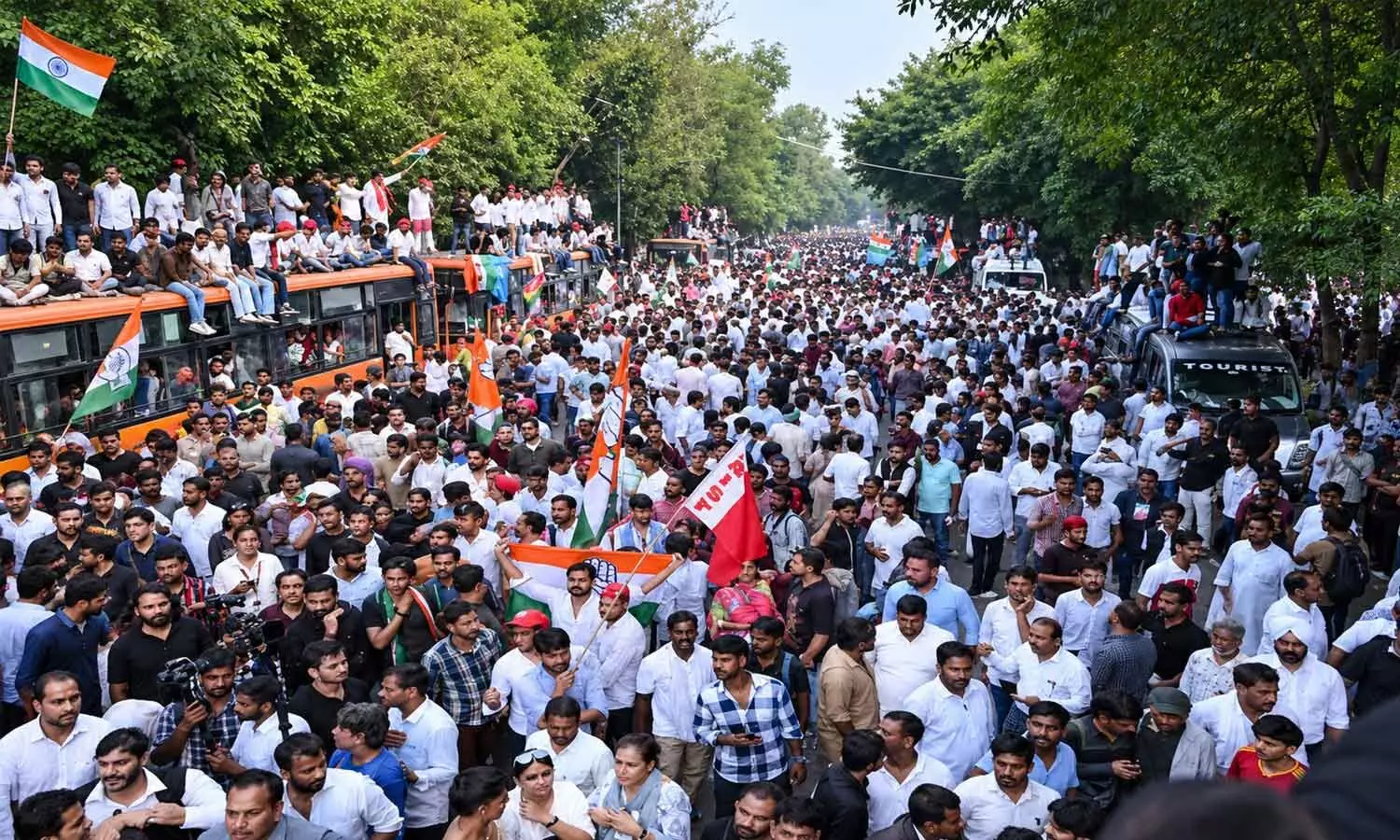
The opposition’s hypocrisy seems to have reached a new high. Its attempts to dictate how the country should be governed and impose deadlines on the government are hardly healthy signs for democracy. This is neither how democracy is protected nor what the Constitution envisages. The opposition’s conduct raises a pertinent question: does it genuinely believe its allegations, or are they merely a cover for seeking regime change through street protests?
The disturbing trend extends from the Cockroach Janta Party (CJP) to the family of Ankita Bhandari, a 19-year-old receptionist who was murdered in September 2022. Three accused were convicted and sentenced to life imprisonment in May 2025. her parents alleged that VIPs were involved in the crime. According to the prosecution, she was pressured to provide sexual services to guests at the resort but resisted and wanted to leave. She went missing on September 18, 2022, and her body was recovered from a canal six days later. The resort was reportedly managed by Pulkit Arya, son of a BJP leader.
The controversy resurfaced in December 2025 when actress Urmila Sanawar, who claims to be the wife of former BJP MLA Suresh Rathore, circulated videos and an audio recording of an alleged conversation with him. She also alleged links to BJP leader Dushyant Kumar Gautam. Both Rathore and Gautam denied the allegations, which have not been established in court.
In January 2026, Uttarakhand Chief Minister Pushkar Singh Dhami ordered a CBI probe into Ankita’s death. The Union Government’s subsequent appointment of Gautam as Governor of Sikkim triggered fresh controversy. Leader of the Opposition Rahul Gandhi met Ankita’s parents and demanded that Gautam’s appointment be withheld until the CBI investigation was completed.
The demand for a fair investigation is understandable. But Ankita’s father subsequently threatened a nationwide agitation and issued the government a 24-hour ultimatum to cancel the appointment. This raises a fundamental question: should every dispute be settled on the streets? What, then, is the role of the judiciary? If the family has objections to the appointment, the opposition should help it seek appropriate legal remedies, including approaching the Supreme Court.
We have repeatedly seen CJP activists issue threats and deadlines while interpreting constitutional principles to suit their arguments. Is this how the opposition proposes to protect the Constitution? If the Modi government is accused of authoritarianism, the opposition must ensure that its own methods do not undermine democratic institutions. It must also explain how it would govern if it came to power.
There are legitimate grounds to question the Election Commission’s actions where evidence warrants scrutiny. The opposition has every right to challenge them in court and raise the commission’s conduct in Parliament. But street protests cannot substitute for institutional scrutiny. Congress has also found a new face in Neha Bora, associated with the All-India Students’ Association (AISA), the student wing of the CPI(ML). Her reported remarks thanking Bangladesh for inspiring young people to fight for regime change have added another dimension to the controversy.
Most of these agitations and political spectacles are taking place in the national capital. The crowds often include party activists from Congress, the Samajwadi Party, Left organisations and their student wings. Yet, many of these protesters invoke the Constitution while their political opponents accuse them of disregarding the rule of law. Chief Ministers such as Telangana’s A Revanth Reddy and Karnataka’s D K Shivakumar have also participated in protests.
Once back in their respective states, however, these leaders court domestic and foreign investors. They must recognise that investors need political stability, public order and confidence in institutions. Persistent confrontation and disorder can damage that confidence.
Rahul Gandhi has said that he has the utmost respect for the Supreme Court and hopes it will do its duty, while also declaring that political agitation will continue regardless of what the courts do. Political protest is a democratic right, but such statements risk creating the impression that judicial outcomes will not influence the opposition’s course of action. That is hardly reassuring, whether it be the investors or the common man.
Andhra Pradesh offers a cautionary example when YSRCP was in power between 2019 and 2024. Policy uncertainty adversely affected the investment climate, and investors refused to invest in the state. The opposition should remember that political instability and uncertainty can discourage investment and affect existing businesses.
Another example of alleged hypocrisy concerns bulldozer demolitions. Opposition parties criticised Uttar Pradesh Chief Minister Yogi Adityanath over demolitions involving properties linked to accused persons. Yet similar actions by the AAP government in Punjab have also attracted scrutiny. If due process is the principle, it must apply uniformly, regardless of which party governs.
The opposition also accuses Delhi Police of brutality and suppressing the voices of young protesters. But what about reported lathi-charges against teachers and other demonstrators in opposition-ruled states?
Hyderabad Police reportedly used lathis this January against unemployed youth protesting over government job notifications in Dilsukhnagar and Ashok Nagar. In Karnataka, police used force against Panchamasali Lingayat protesters demanding inclusion in the OBC 2A reservation category near the Suvarna Vidhana Soudha in Belagavi in December 2024.
More than 10 people were reportedly injured, and in April 2025, the Karnataka High Court directed the state government to constitute an inquiry commission headed by a retired High Court judge. In Kerala, police resorted to a lathi-charge against Kerala Students Union (KSU) activists, the Congress’s student wing, during a protest in December 2023. Youth Congress workers also alleged assaults by police personnel that month.
These incidents demonstrate why allegations of police excesses must be examined consistently, irrespective of the government involved. Police cannot be expected to remain passive when demonstrations violate the law or threaten public order. However, the use of force must be proportionate and lawful. Genuine allegations of brutality should be investigated, and those responsible must be held accountable. Neither police excesses nor unlawful conduct by protesters should be excused.
Accountability must also extend to the funding of political leaders and organisations, including CJP. How do activists who describe themselves as middle-class frequently afford air travel, fleets of cars, luxury hotels and lavish gatherings? Who finances these activities? Political parties and their leaders should answer legitimate questions about funding and financial transparency rather than avoid scrutiny.
Equally disturbing is the use of expressions such as “Hindutva goons” by some spokespersons during debates on national media channels. Political activists can be criticised for specific actions, but branding people collectively based on ideology or religious identity is irresponsible, or shall I say the height of arrogance. Would the same terminology be used against activists associated with other religious or political groups? Such double standards only deepen divisions.
Amid the noise over alleged vote theft and slogans such as “Gyanu, it’s over, bro”, the substantive questions risk being lost. Allegations must be supported by evidence, institutions must be held accountable, and constitutional remedies must be respected.
Whether in the opposition or the ruling party, leaders must practice what they preach. Democracy cannot be protected merely by waving copies of the Constitution, issuing ultimatums or organising street spectacles. Theatrics will not work; consistency, accountability and respect for the rule of law will.
(The author is former Chief Editor of The Hans India)
IDBI privatisation: Govt must stay the course
Political parties should walk the talk: Theatrics won’t protect democracy
Time to restore statehood to J & K
Tipplers to back exchequer! TG govt eyes doubling revenues from bars
CM Revanth steering Hyundai car mfg plant to Hyd
Lucky draw for 41 bars in Hyderabad completed peacefully


