






Who saved Modi from jail? Moily’s revelation embarrasses Congress
In Short
With Moily absolving Manmohan Singh, Rahul Gandhi must explain who intervened, why the investigation was stopped and who exercised the alleged veto power
Share :
Who saved Modi from jail? Moily’s revelation embarrasses Congress
The Leader of the Opposition (LoP), Rahul Gandhi, never tires of blaming the Prime Minister for capturing all institutions and claiming that democracy is in danger, the economy is on the brink of disaster, and so on. While it is admirable that he has remained consistent in making these allegations, both on Indian soil and abroad, he now needs to answer a pertinent question: Who were the Congress leaders who intervened to stall the investigation against Modi during the UPA regime?
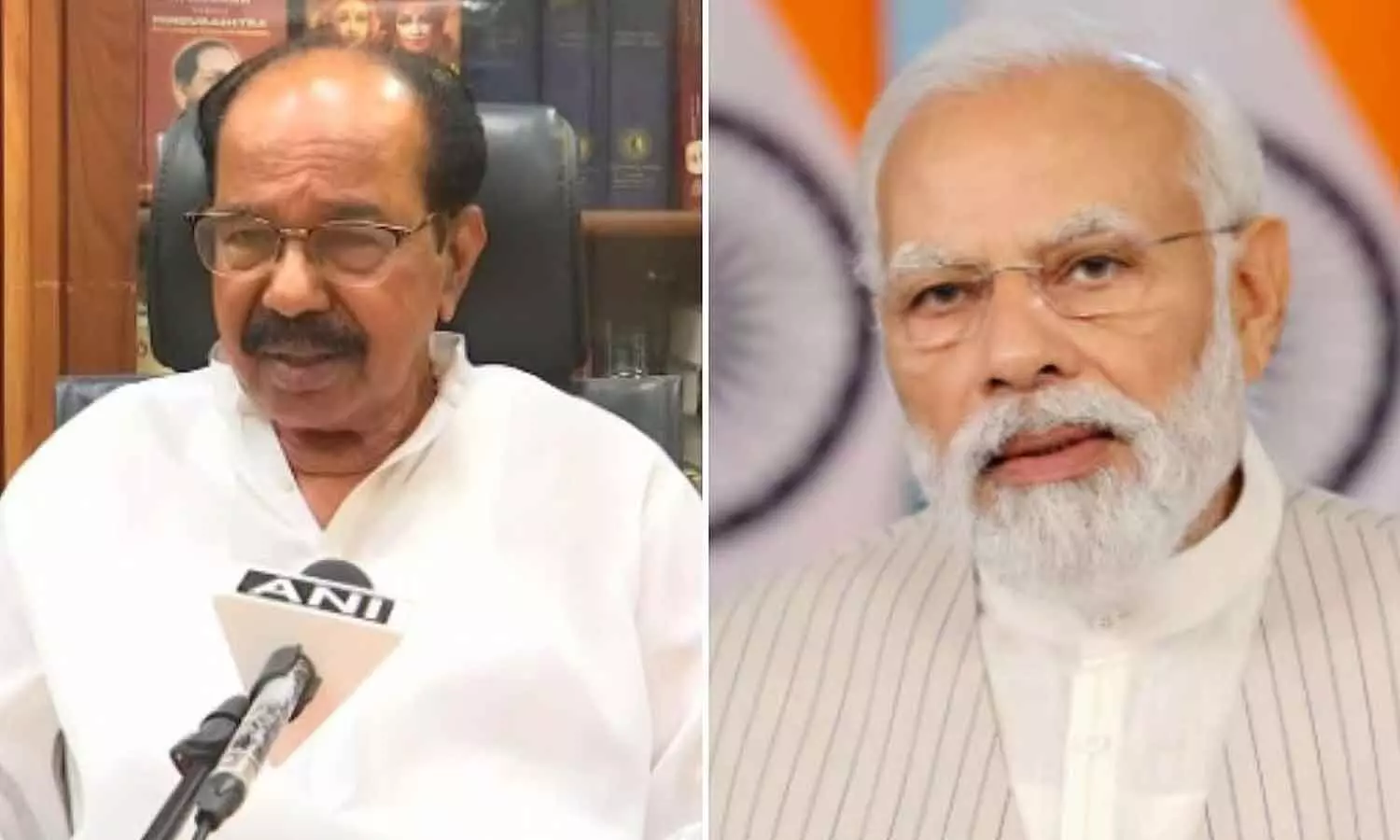
This revelation has come not from Tom, Dick or Harry. Former Union Law Minister Veerappa Moily said on Thursday that the Congress was paying the price for that mistake. Moily made this disclosure at a function organised in Bengaluru to launch Sonia Gandhi’s memoirs.
He did not stop there. He went on to reveal that Sonia Gandhi wanted to introduce sweeping organisational changes in the Congress party. She constituted a committee, of which he was the chairperson. The Moily Committee, he said, submitted detailed recommendations on how the Congress should prepare itself to face future political challenges.
However, the recommendations were never implemented. Although Sonia Gandhi was willing to go ahead with them, “some senior Congress leaders resisted the changes as they did not want to disturb the existing organisational arrangements. If those changes were implemented, there was no question of Modi coming (to power) today,” the veteran Congress leader said.
He suggested that internal resistance and the unwillingness of certain leaders to embrace change had contributed to the Congress’s subsequent political difficulties.
The party, which constantly talks about transparency, needs to explain who those powerful leaders were who wielded the ‘veto’ power to protect Modi and prevent sweeping organisational reforms from being implemented. No one would have known about these behind-the-scenes developments had Moily not brought them up. But since he made the statement on a public platform, it is only fair to expect the Congress to explain who had the power to send Modi to jail and why they chose to protect him.
While Moily refused to name the person who wielded the veto power, he made it clear that the decision was not taken by the then Prime Minister, Dr Manmohan Singh.
Recalling his tenure as Union Law Minister between 2009 and 2011, he referred to the alleged fake Sohrabuddin Sheikh encounter case involving Amit Shah, who was the then Home Minister of Gujarat. Moily said Shah had been arrested and sent to jail in connection with the case and was barred from entering Gujarat for some time.
The allegation was that Sohrabuddin Sheikh was killed in a staged encounter in Gujarat in November 2005. His wife, Kauser Bi, also disappeared and was allegedly killed.
Tulsiram Prajapati, a key witness in the case, also died in an encounter in December 2006. The CBI arrested Amit Shah in July 2010 in connection with the case. He was subsequently granted bail and barred from entering Gujarat for a period. A special CBI court discharged Shah in December 2014, observing that there was insufficient material to proceed against him.
When the case against Modi reached the Supreme Court, the apex court constituted a Special Investigation Team (SIT), which worked under its direct supervision. The SIT eventually gave Modi a clean chit in 2012, finding no prosecutable evidence against him. The apex court also found no material evidence to suggest a criminal conspiracy.
Moily’s statement assumes great significance because he specifically emphasised: “The inquiry and investigation against Modi were stalled by our own government. It wasn’t because of Manmohan Singh. It was because of some other leaders. We are suffering because of that today.”
What exactly is Moily trying to convey through this statement? Does he mean that all institutions, barring the Supreme Court, were under the control of the Congress-led government? His argument suggests that the investigation could have moved further up the political hierarchy and eventually reached Modi. That is precisely why the Congress needs to explain who came to Modi’s rescue and why.
Here, it is important to understand that two separate investigations are often discussed together:
Sohrabuddin Sheikh case: This investigation concerned the alleged fake encounter and the alleged involvement of Gujarat police officials and political figures, including Amit Shah.
2002 Gujarat riots investigation: This concerned allegations of a larger conspiracy involving senior state functionaries, including Narendra Modi.
In the second case, the Supreme Court-appointed SIT examined the allegations against Modi following a complaint by Zakia Jafri, the widow of former Congress MP Ehsan Jafri.
The SIT filed a closure report in February 2012, finding no prosecutable evidence against Modi. The Supreme Court upheld the closure report on June 24, 2022.
So, what exactly was Moily referring to? Was he talking about the Sohrabuddin investigation, the Gujarat riots investigation or some related line of inquiry? Although he did not provide any evidence or identify the person who allegedly “protected” Modi, he maintained that he was not a hypocrite and would not change even a full stop or comma in what he had said.
This statement is bound to put the Congress party, particularly the LoP, in an embarrassing position, given Rahul Gandhi’s repeated allegations of “Institution Chori”. The BJP has seized the opportunity to launch a counterattack, arguing that Moily has vindicated its charge that the Congress government used investigative agencies to target Modi and Shah for political reasons.
Moily also said, “God forbid,” if the Congress ever returned to power, it might even attempt to control the judiciary. The BJP claims that this is clear evidence of political interference in investigations during the UPA regime.
The BJP has demanded that the Congress explain why Sonia Gandhi did not mention this episode in her memoirs, particularly when referring to the Godhra riots and claiming that Muslims constituted the majority of those who suffered.
The Congress needs to explain at what level the decision to protect Modi was taken and what kind of pressure, if any, was exerted on the investigating agencies. Was it a political intervention or an administrative decision? If it was an administrative decision, how could Moily assert that the then Prime Minister, Manmohan Singh, was not responsible for it?
Who indulged in “Satta Chori”? That is the trillion-dollar question for which the country deserves an answer.
(The author is former Chief Editor of The Hans India)


