






- Justice For Victims: AgriGold bond verification drive to begin on Wednesday
- Nitin Nabin to lead BJP’s mega padayatra in Karimnagar today
- Karthika Parva Deepotsavam at Tirumala tomorrow
- Nellore: Dy mayor post triggers intense lobbying within ruling NDA coalition
- Visakhapatnam: Student goes missing at Rushikonda
- Special drive against fake number plates in Anakapalli
- 'We have demonstrated what social justice means': PM Modi cites welfare schemes for poor, marginalised
- India's fuel prices rose only 7 pc compared with 50 to 70 pc in other countries: Hardeep Puri
India’s investment conundrum
In Short
Accelerated private investment key for Developed India goal; Govt should also not encourage corporate monopolies

Share :
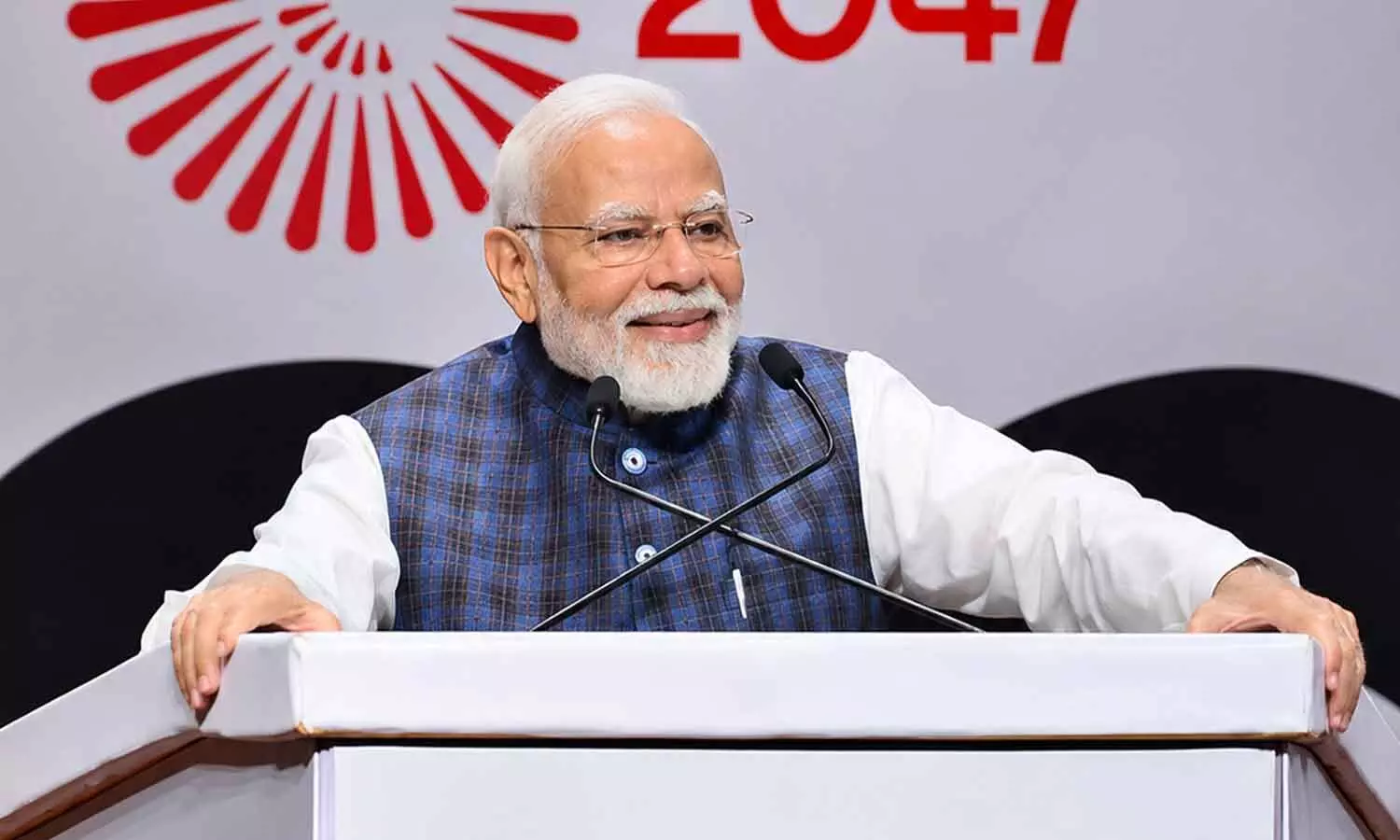
Prime Minister Narendra Modi
Prime Minister Narendra Modi took many by surprise when he pulled up India’s corporate sector at the recent Federation of Indian Chambers of Commerce & Industry (Ficci) event. He found fault with corporates for not increasing wages and creating new jobs even though the central government had reduced corporate tax from 30 per cent to 22 per cent way back in 2019 and cut personal income tax rates.
He went on to describe them as being ‘greedy’. All along, the Prime Minister treated the corporate sector with kid gloves while entrusting the duty of nudging them to Finance Minister Nirmala Sitharaman who urged the corporate sector to loosen their purse strings in the past few years. But Corporate India didn’t heed to her requests to the expected levels.
Consequently, the central government upped the ante on its capital expenditure, spending large investments on infrastructure and other key sectors. It hoped that the increase in public capital spending and incentives like cuts in corporate tax would encourage private investments. But that didn’t happen either.
But are private companies not making profits? Of course, they are. According to a study of over 4,000 top private companies in India, their profits went up by over 19 per cent in the last financial year. That means they are raking in profits left, right and centre. As per some estimates, the Indian private sector is sitting on a cash pile of Rs 12 lakh crore. And this cash pile is growing and expanding every quarter. But are these companies increasing salaries to distribute some of their profits? No. While profits are growing at a faster clip, the salary growth is sluggish, to say the least. In the last financial year, salaries went up by just nine per cent. If inflation is accounted for, the real salary growth is not much. While companies and tycoons are enjoying the fruits of their profits, employees are languishing.
This is not good for the country and its economy. India is a consumption story when it comes to its economic growth. Corporates need to realise that if they increase salaries, employees will spend more, driving up revenues of many companies including those in the service sector. If companies invest more, the new investments will obviously create new jobs, benefiting the country’s youth. Job additions lead to growth in multiple sectors as the spending power of those joining the new jobs will go up.
Soon after the Prime Minister made these remarks, Leader of Opposition in Lok Sabha Rahul Gandhi stepped in to take on his bete noire. The Nehru-Gandhi family scion who became hyperactive these days described the Prime Minister’s take on Corporate India as a confession of policy failure of the Modi government. He went on to say that the country’s industrialists, small traders, the middle class, youth and the poor had been suffering because of the Modi government’s failed policies.
As the Leader of the Opposition, Rahul Gandhi is entitled to criticise the government. But he should have taken up the issues of unemployment and price rise instead of vote chori campaign. That would have given him some political dividend because price rise and associated inflationary pressures would always cost the poor the highest. That’s so because the poor eke out a living on a shoestring budget and any steep rise in prices of essential commodities would deeply dent their purchasing power.
Anyway, why did Modi raise the issue of wages, jobs and investments at this point of time? There are myriad reasons for it. The central government can’t continue the growth momentum through its capital expenditure and tax cuts alone. Private investments must pour in, and Corporate India should increase wages. Also, the Foreign Direct Investment (FDI) hit a slow lane in recent times due to global uncertainties and prolonged wars in different parts of the world.
So, the Prime Minister wants the private sector to chip in now. Furthermore, the country is heading for crucial Assembly polls early next year. Obviously, the Assembly polls in Uttar Pradesh are very crucial for the Prime Minister and Bharatiya Janata Party (BJP), the party he represents. BJP is aiming for a third consecutive Assembly term in the North Indian state under the leadership of Yogi Adityanath as the Chief Minister. The country also witnessed some strong protests by youth in recent months.
Lack of employment opportunities obviously fuels discontent among youngsters while lack of wage growth makes the salaried class restless. Modi can’t afford such developments if he wants to retain power at the Centre in 2029. With agitations against discrepancies in voter lists by the Opposition cooling down, he is going into an overdrive now to clinch UP in 2027 and retain power for a fourth time at the Centre two years later.
Of course, the Prime Minister was right in highlighting the shortcomings of Corporate India, but criticism that he was favouring select business groups was also growing louder. Will he go for a course correction on this?
It is detrimental to the country’s economy and its future if a handful of business groups are allowed to enjoy monopoly or duopoly across sectors. Governments of the day also get a bad name if they do so. Politicians in power tend to favour those businesspersons who helped them climb the power ladder in the country. This has been happening for quite some time whichever party is in power. But helping such businesspersons to have control over key sectors is not good for the country which needs entrepreneurs in droves to catch up with the developed nations faster and provide jobs to its growing population.
This is not to say that the governments should go after business houses. For, they are playing a key role in India’s growth story, creating jobs and revolutionising some sectors. For instance, Mukesh Ambani’s Reliance Jio bet transformed India’s telecom and internet sectors. Vast expansion in India’s mobile usage, rise of social media and mushrooming of content creators are mainly due to Ambani’s vision. Moreover, Jio is the best test case for starting a mega startup in India by those who have funds at their disposal.
While Mukesh Ambani scripted historic success in the telecom sector in just 10 years, his younger brother Anil failed miserably. When the Ambani brothers separated, Anil got the telecom business! Therefore, the government should do a balancing act and encourage entrepreneurship while preventing business monopolies in the country.
Nevertheless, it’s not easy to spur the country’s private sector to invest more in India unless the government tackles many challenges that corporate India faces. The Ease of Doing Business concept is alien to several states. Some states are not paying the incentives that they promise. Like investments, the Centre should also track pending industrial incentives in the states and take some action if there were any inordinate delays. MSMEs are the biggest sufferers of delayed incentives in many states and some states from South are more notorious for this!
The central government should also turn unprecedented curbs on work visas by the US into an opportunity, encourage reverse migration from that country and initiate steps to make India the world’s technology superpower. Corporate India should also tap into the growing export opportunities as the central government has signed trade agreements with several countries.
It should focus on reducing India’s dependence on imports. That’s a big opportunity. All said and done, Corporate India is going to play a key role in India’s aspiration to become a developed nation in the next couple of decades. So, the central government should handle it with care while nudging it whenever required. That strategy will yield good results irrespective of who is in power in the country. But the faster the private investment conundrum is decoded, the better it is for the country. For, accelerated private investment holds the key for achieving Developed India (Viksit Bharat) goal.
GVMC set to usher in its newly-elected council members
RSS chief Mohan Bhagwat to share expansion plans at Delhi event on Nov 29
PM Modi praises Gujarat Guv for outreach to Dalit families, natural farming initiatives
From serving tea, carrying posters to becoming councillors: PM Modi cites BJP workers' rise from grassroots
NDRF has saved over 1.61 lakh lives through 11,000 operations: HM Amit Shah
JEE (Main) 2027: NTA receives 13.10 lakh forms with fee, window to close at midnight


