




- Kishau dam will increase water availability in Yamuna, says Haryana CM
- Engineers key to MP's economic and social development: CM Mohan Yadav
- DDCA unveils enhanced LED perimeter displays at Arun Jaitley Stadium during India-Afghanistan T20I
- GCL Season 4: Ganges Grandmasters stun holders Alpine Pipers to clinch maiden crown
- Chip Maker Applied Materials to Invest ₹3,600 crore: MB Patil
- Modi Raised India’s Concerns In Xi Jinping Talks, Stressed Mutual Sensitivity: MEA
- Army's Western Command commemorates 80 years of service at Chandimandir
- Hope Kerala govt will eventually give green signal to high-speed rail: Sreedharan
Learn security lessons from Bolarum arms theft shocker
In Short
A young recruit can acquire familiarity with firearms, military discipline, operational procedures, security systems and the culture of a highly organised force. For four years, that knowledge is controlled by military hierarchy, regulations, supervision and institutional discipline. The question is whether the government has created sufficient safeguards to ensure that the transition from military authority to civilian life is secure, dignified and professionally productive.

Share :
Learn security lessons from Bolarum arms theft shocker
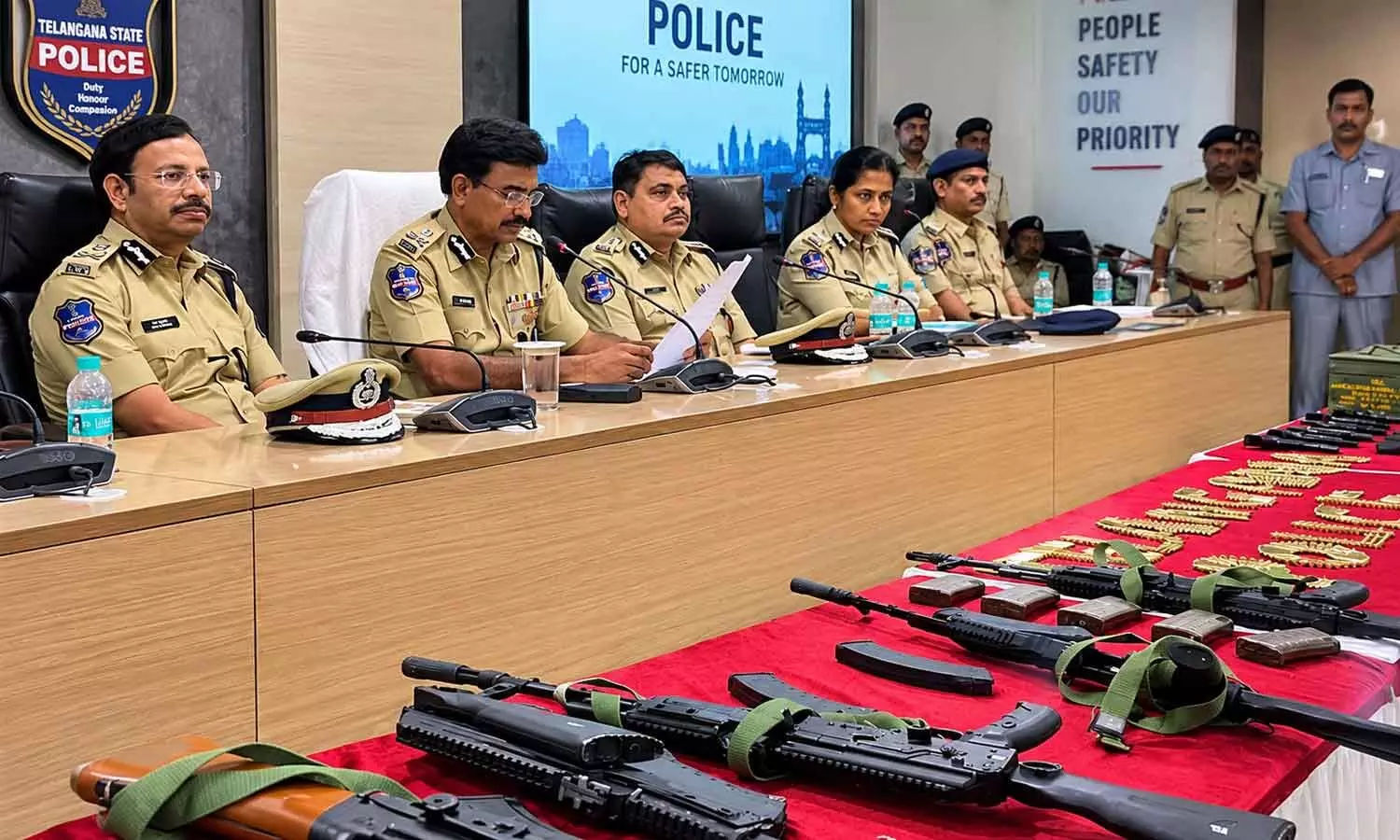
The theft of service weapons from the 20 Madras Regiment premises at Bolarum in Secunderabad raises serious questions, which go beyond the specific criminal investigation. It concerns the security of military weapons, the possibility of insider access and the consequences of a fundamental change in the recruitment and service structure of the armed forces.
When young persons are trained to handle weapons and sensitive military systems, and a large majority are required to leave the armed forces after four years, has the government adequately addressed the security risks associated with that transition?
Let us note the size of the crime. Twelve firearms, including four AK-203 assault rifles, an INSAS rifle, six 9 mm pistols and another pistol, along with 21 magazines, more than 1,800 rounds of ammunition and a night-vision device, were reported missing. The weapons were last physically accounted for at about 6 pm on August 30, and the discrepancy was discovered the following morning when the storage facilities were opened.
The armoury was not visibly marked, the premises had several entry and exit points, and weapons and ammunition were kept in separate rooms. Investigators reportedly suspect that the removal of ammunition from the arms storage area could indicate prior knowledge of the location of military stores. Security lapses, including the reported switching off CCTV cameras during the night, have also come under examination.
The case has expanded into a multi-agency inquiry involving the National Investigation Agency (NIA), Intelligence Bureau, military intelligence, army authorities and Bolarum police, with officials examining possible links to terror, extremist or organised criminal activity. The worry is that if a service weapon falls into the hands of unauthorised or wrong persons, they may be used for spreading terror. This makes insider access particularly significant. An outsider may know little about the internal arrangements of a military establishment.
A person who has served within such an establishment may, depending on his duties and access, know the location of storage facilities, security routines, access procedures, movement patterns and weaknesses in surveillance. This observation should not be converted into a general suspicion against former soldiers or Agniveers. There is no justification in describing every Agniveer as a potential criminal. The real issue is one of institutional risk management.
Implications of Agniveer:
The word “Agniveer” literally conveys the idea of a warrior of fire or a fiery warrior. At the end of four years, up to 25 per cent of a batch may be selected for continuing in regular military service This is substantially different from the traditional understanding of a soldier’s career. The Agnipath scheme, introduced in 2022, changed the model of recruitment for soldiers, sailors and airmen. The material under consideration describes the four years as including military training, followed by a selection in which only one-fourth may continue in regular service.
That structure raises a question which should be addressed without political prejudice. What happens to the three-fourths who leave after acquiring military training and experience? A young recruit can acquire familiarity with firearms, military discipline, operational procedures, security systems and the culture of a highly organised force.
For four years, that knowledge is controlled by military hierarchy, regulations, supervision and institutional discipline. The question is whether the government has created sufficient safeguards to ensure that the transition from military authority to civilian life is secure, dignified and professionally productive.
The employment factor:
The most significant structural concern is employment. Under the scheme, only 25 per cent of a batch may be retained for longer military service, leaving up to 75 per cent to enter civilian life after four years. The scheme provides a Seva Nidhi package, skill certification, and certain reservation or age-relaxation benefits in specified recruitment. But a financial package and a certificate cannot automatically guarantee a stable career.
A young person who enters the armed forces at around the age of 17.5 years, spends some of the most formative years of his life under military discipline. If adequate opportunities are not available, frustration, economic insecurity and a loss of professional identity may become social problems. This does not mean that unemployment will turn former military personnel into criminals.
Such a sweeping conclusion would be unjustified. But any responsible security policy must recognise that criminal networks, extremist organisations and illegal arms dealers may seek to exploit people possessing specialised knowledge or skills. Prevention requires the Government to identify and reduce that vulnerability before it becomes a problem.
Military authority cannot simply disappear at discharge:
A person authorised to handle a military firearm exercises a degree of State authority that an ordinary citizen does not possess. During military service, that authority is surrounded by safeguards: command hierarchy, military law, armoury registers, supervision, physical verification and institutional accountability. When an individual leaves service, these controls change. The government should come up with a carefully designed system for the transition.
There should be a formal discharge protocol covering weapons and equipment, access privileges, identity documents, sensitive information and knowledge relating to military installations.
The larger armoury-security problem:
The Bolarum incident also demonstrates that the Agniveer question should not be allowed to obscure the immediate responsibility of the military establishment itself. Armoury security must be strong enough to prevent theft regardless of whether the offender is an outsider, a serving member, a former member, or an organised criminal group.
Every firearm and every round of ammunition should be subject to continuous and independently verifiable accounting. Physical inventories should be reconciled with electronic records. Surprise inspections should supplement routine checks.
Surveillance systems should be tamper-resistant, and any interruption should itself generate an immediate alert. The basic principle should be uncompromising: a military weapon must never be able to disappear unnoticed between two routine physical inspections.
The Bolarum incident reportedly resulted in heightened security measures in the cantonment, including alerts to defence personnel and precautionary measures for schools located within the cantonment.
The constitutional dimension:
There is a deeper constitutional principle involved. Military power eventually belongs to the State and is exercised under constitutional civilian authority. An individual soldier is entrusted with that power for a specific public purpose. It is therefore the State’s responsibility to ensure that the power remains subject to institutional control throughout the person’s service and that the transition after service does not create avoidable vulnerabilities.
The Agnipath model should consequently be evaluated not merely in terms of defence expenditure, manpower costs or the average age of the armed forces. It must also be evaluated in terms of national security, institutional loyalty, employment, rehabilitation and public safety.
An independent review should ask several questions. Is four years sufficient to provide the necessary military and ethical training to personnel entrusted with sophisticated weapons? Is the selection of the 25 per cent who continue in regular service sufficiently transparent? Are the remaining 75 per cent receiving realistic employment opportunities?
Are discharge procedures strong enough to protect military information and equipment? Can former personnel be effectively protected from exploitation by criminal or extremist organisations?
These questions do not indict the Agnipath scheme. They are questions that any responsible government should be willing to answer. The lesson is not that an Agniveer is dangerous. The lesson is that military training creates responsibility, and the State must responsibly manage the transition when that authority ends. The Bolarum theft, whatever its eventual explanation, makes it clear that weapons’ security and human security are inseparable.
(The writer is a former CIC, and presently Professor, School of Law, Mahindra University, Hyderabad)


