






Peace has come to Bastar but eludes Gutti Koyas
In Short
Telangana’s forest officials treat the settlements as encroachments. Early in 2025, forest staff in Aswaraopeta mandal dug trenches around some 180 acres farmed by 25 families, and residents say about eight of those families were left with no land at all. In July this year, plantation work in the eco-sensitive zone of the Kinnerasani wildlife sanctuary ended in a confrontation, each side accusing the other of attack. A forest department inquiry later found that families who arrived from 2014 onward had occupied about 230 acres of reserve forest.

Share :
Peace has come to Bastar but eludes Gutti Koyas
As the Centre’s deadline of March 31, 2026, ran out, Chhattisgarh’s Deputy Chief Minister, Vijay Sharma, declared that no armed Maoist cadres remained anywhere in the state. Some 400 security camps, he said, would gradually become police stations, schools, hospitals and panchayat buildings, and the state’s industrial policy now rewards companies that employ former cadres. Missing from the announcement were the families who ran from the war in the first place.
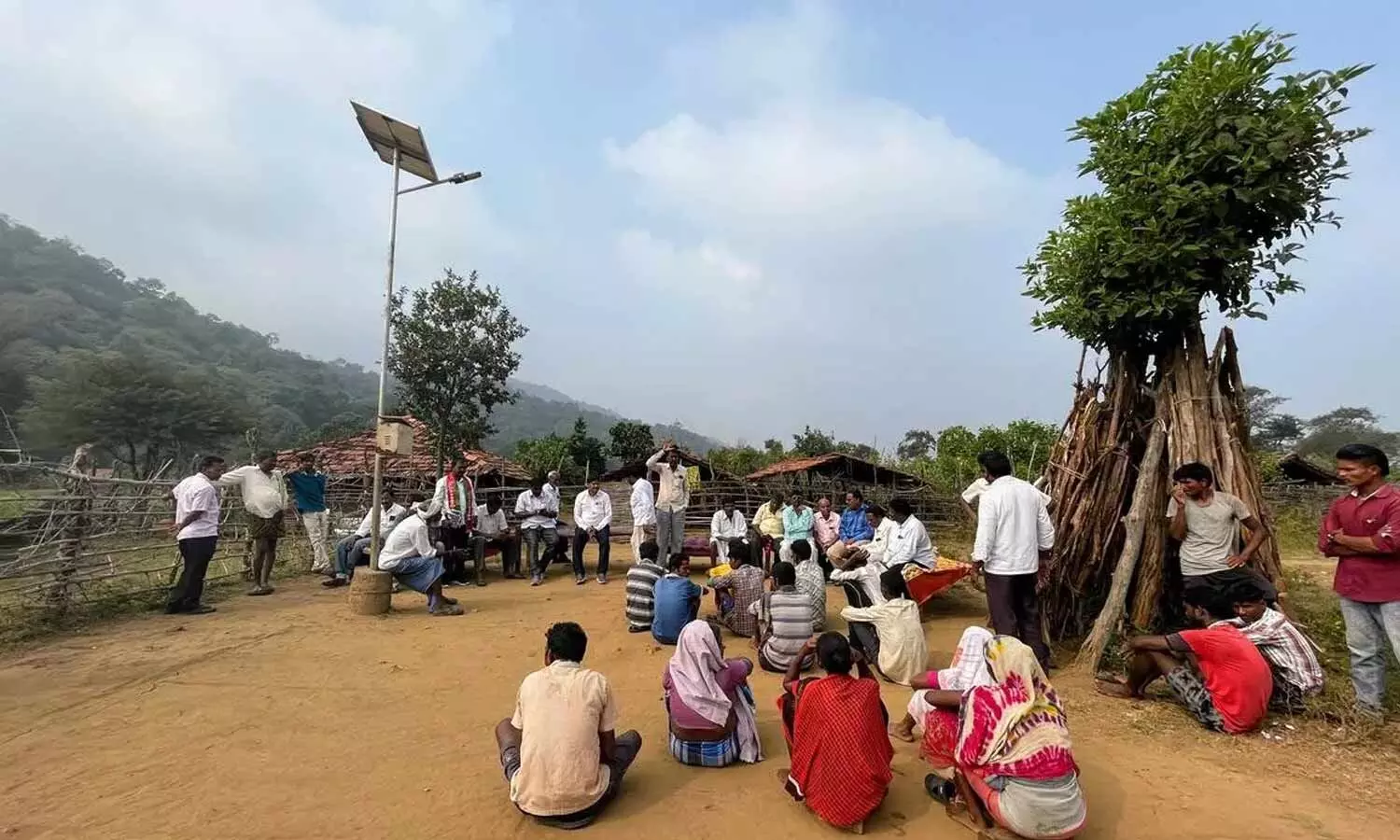
From 2005, as the Salwa Judum and the Maoists fought over the villages of southern Bastar, thousands of Gutti Koya families fled Sukma, Bijapur and Dantewada for what is now Telangana and Andhra Pradesh. However, nobody seems to agree on how many they are. A survey by the Bastar administration this year counted 6,939 displaced families, or 31,098 people. Before the National Commission for Scheduled Tribes, government surveys counted 3,335 families while an independent survey put the figure at 9,651. A state that cannot agree on how many people it displaced is unlikely to have a plan for them.
Chhattisgarh’s answer, reported in April, is to invite them home. Officials are said to be weighing whether to bring them under the rehabilitation policy written for surrendered Maoists. However, the families have largely declined. At a meeting in Dantewada attended by about 70 community representatives, Koram Kosa said a new generation of Gutti Koyas had grown up elsewhere.
“It is not possible to return to our villages to start life afresh now,” he said, and officials reported that most of those present agreed with him. What they asked for instead was caste certificates and land pattas where they now live.
A study by Bharath Bhushan Mamidi of the Centre for Economic and Social Studies (CESS), Hyderabad, shows why. Its July 2023 report rests on a survey of 3,250 Gutti Koya households in 121 settlements, covering every settlement in Mulugu and Jayashankar Bhupalapally and six of the twelve mandals of Bhadradri Kothagudem. The survey shows people who have put down their roots. Of the 3,250 households, 3,111 still live where they first arrived. Nearly nine in ten of those surveyed speak Telugu. Children aged 14 and below make up 36.9 per cent of the population, and most residents under 20 were born in the settlements where they live now. For them, “return” means moving to a place they have never seen.
Telangana already treats them as residents when it suits. Seven in ten eligible adults hold voter cards, and 43.6 per cent of households pay house tax to the gram panchayat. Yet their houses have no patta, and they cannot contest local elections, because the area is reserved for Scheduled Tribe candidates and most Gutti Koyas are not recognised as one in Telangana.
The state counts their votes and collects their tax, but it does not count them as its own. The children carry the heaviest cost. Only 608 people, about 4.5 per cent of the community, hold a birth certificate, most of them children who needed one to get into school. More than a quarter of children aged 6 to 18 have never enrolled. Three in four births in the five years before the survey took place at home, and nearly two in three of those home births were attended by relatives or friends. Mothers reported 90 deaths of infants under one year and 31 deaths of children aged one to five over the same period. A child without a birth certificate cannot prove they belong to either state.
Meanwhile, Telangana’s forest officials treat the settlements as encroachments. Early in 2025, forest staff in Aswaraopeta mandal dug trenches around some 180 acres farmed by 25 families, and residents say about eight of those families were left with no land at all. In July this year, plantation work in the eco-sensitive zone of the Kinnerasani wildlife sanctuary ended in a confrontation, each side accusing the other of attack. A forest department inquiry later found that families who arrived from 2014 onward had occupied about 230 acres of reserve forest.
The department’s concern is not frivolous. Reserve forests and sanctuaries are protected for good reason, and some families arrived well after the worst of the violence. But eviction without a destination does not protect a forest. Instead, it pushes people onto the next patch of land and displaces them a second time. And so, a state that wants its forests protected has to say where the families should go.
There is a precedent, and it is the Centre’s own. In September 2025, the National Commission for Scheduled Tribes urged the Centre to frame a dedicated policy for these families and asked Chhattisgarh to study the Bru resettlement plan of 2018, an idea the families’ own association had first put before it. Under the 2018 agreement, which aimed to send the Bru back to Mizoram, only 328 families had returned by November 2019. In January 2020 the Centre signed a new agreement and settled them permanently in Tripura, with house plots, building assistance and two years of rations and cash support. Thus, in the case of the Brus, when the return failed, the government made settlement the answer.
The Gutti Koyas need the same honesty. First, Telangana and Chhattisgarh should agree on a single joint count, so that policy rests on one number. Second, every family should have a real choice, and the Commission has already asked for one. They could return with land, housing and livelihood support from Chhattisgarh, or stay where they are with house pattas and a route to cultivation rights under the Forest Rights Act, which the Commission has told the states to use. Third, every Gutti Koya child should be registered at birth, whatever the adults decide. That costs almost nothing and needs no new law.
Chhattisgarh’s offer to the families who fled the war reportedly borrows the scheme written for those who fought it, and it is an offer only to those who come back. A peace that settles the fighters and leaves the displaced in a forest neither state will give them is not yet finished.
(The writer is a doctoral scholar at the Faculty of Law, University of Delhi, working on violence-induced internal displacement)


