




- Kartikeya Gummakonda turns director with ‘Comeback’
- ‘HALF’ makes history as first Malayalam film in TIFF’s midnight madness
- Ajith Kumar’s racing journey takes centre stage in ‘Gladiators’
- Krithi Shetty’s traditional first look as ‘Deepu’ unveiled on her birthday
- Parents’ support drives dreams: Nandini Reddy
- Sri Lakshmi Pictures bags worldwide rights of ‘Chakkora’, October 9 release
- ‘Emo Emo Idi’ to arrive in cinemas on Oct 30
- ‘I Hate Marriage’: ‘Appude Pellaa?’ lyrical song released
Why do MLAs, Speaker, and the CM lie about defection?
In Short
Doesn’t the Speaker or the Leader of the House (the Chief Minister) know that Nagender is disqualified as an MLA?

Share :
Why do MLAs, Speaker, and the CM lie about defection?
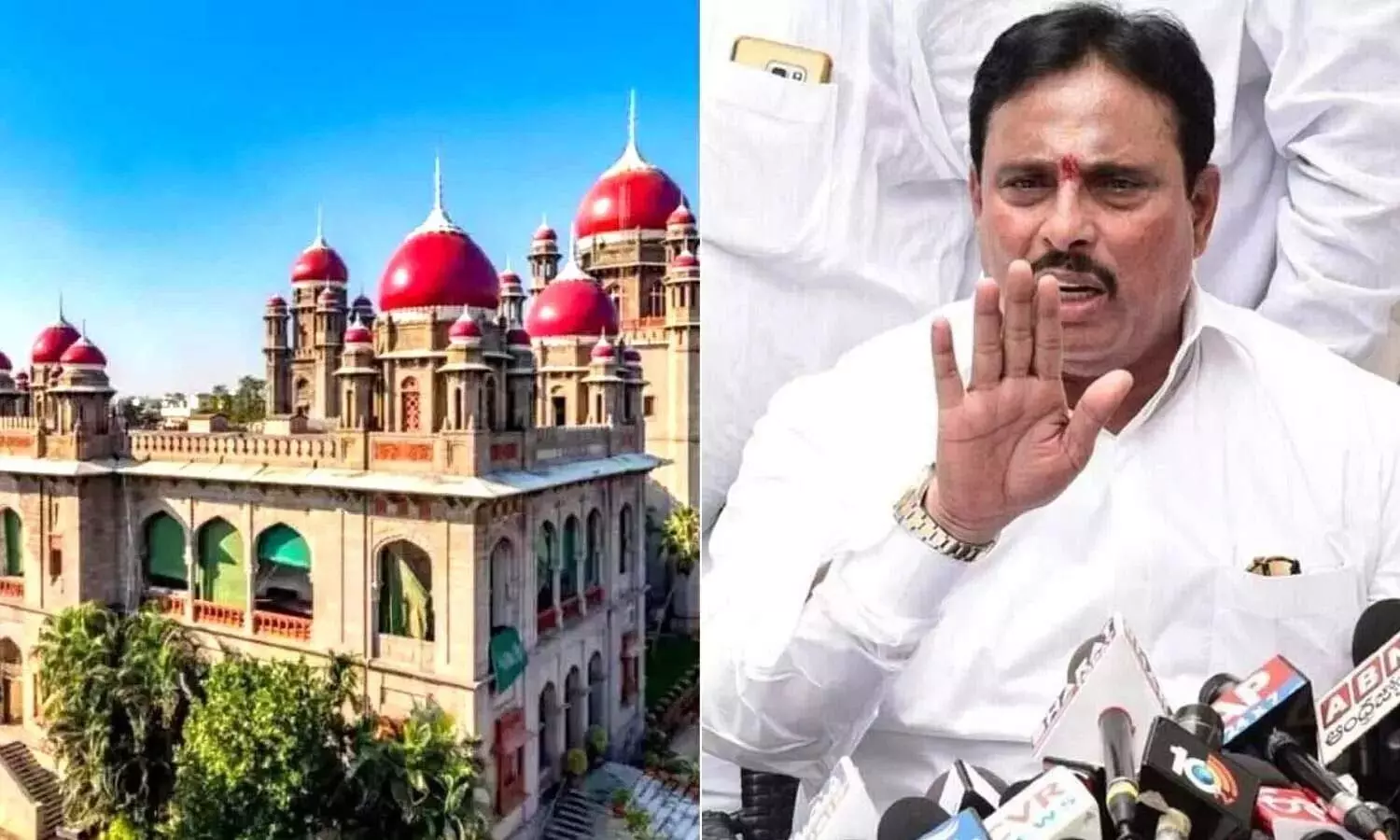
Nowthat it has been confirmed that Danam Nagender is not an MLA, the next question is whether he belonged to the BRS or Congress? The first is answered, and no one can know about the second.
Doesn’t the Speaker or the Leader of the House (the Chief Minister) know that Nagender is disqualified as an MLA? Is it wrong to call every single syllable, sentence, drafted affidavit, sworn declaration, legislative phrase, and affidavit drafted and filed through the Assembly Secretary, a blatant lie? Do not assume that falsehoods are not uttered inside the Assembly. One can hardly expect a minister to speak the truth; that is what ‘politics’ is all about. Whether one regards them as sacred, calls them political paragons of virtue, labels them patriotic degenerates, or mocks them as legislative stalwarts, we are left with no choice but to listen and write about. Our journalists sit tight-lipped in press conferences, take down these lies, and dutifully publish them in newspapers.
The judgment declared Nagender disqualified from the office of MLA under Article 191(2) read with Paragraph 2(1)(a) of the Tenth Schedule of the Constitution, effective retrospectively from April 23, 2024, the very date he filed his nomination as an INC candidate for the Lok Sabha elections. This is an open constitutional reality that ought to have been declared the very next day after the petition was filed, not some ‘state secret’. It is a raw, bleeding fact. There is no need to repeatedly brandish the text of the Constitution before everyone’s eyes. The august office of the Speaker (regardless of the party in power) is endowed with the powers of a judge. Yet, when they knowingly perpetuate falsehoods, it is treated neither as a crime, nor as a constitutional violation, nor as an offense under the penal code. This is not about specific names; whoever occupies that august Speaker’s chair from any party commits this wrong, and no one stands to hold them accountable in the dock of truth.
What’s your stance, honourable MLA?
Right after the verdict was delivered on September 18, Nagender claimed that he would not appeal in the Supreme Court. However, right before the Telangana High Court bench, his counsel intervened to state that they would challenge the ruling in the Supreme Court and prayed for the operation of the judgment to be suspended until then.
Responding to this, senior counsel appearing for Padi Kaushik Reddy reminded the court that the disqualified Nagender had already enjoyed the fruits of his office unlawfully for two and a half years. Nearly every word spoken in these situations stands in direct contradiction to the constitutional spirit. On one hand, his lawyer requests a suspension of the disqualification order to file an appeal before the Supreme Court; on the other, the MLA publicly claims he will not move the Supreme Court. This is not an isolated instance. Every defected, high-and-mighty MLA speaks in this exact vein. Everyone knows this reality. The Speaker knows it. The Chief Minister also knows it.
A public lie!
This public lie cannot be masked as a secret. Yet they stall and wait until the Supreme Court speaks, fully aware of what the eventual outcome will be. Even the common citizen knows this. The MLAs and political leaders, who deliberately utter falsehoods know it; lawyers even advise them that stretching the truth is par for the course. Every defecting MLA poses as an embodiment of truth while persistently dealing in deception. Pointing this out plainly may sound harsh yet ignoring it undermines public decency.
How can Danam hold office as an MLA?
Accepting the argument that such a defected legislator is neither eligible nor entitled to continue in office for even a single day, the division bench declared that the judgment comes into immediate effect. The court directed the Registry to dispatch copies of the order to the Election Commission of India (ECI) and the Secretary of the Legislative Assembly. This is justice, constitutional adjudication, and public duty—even if it runs counter to petty political expediency. Suffice to state that it is falsehood that seems to triumph in practice.
The bench firmly held that Nagender, having been elected as a BRS MLA in the 2023 Assembly elections, had voluntarily given up his membership of the BRS by contesting the 2024 Lok Sabha elections from the Secunderabad parliamentary constituency as an INC candidate while continuing as an MLA. No further proof is required. Did the Speaker truly fail to recognize this basic fact?
Unjust enrichment of legislator:
The court made it explicit that the Khairatabad Assembly constituency stands vacant. While that consequence is obvious, stating it explicitly became necessary to forestall further excuses before an appeal to the Supreme Court. The High Court quashed the orders issued by the Speaker on March 11 of this year, which had dismissed the disqualification petitions. That means for over six months, he continued unlawfully as an MLA. Right from the moment of defection, public salaries, allowances, protocols, and prestige were illegitimately enjoyed—a reign of political deceit consuming half an elected term.
One wonders how deeply distressing it must have been for legal scholars, constitutional law professors, and especially the High Court division bench, comprising Chief Justice Aparesh Kumar Singh and Justice G M Mohiuddin to adjudicate such an open-and-shut violation. They were compelled to deliver a comprehensive, 91-page constitutional exposition to state what should have been self-evident.
A gross injustice:
Anyone who has read the Constitution with even minimal comprehension can see through this gross injustice. What follows instead is an endless series of adjournments, the perpetual curse of pendency. The blame does not rest solely on the judicial process; every Speaker who knowingly turns a blind eye, the advocates who facilitate it, and every beneficiary who profits from organised falsehood share an equal measure of guilt.
The ball was set rolling by BRS MLA Padi Kaushik Reddy after he filed a disqualification petition before the Speaker on March 18, 2024, and BJP Legislative Party leader Aleti Maheshwar Reddy filed another on July 1, 2024, invoking the anti-defection law. Challenging the Speaker’s rejection of these petitions, both approached the High Court separately. After hearing arguments from both sides, the Bench reserved judgment on August 21. Prolonged delays remain inevitable, allowing defectors to run out the legislative clock. Thus, even when acting as a tribunal, the Speaker effectively enables the five-year term to be consumed under the guise of due process.
Why didn’t BRS take disciplinary action?
The Speaker, while examining the disqualification petitions, dismissed them on March 11 of this year, citing “due process.” The Speaker took the view that under the Tenth Schedule, his jurisdiction is confined strictly to conduct and official business within the four walls of the Legislative Assembly, and that political activities conducted outside the House cannot form the basis for disqualification, arguing that this remains the exclusive preserve of the legislative branch unless reviewed by the judiciary. The Speaker further observed that merely contesting on a Congress ticket in the 2024 Lok Sabha elections was insufficient to prove that Nagender had voluntarily given up his BRS membership, pointing out that he had not tendered a formal resignation, that there was no official documentation evidencing his formal enrollment in the Congress party, and that the BRS itself had not initiated disciplinary proceedings against him. This failure by the political party is an important lesson in organizational negligence. Consequently, the courts had to step in to redress actions committed outside the floor of the House.
Any actions “within” the House?
This is precisely why the grounds cited by the Speaker could not withstand judicial scrutiny. The High Court clarified that when determining disqualification under the Tenth Schedule, one need not limit the inquiry solely to a member’s voting pattern or conduct inside the Assembly. Reading mere headlines gives the impression that the law is narrow, but a deeper look exposes how deeply flawed that view is.
The High Court treated Nagender contesting the Secunderabad Lok Sabha election as a Congress candidate after having been elected on a BRS ticket as a decisive “external act.” Did the Speaker lack this basic legal understanding?
The constitutional morality question is: After the Telangana High Court’s order, how can one hold office as the Chief Minister and Speaker?
(The writer is a former CIC, and presently Professor, School of Law, Mahindra University, Hyderabad)
CM Revanth Reddy preparing to tighten noose around KCR family
Sleep talking is not funny, it is serious business
Naidu condemns YSRCP attack on DSC teachers
El Nino Triggered Drought In State: CM calls for conservation of water, climate-resilient farming
AP govt raises medical students’ stipend by 5-10%
Tirumala Brahmotsavams: Geo-tagging, surveillance help trace missing devotees


