




- EPFO Wage Ceiling Raised To ₹25,000: Cabinet Decision To Expand Social Security Coverage
- PhonePe's Sameer Nigam Says UPI MDR Move Brings IPO Filing Closer
- Prabhas’s Fauzi Might Feature Controversial Adolf Hitler Sequence?
- UPI MDR Row: Centre Rejects Foreign Influence Claims, Says Policy Decisions Are Independent
- Karnataka MLA’s Niece Removed From Medical Officer Post Amid Dual Engagement Probe
- CM Revanth Reddy alleged land scam worth ₹1 lakh cr in Telangana, says will form SIT
- Adivi Sesh’s G2 Makers Eye February 5 Release
- Rapido Fined ₹10 Lakh By Consumer Watchdog For Misleading Ads, Unfair Practices
Sri K.V. Ranga Reddy: A Flame of Courage in Telangana’s Liberation
In Short
A heartfelt tribute on Hyderabad Liberation Day, celebrated on 17 September, to a freedom fighter, educationist and statesman who helped give Telangana the courage to dream of dignity, democracy and freedom.

Share :
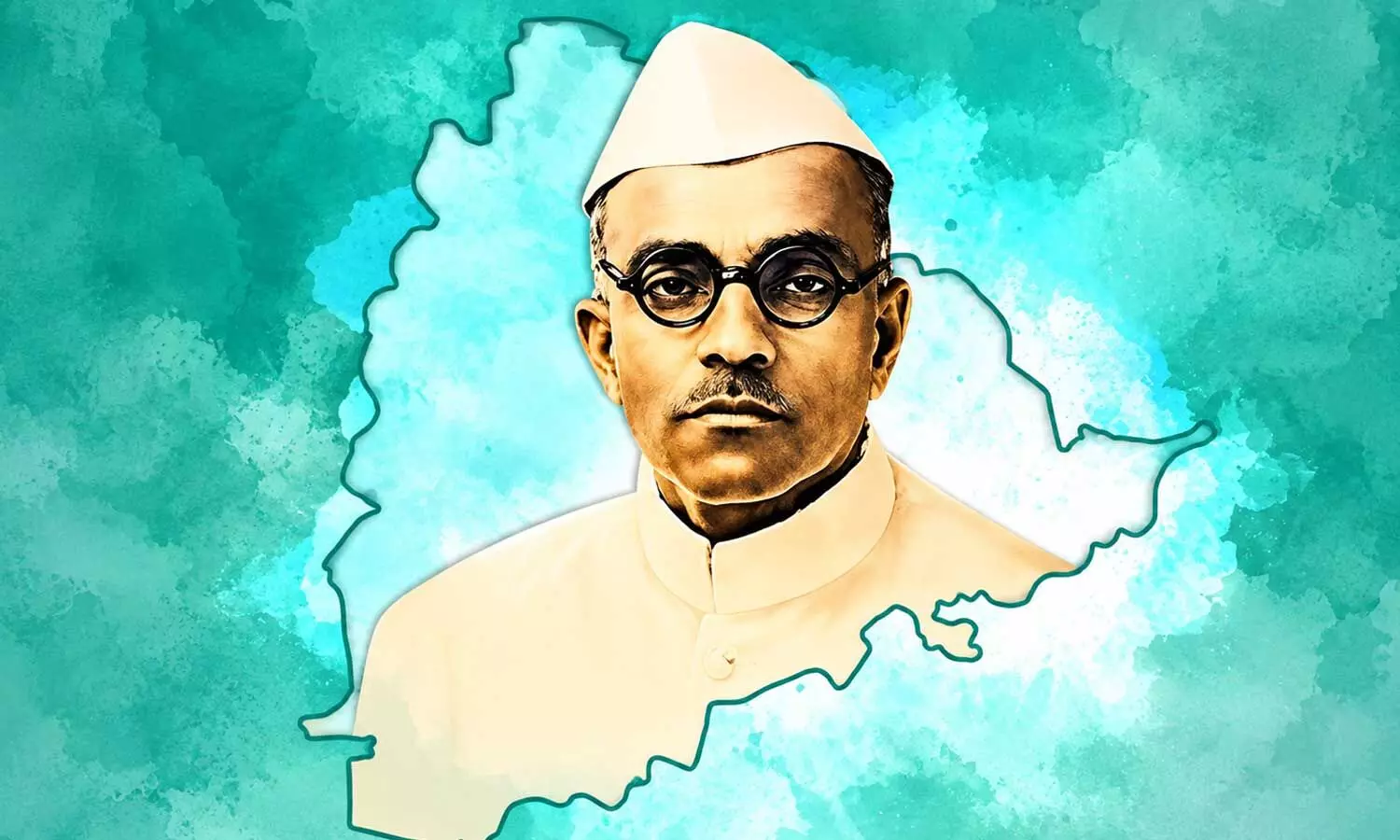
Sri K.V. Ranga Reddy
Every year, when Hyderabad Liberation Day is observed on 17 September, Telangana pauses to remember not only a historic political turning point, but also the men and women who carried the burden of that struggle in their hearts. Among those noble souls, Sri Konda Venkata Ranga Reddy occupies a place of rare honour. He was not merely a leader of his time; he was a voice of conscience in an age of fear, a builder of hope in a society scarred by oppression, and a statesman who believed that freedom must ultimately serve the dignity of ordinary people.
Courage That Refused to Bow
The years before Hyderabad’s integration with the Indian Union were filled with uncertainty and pain. While the rest of India had awakened to freedom in 1947, the people of Hyderabad State continued to live under autocratic rule, feudal pressure and the terror of the Razakars. In that difficult hour, when silence was safer than speech, Ranga Reddy chose courage. As one of the founder-members of the Hyderabad State Congress and an active participant in the liberation movement, he stood with the people when they needed leaders who would not bend before power.
His stirring words at Siddiambar Bazar — “Ghulam ki zindagi se, maut acchi” — still echo like a call to self-respect. They were not words of anger alone; they were words born from wounded dignity and unshakable conviction. In that one sentence, he expressed the anguish of a people who had suffered enough and the resolve of a society that was ready to claim its rightful place in free India.
Yet his courage was never reckless. Sri Ranga Reddy understood that true liberation could not be built on hatred, disorder or ideological extremism. At a time when some radical groups tried to use the region’s unrest for their own political battles, he stood firmly for a democratic and united path. He believed that the suffering of farmers, workers and the poor had to be addressed through social reform, constitutional values and responsible public action. His principled stand helped keep the movement for Hyderabad’s accession focused on the larger vision of a free, united and democratic India.
A Guide to People and Future Leaders
Ranga Reddy’s greatness lay not only in leading from the front, but also in awakening leadership in others. He mentored younger public figures, strengthened democratic organisation and gave direction to people’s aspirations. His guidance to leaders such as Marri Chenna Reddy reflected his ability to shape minds, inspire commitment and transform scattered public anger into purposeful civic resistance.
He also knew that political freedom would remain incomplete without social awakening. His engagement with reformist platforms, including the Arya Samaj, carried the message of education, equality and self-respect to wider sections of society. In a divided and fearful age, he chose the harder path: to build bridges, to heal wounds, and to remind people that liberation was not against any community, but against injustice, fear and humiliation.
17 September: A Dawn After a Long Night
As the crisis deepened, Ranga Reddy and Burgula Ramakrishna Rao carried the pain and aspirations of Hyderabad’s people to the national leadership. They briefed Jawaharlal Nehru on the growing Razakar atrocities and the Nizam’s refusal to accede to the Indian Union, but immediate military action was not forthcoming. Undeterred, these two voices from Telangana later approached Sardar Vallabhbhai Patel, impressing upon him that every delay would only prolong public suffering and weaken ordinary citizens’ faith in justice. Their intervention helped pave the way for Operation Polo, which finally brought Hyderabad into the Indian Union.
When Hyderabad was finally integrated into the Indian Union in September 1948, it marked more than the end of a political impasse. It was the dawn after a long night of anxiety. For countless families, 17 September meant relief from fear, the beginning of democratic possibility and the assurance that they belonged to a free republic. Ranga Reddy’s place in that history is defined by his steady insistence that Telangana’s future must be rooted in freedom, unity and public dignity.
Education: His Most Enduring Gift
For Ranga Reddy, liberation did not end with political integration. He knew that a free society could remain weak if its children were denied education. That is why his contribution as an educationist is one of the most beautiful chapters of his life. As a founder-member of the Andhra Vidyalaya Education Society, which established the first Telugu-medium high school in the Nizam’s dominions, he helped open doors of learning at a time when education was both scarce and socially transformative.
His commitment to women’s education was equally inspiring. As founder-president of Sangam Laxmibai Vidyapeet, he supported institutions dedicated to girls and women, helping nurture a future in which daughters, too, could study, lead and serve society. Long after political speeches fade, such institutions continue to speak — through classrooms, hostels, teachers and generations of students whose lives were touched by his vision.
In public office, he carried the same quiet strength. As Revenue Minister and later as Deputy Chief Minister of Andhra Pradesh, he worked in a society emerging from feudal structures and searching for democratic confidence. His journey from resistance to governance symbolised a rare kind of leadership: one that fights when freedom is denied and builds when freedom is won.
A Tribute for Generations
Today, as Hyderabad Liberation Day is celebrated on 17 September, remembering Sri K.V. Ranga Reddy is not merely an act of homage; it is an act of gratitude. He reminds us that freedom was not gifted in silence — it was earned through sacrifice, conviction and the courage of those who stood up when history demanded moral clarity.
His life asks us a simple but powerful question: What do we do with the freedom we inherited? If we honour him only with words, our tribute remains incomplete. We honour him truly when we become voice of voiceless, expand education, protect social harmony and serve the common good with integrity. In that sense, Sri K.V. Ranga Reddy is not only a memory of Telangana’s past; he is a guiding light for its future.
Selected References
K.V. Ranga Reddy, The Struggle and the Betrayal: The Telangana Story.
K.M. Munshi, The End of an Era: Hyderabad Memories.
V.P. Menon, The Story of the Integration of the Indian States.
Institutional records of Andhra Vidyalaya Education Society and Sangam Laxmibai Vidyapeet.
Telangana High Court deferes verdict on Danam Nagender disqualification plea to Friday
Section 22-A: 1 Crore Acres Or 3 Lakh Acres?
Telangana CM Revanth Reddy orders probe on KCR farmhouse
CM Chandrababu inaugurates SV Museum and EV buses in Tirumala
SEMICON India 2026: Chip industry push gets boost as PM Modi set to lead inaugural session on September 17
Keralam govt in talks with several states, discoms for power purchase: CM Satheesan


