




- South Hyderabad set to emerge as city’s next major growth corridor
- Assembly seeks Central aid over rainfall deficit
- Residents cry foul over mounds of garbage in the vicinity of JBS
- HYDRAA chief inspects IDL lake to ensure hassle-free immersion
- Trade body urges Centre to roll back UPI charges
- Mamata backs Cong in Nandigram after her candidate withdraws
- Football vs Envelope: Mamata, rebels get new names, symbols
- Modi to open environment meet today
Beyond AI tools: Building skills for independent thinking
In Short
As AI reshapes education and workplaces, experts emphasize the need for AI literacy, critical thinking, and human judgment to prevent over-reliance on automated tools.

Share :
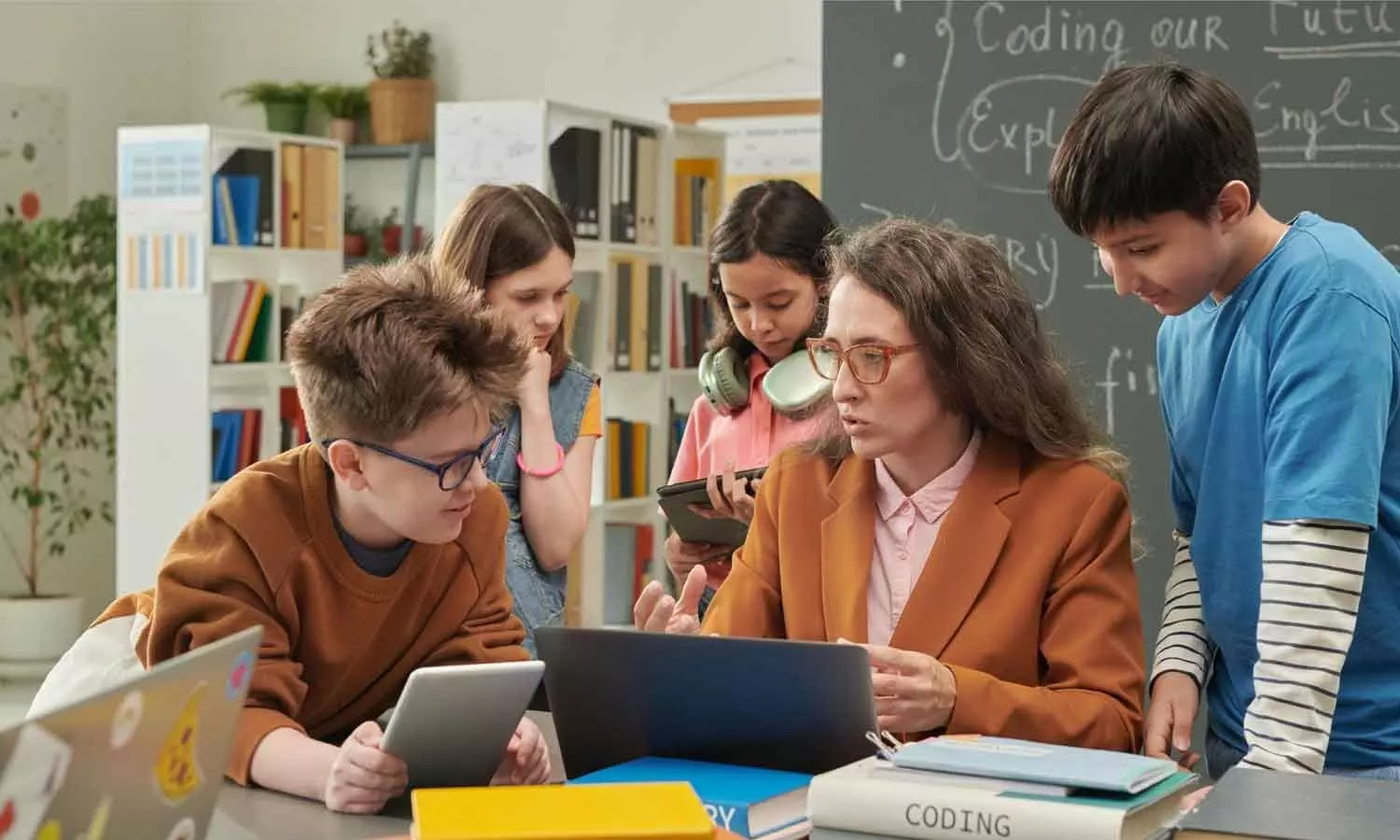
Beyond AI tools: Building skills for independent thinking
Artificial intelligence is becoming part of everyday learning and working, offering students and professionals new ways to find information, understand concepts and complete routine tasks. As adoption grows, however, educators and institutions are also examining an important question: how can AI be used without weakening independent thinking and judgment?
UPSC Chairman Dr Ajay Kumar highlighted the importance of retaining human judgment in an increasingly AI-enabled environment. His remarks drew attention to the distinction between using technology as a support tool and allowing it to replace the process of thinking and questioning.
Recent studies suggest that this distinction is becoming increasingly relevant in workplaces. A joint survey by KPMG and the University of Melbourne on AI use among Indian employees found that 67 per cent of respondents intentionally used AI at work. The survey also indicated that many users were relying on AI-generated information without independently checking its accuracy.
The findings point to a broader need for AI literacy. As employees incorporate AI into research, writing, analysis and other tasks, understanding the strengths and limitations of these systems becomes as important as knowing how to operate them.
Research by IIM Ahmedabad and the Wadhwani Foundation involving more than 550 white-collar employees similarly found that AI adoption was becoming part of workplace practices. While a significant proportion of respondents reported using AI tools, fewer said their organisations had provided training on how to use them effectively.
This gap between adoption and training is relevant to education as well. Students entering workplaces where AI is widely used will need more than familiarity with digital tools. They will also need the ability to assess information, identify errors, ask appropriate questions and make decisions independently.
The same issue is emerging in schools. A survey covering students, parents and teachers across Delhi-NCR, Haryana, Chandigarh, Lucknow and Meerut found that a large majority of students in Classes 9 to 12 were using AI tools for educational purposes. Students reported using these tools for activities ranging from understanding concepts to completing homework.
The findings also highlighted the role of parents and teachers in guiding students. With AI tools becoming increasingly accessible, students may encounter them outside formal classroom settings, making digital and AI literacy a shared responsibility involving schools, families and learners.
India’s Economic Survey 2025-26 has also discussed the implications of excessive reliance on AI for learning and critical-thinking abilities, drawing attention to international research in this area. The discussion reflects a wider recognition that the impact of AI on education extends beyond questions of access and convenience.
Educational institutions are beginning to respond. The Ministry of Education has directed CBSE and NCERT to develop AI and Computational Thinking content from Class 3 onwards for the 2026-27 academic session. The broader objective is to introduce students to emerging technologies while continuing to strengthen foundational learning and thinking skills.
The challenge for education systems is therefore not simply to teach students how to use AI tools.
It is also to help them understand when those tools are appropriate, how their outputs should be evaluated and where human judgment remains essential.
For teachers, this could mean designing assignments that require students to explain their reasoning rather than simply submit an answer. For students, it could mean attempting a problem independently before turning to an AI tool, checking information against reliable sources and considering alternative explanations. AI can support learning in several ways, including explaining difficult concepts, generating examples, assisting with brainstorming and providing feedback. At the same time, its responses can contain errors, omissions or misleading information. Treating an AI-generated response as material to examine rather than an unquestionable answer can help students retain ownership of the learning process.
The objective, therefore, need not be to limit the use of AI. Instead, education can focus on developing the skills required to use it responsibly. Critical thinking, problem-solving, communication and the ability to evaluate information remain relevant even as the tools used to apply those skills change.
As AI becomes more deeply integrated into classrooms and workplaces, the emphasis may increasingly shift from simply knowing how to use the technology to knowing how to use it thoughtfully. Preparing students for an AI-enabled future will require both technological familiarity and the confidence to question, verify and think independently.
(The author is Founder, Crazinos)


