




- Vivo unveils OriginOS 7 with AI features
- ‘Don’t Sleep’ teaser raises the bar
- Parineeti Chopra shares easy makeup hack for hotel rooms
- Today is World Values Day: Building respect, understanding and social harmony
- UoH hosts conclave on Shaheed Baji Rout & youth-led nation-building
- The faculty of vision can cause strange perceptions
- Voter lists a nightmare for BLOs and electors?
- Samajwadi Party ignored teachers, offered prayers at graves of mafias: Yogi Adityanath
Local polls in AP from Oct 28
In Short
To be held in 3 phases

Share :
Local polls in AP from Oct 28
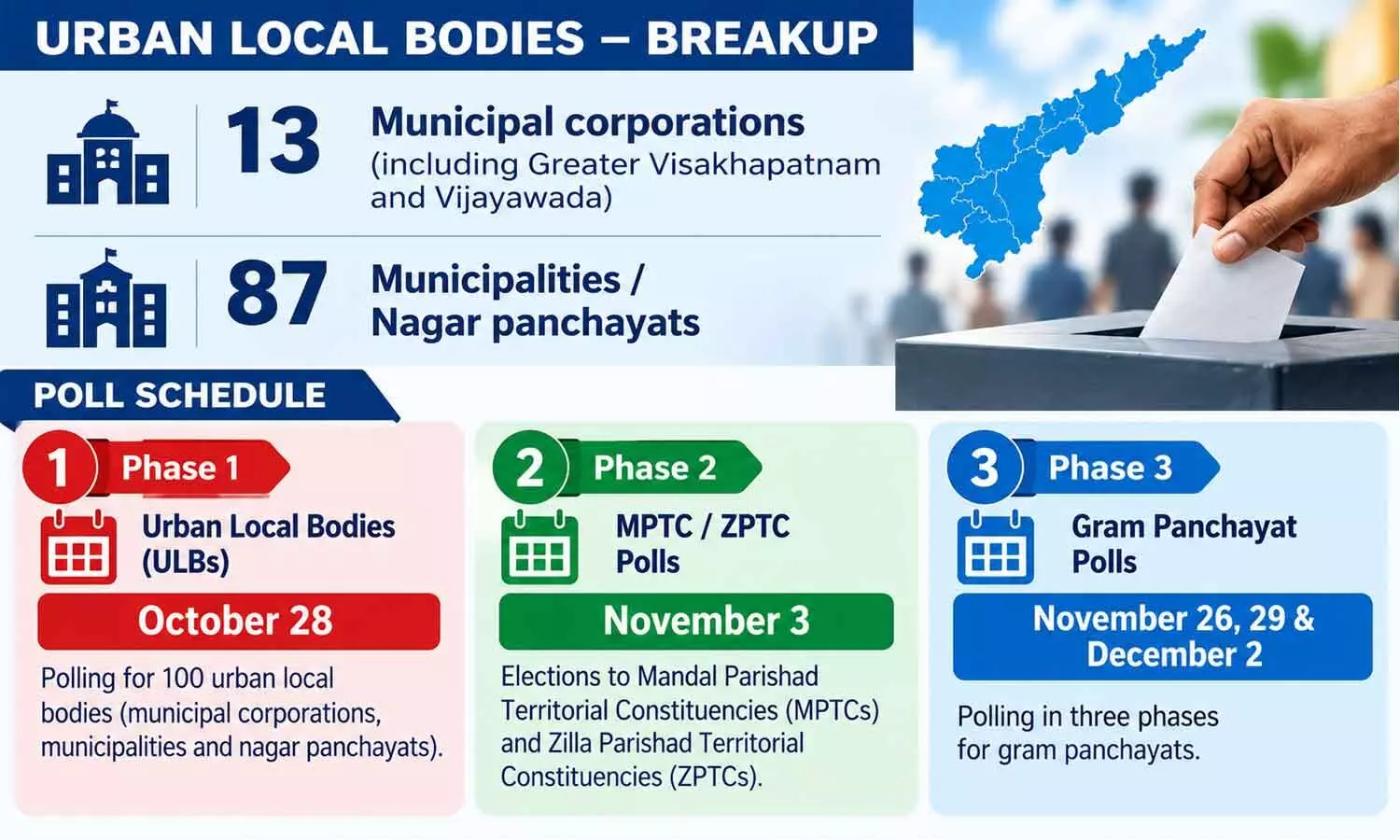
Amaravati: The State Election Commission (SEC) on Wednesday announced the schedule for the second ordinary elections to urban and rural local bodies, setting October 28 as the polling date for 104 urban local bodies, November 3 for Mandal Parishad Territorial Constituencies (MPTCs) and Zilla Parishad Territorial Constituencies (ZPTCs), and November 26, 29 and December 2 for gram panchayat elections in three phases.
State Election Commissioner Anil Chandra Punetha said the Commission had issued notifications for 17 municipal corporations and 87 municipalities and nagar panchayats. Elections to the remaining 23 urban local bodies -- four municipal corporations and 19 municipalities/nagar panchayats - have not been notified at this stage as pre-election activities are still under way. The four notifications cover Greater Visakhapatnam Municipal Corporation, Vijayawada Municipal Corporation, 11 other municipal corporations and 87 municipalities/nagar panchayats. The 11 corporations are Vizianagaram, Eluru, Machilipatnam, Guntur, Ongole, Nellore, Tirupati, Chittoor, Kadapa, Kurnool, and Anantapuram.
For the notified urban local bodies, election notices will be issued on October 16, and nominations can be filed between 11:00 am and 3:00 p.m. The last date for filing nominations is October 18, followed by scrutiny on October 19. Candidates can withdraw their nominations until 3:00 p.m. on October 21, when the final list of contesting candidates will be published after 3:00 p.m. Polling will take place on October 28 from 7:00 a.m. to 5:00 p.m., with a re-poll, if necessary, on October 29. Counting will begin at 8:00 a.m. on October 30. The schedule specifies that there will be no appeals against rejection of nominations in urban local body elections.
The MPTC and ZPTC elections will be conducted in a single phase. The SEC notification is scheduled for October 19, election notices for October 21 and the last date for nominations for October 23.
Scrutiny will take place on October 24, followed by appeals against rejected nominations on October 25 and disposal of appeals on October 26. The last date for withdrawal and publication of the final list of candidates is October 27.
Polling will be held on November 3, re-polling, if required, on November 4. counting and declaration of results will take place on November 5. Gram panchayat elections will be held in three phases. For Phase I, the SEC notification is scheduled for November 13, polling for November 26 and counting as well as declaration of results for the same day.
Phase II notifications will be issued on November 16, with polling as well as counting and results on November 29. For Phase III, notifications will be issued on November 19, with polling as well as counting and results on December 2. In each phase, the schedule provides for re-polling on the day after polling.
The schedule also lays down dates for indirect elections to leadership positions in local bodies. The special meetings for these elections are scheduled for November 5-6 for urban local bodies, November 11-12 for MPTCs/ZPTCs, November 26-27 for Phase I gram panchayats, November 29-30 for Phase II and December 2-3 for Phase III.
The Model Code of Conduct has come into force across the state with immediate effect and will remain in force until completion of the election process.
President Murmu offers prayers at Vijayawada's Kanaka Durga Temple
High-level demographic committee launches website seeking relevant inputs
IDBI Bank restructuring to strengthen banking ecosystem: FM Sitharaman
CJS vs Police: Delhi Braces for Another Showdown on Friday
Ex-SC Judge Kurian Joseph Says Supreme Court Must Act If Warnings Fail, Calls For Stronger EC Safeguards
Local polls in AP from Oct 28


