




- Indrakeeladri decked up for Dasara festivities
- Green Card crackdown major setback for Indian IT giants
- ED seeks day-to-day trial of Jagan in quid pro quo case
- Donald Trump continues to harp on Nobel
- “Haven’t you taken pesticide yet”, tehsildar mocks farmer
- 'Urgent relief': Maha CM Fadnavis directs immediate foodgrain supply to 265 drought-hit talukas
- BJP won bypolls, rejects Opposition's claim that govt is afraid: Assam CM Sarma
- Sting operation row: Union Min Kumaraswamy questions CM Shivakumar, demands probe
Rajiv panel recommendations approved…Cabinet clears BC quota across eight categories
In Short
- Average fixed at 28.18 per cent; share varies across rural and urban local bodies
- NDA promises over 34% party-level opportunities where statutory quota falls short

Share :
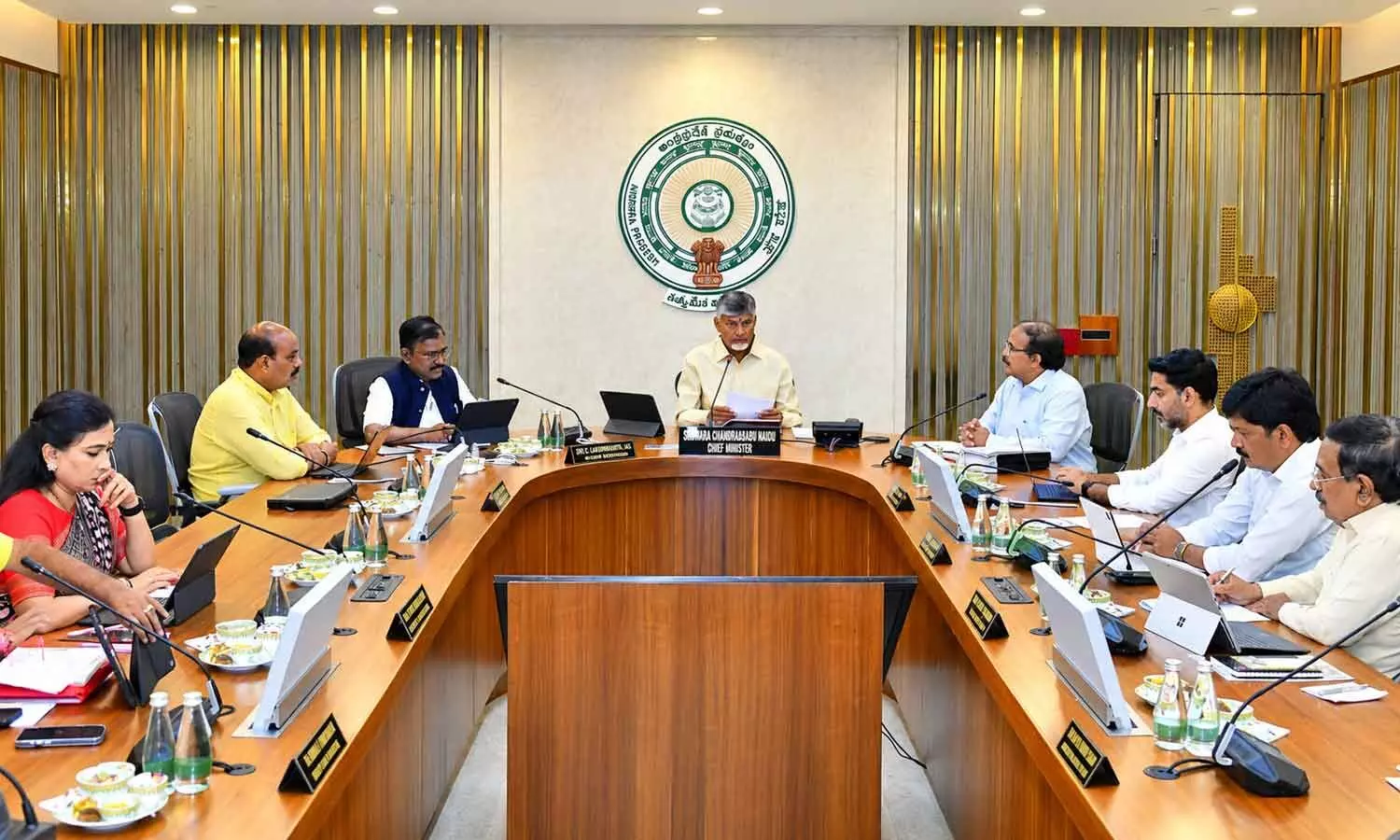
Chief Minister Nara Chandrababu Naidu conducting a Cabinet meeting along with Council of Ministers and Chief Secretary G Sai Prasad at the Secretariat on Saturday
Amaravati: The Andhra Pradesh Cabinet has approved the Rajiv Ranjan Mishra Commission’s recommendations on Backward Class reservations in rural and urban local bodies, setting the statutory quota at differing rates for various categories of elected posts.
With the average BC reservation working out to 28.18 per cent, the ruling alliance has separately committed to providing more than 34 per cent of party-level opportunities to BCs in areas where the statutory quota falls short.
The Cabinet decision, taken at a meeting chaired by Chief Minister N Chandrababu Naidu on Saturday, has been referred to the Panchayat Raj and Rural Development as well as the Municipal Administration and Urban Development departments for implementation. The State Election Commission will take further action in accordance with the finalised reservations.
Agriculture Minister K Atchannaidu said the commission, headed by Rajiv Ranjan Mishra, was constituted through GO No. 3 on February 19, 2026, in line with the Supreme Court’s guidelines. It examined population data across districts and social groups to recommend BC quotas for different local bodies.
The proposed reservations are 26.73 per cent for Gram Panchayat ward members, 27.95 per cent for Sarpanches, 25.55 per cent for MPTC members, 24.60 per cent each for Mandal Parishad presidents and ZPTC members, and 23.08 per cent for Zilla Parishad chairpersons.
In urban local bodies, the quota is 32.78 per cent for ward members, 33.02 per cent for municipal chairpersons, and 35.29 per cent for mayors. Social Welfare Minister Dola Bala Veeranjaneya Swamy said SC, ST and BC quotas were calculated according to the population of each local unit, with ST and SC allocations considered before determining the BC share.
In a press note, special secretary to government S Satyanarayana said the departments concerned must comply with Articles 243D and 243T of the Constitution governing SC/ST reservations in panchayats and municipalities. These reservations must be calculated with reference to the last published Census, as required under Articles 243(f) and 243P(g).
As Census figures specific to BCs are unavailable, the government has accepted the commission’s estimates based on contemporary evidence, including the Unified Family Survey and Swarna Gramam & Swarna Wardu (SGSW) records, as the basis for BC reservations.
Atchannaidu said SC and ST quotas had been accounted for before determining the BC share. He alleged that the previous YSR Congress government reduced BC reservations from 34 per cent to 24 per cent in 2019, costing BCs around 17,000 political positions. The alliance said it would compensate for shortfalls in statutory quotas through additional party-level opportunities for BCs and was ready for elections upon issue of notification by the SEC.
Rajiv panel recommendations approved…Cabinet clears BC quota across eight categories
CM Naidu sets Nov 15 deadline for local polls
GO on BC quota in local bodies caps total reservations at 50%
Two die, two missing at Pakala beach
El Nino century’s biggest natural crisis: CM Revanth Reddy
Karnataka BJP mocks CM Shivakumar’s Delhi trip, says ‘visit villages instead of sitting on Delhi streets’


